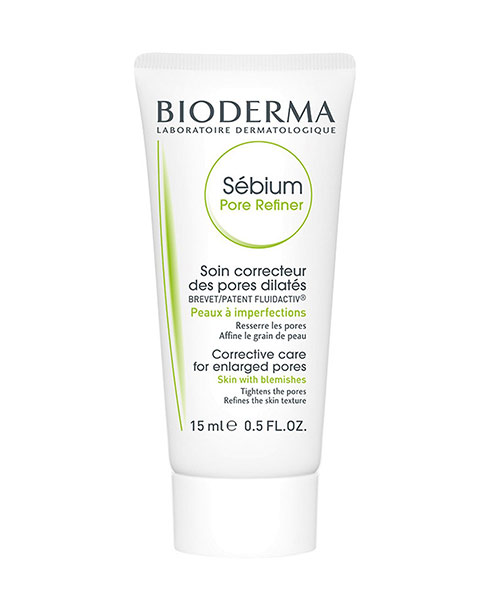
Bioderma Sébium Pore refiner

Bioderma

Sébium Pore refiner

face emulsion

Added Last edited

Fit by skin type

General, ingredient-based — not your personalized match.

Dry
70%
Combination (dry)
70%
Balanced
100%
Combination (oily)
70%
Oily
70%

See how this fits your skin

Take the skin test and I'll show you how suitable this product is for you.

Take the skin test
3
Ingredients
3
Benefits
1
Actives
Find Dupes

The dermatological corrector of persistent enlarged pores. Visibly tightens the appearance of pores, refines look of skin texture, preserves skin radiance, and mattifies.

Key Insights

Benefits

3
Anti-Acne
Anti-Aging
Blackhead Reducing

Active Ingredients

1
BHA

Full Ingredients

3 total

About Sébium Pore refiner

Overview

Sébium Pore refiner is a cushioning emulsion from Bioderma, a brand based in France.

Texture and finish

By its ingredient list the formula reads as moderately cushioned — emollient enough to feel like a cream, without the heaviest occlusives near the top. There is very little humectant content, so this is not the step in a routine that adds water to skin.

What the formula does

Oil control: Moderate. Ingredients that moderate sebum or absorb shine, and here that comes from Salicylic Acid.

Cell renewal: Moderate. Retinoids, acids and enzymes that speed surface turnover, and here that comes from Salicylic Acid.

Who it suits

On richness alone it suits Balanced skin best, and is the least natural fit for Dry, Combination (dry), Combination (oily) and Oily skin. Nothing in the list is flagged as a common irritant, which is a reasonable starting point for reactive skin — though a patch test is still the only way to know.

What it does not target

The formula contributes little or nothing on hydration, barrier support, antioxidant protection and brightening and tone. That is not a fault — most products are not meant to do everything — but if one of those is your priority, this is not the product that will address it. One ingredient on the label has not been matched to our database yet, so the analysis above reads a slightly incomplete list.

Where it fits in a routine

It can be used morning and evening. In a routine it goes after serums. Seal in your serums with it; in the morning, sunscreen still goes on top.

This summary is generated from the product's ingredient list. It is not a review, it is not the brand's own marketing claims, and it does not replace advice from a dermatologist.

Pros and cons

Drawn purely from the ingredient list

Pros

  • No common irritants flagged in the list

Things to know

  • Contains ingredients usually flagged for review during pregnancy
  • Part of the label has not been matched to our ingredient database yet

Which skin types it suits

Scored on how rich or light the formula reads from its INCI order.

Suitable for

  • Balanced skin

Less suitable for

  • Dry skin
  • Combination (dry) skin
  • Combination (oily) skin
  • Oily skin

Sensitive skin

No ingredient in this formula carries a common-irritant flag, making it a reasonable option for reactive skin. A patch test is still recommended, as individual skin reactivity varies.

Skin concerns

Based on the curated benefits documented for this product's ingredients.

Helps with

  • Anti-Acne 1 ingredient

    Targets breakouts by reducing bacteria and unclogging pores

  • Anti-Aging 1 ingredient

    Boosts collagen and cell turnover to reduce fine lines and wrinkles

  • Blackhead Reducing 1 ingredient

    Helps unclog pores and reduce blackheads for clearer skin

Does not target

Dark Spot Fading Evens Skin Tone Hydration Oil Control Pore Minimizer Smooths Bumpy Skin Soothing

None of the ingredients in this formula are associated with these benefits. This is not unusual, as most products are designed to target a limited number of concerns.

Key ingredients

The actives, UV filters and benefit-carrying ingredients in this formula, in the order they are listed.

2nd on the list, which puts it at an estimated 5–20% of the formula.

Salicylic acid

Anti-Acne Anti-Aging Blackhead Reducing

Formula analysis

Each axis is scored from the ingredients present and how high up the list they sit.

Hydration None

Ingredients that pull and hold water in the upper layers of skin

Barrier support None

Lipids and repair signals that support skin barrier integrity

Antioxidant support None

Ingredients that mop up free radicals from UV and pollution

Oil control Moderate

Ingredients that moderate sebum or absorb shine

Brightening None

Ingredients that act on uneven tone and post-inflammatory marks

Soothing None

Ingredients aimed at visible redness and reactivity

Cell renewal Moderate

Retinoids, acids and enzymes that speed surface turnover

Firmness signalling None

Peptides and growth factors that signal for collagen support

Active and supporting ingredients

"Active" here means an ingredient carrying a recorded active type or a recognised UV filter.

Active ingredients (1)

Supporting ingredients (1)

Solvents, emollients, texture agents and preservatives — the formula that carries the actives.

Fomes Officinalis Extract

What to layer it with

Judged by the same curated rules our routine checker uses. It reads the ingredients, not the label.

Compatible with

  • Azelaic acid
  • Copper peptides
  • Bakuchiol
  • Niacinamide
  • Hyaluronic acid
  • Ceramides
  • Signal peptides
  • Panthenol
  • Sunscreen

Use with caution

  • Retinoids (retinol, retinal)

    Best kept to separate routines — one in the morning, one at night, or on alternate days.

  • Vitamin C (L-ascorbic acid)

    Can be layered, but the combination raises the irritation risk. Go slowly.

  • AHAs (glycolic, lactic)

    Can be layered, but the combination raises the irritation risk. Go slowly.

  • BHA (salicylic acid)

    Can be layered, but the combination raises the irritation risk. Go slowly.

  • PHAs (gluconolactone)

    Can be layered, but the combination raises the irritation risk. Go slowly.

  • Benzoyl peroxide

    Can be layered, but the combination raises the irritation risk. Go slowly.

Where it fits in a routine

Morning Evening
  1. Cleanse
  2. Toning
  3. Treat
  4. Moisturise
  5. Protect

This product is the "Moisturise" step.

  • Seal in your serums with it; in the morning, sunscreen still goes on top.

Safety and suitability

Flags to check, not verdicts. None of this is medical advice — if you are pregnant, breastfeeding or treating a skin condition, ask a doctor.

Pregnancy and breastfeeding
Contains Salicylic Acid, usually reviewed with a doctor during pregnancy.
Fungal acne (malassezia)
No ingredient here is a recognised food source for malassezia.
Sensitive and reactive skin
No ingredient in this formula carries a common-irritant flag, making it a reasonable option for reactive skin. A patch test is still recommended, as individual skin reactivity varies.

Ingredients by function

Most ingredients do more than one job, so these counts add up to more than the 2 ingredients on the label.

1
Active

Changes how skin behaves rather than how it feels

1
Exfoliant

Loosens or dissolves dead surface cells

1
Occlusive

Forms a film that slows water loss

1
Plant extract

Botanical material, usually for antioxidants or scent

1
Preservative

Keeps the product free of microbial growth

Ingredient breakdown

Every ingredient on the label, in order, with what it does and roughly how much of it is likely to be there.

Estimated level
10–40%
Confidence
Low — inferred from list position alone
Roles
Occlusive, Plant extract

1st on the list, which puts it at an estimated 10–40% of the formula.

Fomes Officinalis Extract is an extract of the Mushroom White Agaric, Fomes officinalis, Polyporaceae

Estimated level
5–20%
Confidence
Low — inferred from list position alone
Roles
Active, Exfoliant, Preservative

2nd on the list, which puts it at an estimated 5–20% of the formula.

Salicylic acid

Anti-Acne Anti-Aging Blackhead Reducing
10 scientific references
  • Experimental Dermatology, July 2019, pages 786-794
  • European Commission Scientific Committee on Consumer Safety, June 2019, pages 1-70
  • Regulatory Toxicology and Pharmacology, April 2018, pages 245-251
  • Journal of Cosmetic Science, January-February 2017, pages 55-58
  • Clinical, Cosmetic, and Investigational Dermatology, August 2015, pages 455-461
  • Clinical, Cosmetic, and Investigational Dermatology, November 2010, pages 135-142
  • Seminars in Cutaneous Medicine and Surgery, September 2008, pages 170-176
  • Journal of the American Academy of Dermatology, April 2007, pages 651-663
  • International Journal of Cosmetic Science, February 2000, pages 21-52
  • Seminars in Dermatology, December 1990, pages 305-308

Not yet matched to our database

These are printed on the label but have not been linked to an ingredient record yet, so they are excluded from the analysis above.

Fluidactiv™ technology

Frequently asked questions

What ingredients are in Sébium Pore refiner?

FOMES OFFICINALIS EXTRACT, SALICYLIC ACID.

What are the active ingredients in Sébium Pore refiner?

SALICYLIC ACID.

How do I use Sébium Pore refiner?

Once or twice a day. Use on skin cleansed with Sébium Gel moussant (Foaming gel) or Sébium H2O. Apply on its own or before applying your skincare cream, either all over the face for oily skin, or locally on the T-zone for combination skin: Forehead, nose, chin.

What skin types is Sébium Pore refiner good for?

Judged on how rich the formula reads from its ingredient list, it suits Balanced skin best. It is the least natural fit for Dry, Combination (dry), Combination (oily), Oily skin.

Is Sébium Pore refiner good for sensitive skin?

No ingredient in this formula carries a common-irritant flag, making it a reasonable option for reactive skin. A patch test is still recommended, as individual skin reactivity varies.

Can I use Sébium Pore refiner while pregnant?

It contains Salicylic Acid, which are usually reviewed with a doctor during pregnancy. Ask your doctor or midwife before using it.

What can I layer with Sébium Pore refiner?

It layers well with Azelaic acid, Copper peptides, Bakuchiol, Niacinamide, Hyaluronic acid, Ceramides. Take more care combining it with Retinoids (retinol, retinal), Vitamin C (L-ascorbic acid), AHAs (glycolic, lactic), BHA (salicylic acid), PHAs (gluconolactone), Benzoyl peroxide — use them in separate routines or on alternate days.

When should I apply Sébium Pore refiner?

Use it morning and evening, after serums.

How many ingredients does Sébium Pore refiner have?

It lists 2 ingredients, of which 1 are recorded as actives.

Who makes Sébium Pore refiner?

Bioderma, a brand based in France.
Brand
Bioderma
Country
France

Reviews

0 total

Log in to leave a review.

No reviews yet. Be the first to share your thoughts.
