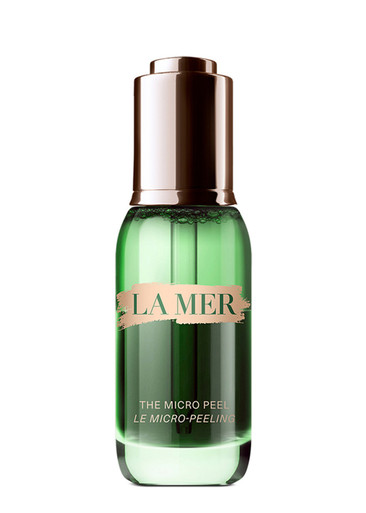
LA MER The Micro Peel

LA MER

The Micro Peel

face chemical peel

Added Last edited

Fit by skin type

General, ingredient-based — not your personalized match.

Dry
80%
Combination (dry)
80%
Balanced
50%
Combination (oily)
20%
Oily
20%

See how this fits your skin

Take the skin test and I'll show you how suitable this product is for you.

Take the skin test
3
Ingredients
0
Benefits
0
Actives
Find Dupes

A potent at-home treatment designed to work overnight. A powerful peel that refines yet is gentle on skin The Micro Peel resurfaces skin to polished perfection and clarifies pores all while soothing and replenishing.

About The Micro Peel

Overview

The Micro Peel is a rich chemical peel from LA MER.

Texture and finish

By its ingredient list the formula reads as rich: occlusives and butters sit high enough in the order to give it real weight on skin. The oils in it point to a dewy, emollient finish rather than a matte one. There is very little humectant content, so this is not the step in a routine that adds water to skin.

What the formula does

Antioxidant support: Moderate. Ingredients that mop up free radicals from UV and pollution, and here that comes from Lactobacillus/rhodopseudomonas/saccharomyces/sucrose/(scutellaria Baicalensis/coptis Chinensis) Root/phellodendron Amurense Bark/lonicera Japonica Flower/chaenomeles Sinensis Fruit/camellia Sinensis Leaf/brassica Oleracea Italica Ferment Filtrate.

Who it suits

On richness alone it suits Dry and Combination (dry) skin best, and is the least natural fit for Combination (oily) and Oily skin. Nothing in the list is flagged as a common irritant, which is a reasonable starting point for reactive skin — though a patch test is still the only way to know.

What it does not target

The formula contributes little or nothing on hydration, barrier support, oil control and brightening and tone. That is not a fault — most products are not meant to do everything — but if one of those is your priority, this is not the product that will address it. One ingredient on the label has not been matched to our database yet, so the analysis above reads a slightly incomplete list.

Where it fits in a routine

Use it in the evening. In a routine it goes after cleansing, before serums. Start at once or twice a week and build up only if skin stays comfortable. Wear sunscreen the next morning — fresh exfoliation raises UV sensitivity.

This summary is generated from the product's ingredient list. It is not a review, it is not the brand's own marketing claims, and it does not replace advice from a dermatologist.

Pros and cons

Drawn purely from the ingredient list

Pros

  • No common irritants flagged in the list

Things to know

  • 2 ingredients could feed malassezia (fungal acne)
  • Part of the label has not been matched to our ingredient database yet

Which skin types it suits

Scored on how rich or light the formula reads from its INCI order.

Suitable for

  • Dry skin
  • Combination (dry) skin

May suit

  • Balanced skin

Less suitable for

  • Combination (oily) skin
  • Oily skin

Sensitive skin

No ingredient in this formula carries a common-irritant flag, making it a reasonable option for reactive skin. A patch test is still recommended, as individual skin reactivity varies.

Formula analysis

Each axis is scored from the ingredients present and how high up the list they sit.

Hydration None

Ingredients that pull and hold water in the upper layers of skin

Barrier support None

Lipids and repair signals that support skin barrier integrity

Antioxidant support Moderate

Ingredients that mop up free radicals from UV and pollution

Oil control None

Ingredients that moderate sebum or absorb shine

Brightening None

Ingredients that act on uneven tone and post-inflammatory marks

Soothing None

Ingredients aimed at visible redness and reactivity

Cell renewal None

Retinoids, acids and enzymes that speed surface turnover

Firmness signalling None

Peptides and growth factors that signal for collagen support

What is and is not in it

Part of this label has not been matched to our ingredient database, so only what is present is listed — no absence is claimed.

Contains

  • Facial oils

    Passiflora Edulis Seed Oils Peg-8 Esters

What to layer it with

Judged by the same curated rules our routine checker uses. It reads the ingredients, not the label.

Compatible with

  • Vitamin C (L-ascorbic acid)
  • Retinoids (retinol, retinal)
  • AHAs (glycolic, lactic)
  • BHA (salicylic acid)
  • PHAs (gluconolactone)
  • Benzoyl peroxide
  • Azelaic acid
  • Copper peptides
  • Bakuchiol
  • Niacinamide
  • Hyaluronic acid
  • Ceramides
  • Signal peptides
  • Panthenol
  • Sunscreen

Nothing in this formula belongs to a group our rules can put in conflict, so it layers freely. Order still matters — thinnest texture first.

Where it fits in a routine

Evening
  1. Cleanse
  2. Exfoliate
  3. Treat
  4. Moisturise

This product is the "Exfoliate" step.

  • Start at once or twice a week and build up only if skin stays comfortable.
  • Wear sunscreen the next morning — fresh exfoliation raises UV sensitivity.

Safety and suitability

Flags to check, not verdicts. None of this is medical advice — if you are pregnant, breastfeeding or treating a skin condition, ask a doctor.

Pregnancy and breastfeeding
Nothing in this formula is on the standard pregnancy-caution list. That is not clearance — ask your doctor about anything you use daily.
Fungal acne (malassezia)
2 ingredients could feed malassezia: Passiflora Edulis Seed Oils Peg-8 Esters, Lactobacillus/rhodopseudomonas/saccharomyces/sucrose/(scutellaria Baicalensis/coptis Chinensis) Root/phellodendron Amurense Bark/lonicera Japonica Flower/chaenomeles Sinensis Fruit/camellia Sinensis Leaf/brassica Oleracea Italica Ferment Filtrate. That is about the yeast's food supply, not a prediction that you will break out.
Sensitive and reactive skin
No ingredient in this formula carries a common-irritant flag, making it a reasonable option for reactive skin. A patch test is still recommended, as individual skin reactivity varies.

Ingredients by function

Most ingredients do more than one job, so these counts add up to more than the 2 ingredients on the label.

1
Humectant

Draws water into the upper layers of skin

1
Occlusive

Forms a film that slows water loss

1
Plant extract

Botanical material, usually for antioxidants or scent

Ingredient breakdown

Every ingredient on the label, in order, with what it does and roughly how much of it is likely to be there.

Estimated level
10–40%
Confidence
Low — inferred from list position alone

1st on the list, which puts it at an estimated 10–40% of the formula.

Passiflora Edulis Seed Oils PEG-8 Esters is a product obtained by the transesterification of a blend of Passiflora Edulis Seed Oil with PEG-8.

Estimated level
5–20%
Confidence
Low — inferred from list position alone
Roles
Humectant, Occlusive, Plant extract

2nd on the list, which puts it at an estimated 5–20% of the formula.

This is a filtrate of the product obtained by the fermentation of sucrose, the roots of Scutellaria baicalensis and Coptis chinensis , the bark of Phellodendron amurense , the flowers of Lonicera japonica , the fruit of Chaenomeles sinensis , the leaves of Camellia sinensis and the whole plant, Brassica oleracea italica by the microorgansims, Lactobacillus, Rhodopseudomonas and Saccharomyces.

Not yet matched to our database

These are printed on the label but have not been linked to an ingredient record yet, so they are excluded from the analysis above.

Miracle Broth

Frequently asked questions

What ingredients are in The Micro Peel?

PASSIFLORA EDULIS SEED OILS PEG-8 ESTERS, LACTOBACILLUS/RHODOPSEUDOMONAS/SACCHAROMYCES/SUCROSE/(SCUTELLARIA BAICALENSIS/COPTIS CHINENSIS) ROOT/PHELLODENDRON AMURENSE BARK/LONICERA JAPONICA FLOWER/CHAENOMELES SINENSIS FRUIT/CAMELLIA SINENSIS LEAF/BRASSICA OLERACEA ITALICA FERMENT FILTRATE.

How do I use The Micro Peel?

At night after cleansing gently shake The Micro Peel to activate the formula and apply a thin even layer with fingers avoiding lips eyes and the contours of the eyes. You may experience a slight tingling sensation during application. Do not rinse off once dry. Follow with your La Mer serum and a moisturiser of your choice.

What skin types is The Micro Peel good for?

Judged on how rich the formula reads from its ingredient list, it suits Dry, Combination (dry) skin best. It is the least natural fit for Combination (oily), Oily skin.

Is The Micro Peel good for sensitive skin?

No ingredient in this formula carries a common-irritant flag, making it a reasonable option for reactive skin. A patch test is still recommended, as individual skin reactivity varies.

Is The Micro Peel fungal acne safe?

2 ingredients could feed malassezia: Passiflora Edulis Seed Oils Peg-8 Esters, Lactobacillus/rhodopseudomonas/saccharomyces/sucrose/(scutellaria Baicalensis/coptis Chinensis) Root/phellodendron Amurense Bark/lonicera Japonica Flower/chaenomeles Sinensis Fruit/camellia Sinensis Leaf/brassica Oleracea Italica Ferment Filtrate. That describes the yeast's food supply, not a prediction that they will cause a breakout.

Can I use The Micro Peel while pregnant?

Nothing in this formula is on the standard pregnancy-caution list. That is not medical clearance — check anything you use daily with your doctor or midwife.

What can I layer with The Micro Peel?

It layers well with Vitamin C (L-ascorbic acid), Retinoids (retinol, retinal), AHAs (glycolic, lactic), BHA (salicylic acid), PHAs (gluconolactone), Benzoyl peroxide.

When should I apply The Micro Peel?

Use it in the evening, after cleansing, before serums.

How many ingredients does The Micro Peel have?

It lists 2 ingredients, of which 0 are recorded as actives.

Who makes The Micro Peel?

LA MER.
Brand
LA MER

Reviews

0 total

Log in to leave a review.

No reviews yet. Be the first to share your thoughts.
