4th on the list, which puts it at an estimated 2–10% of the formula.
Naturally occurring substances, kaolin (CI 77004)
Oil Control
Pore Minimizer
Alpha-H
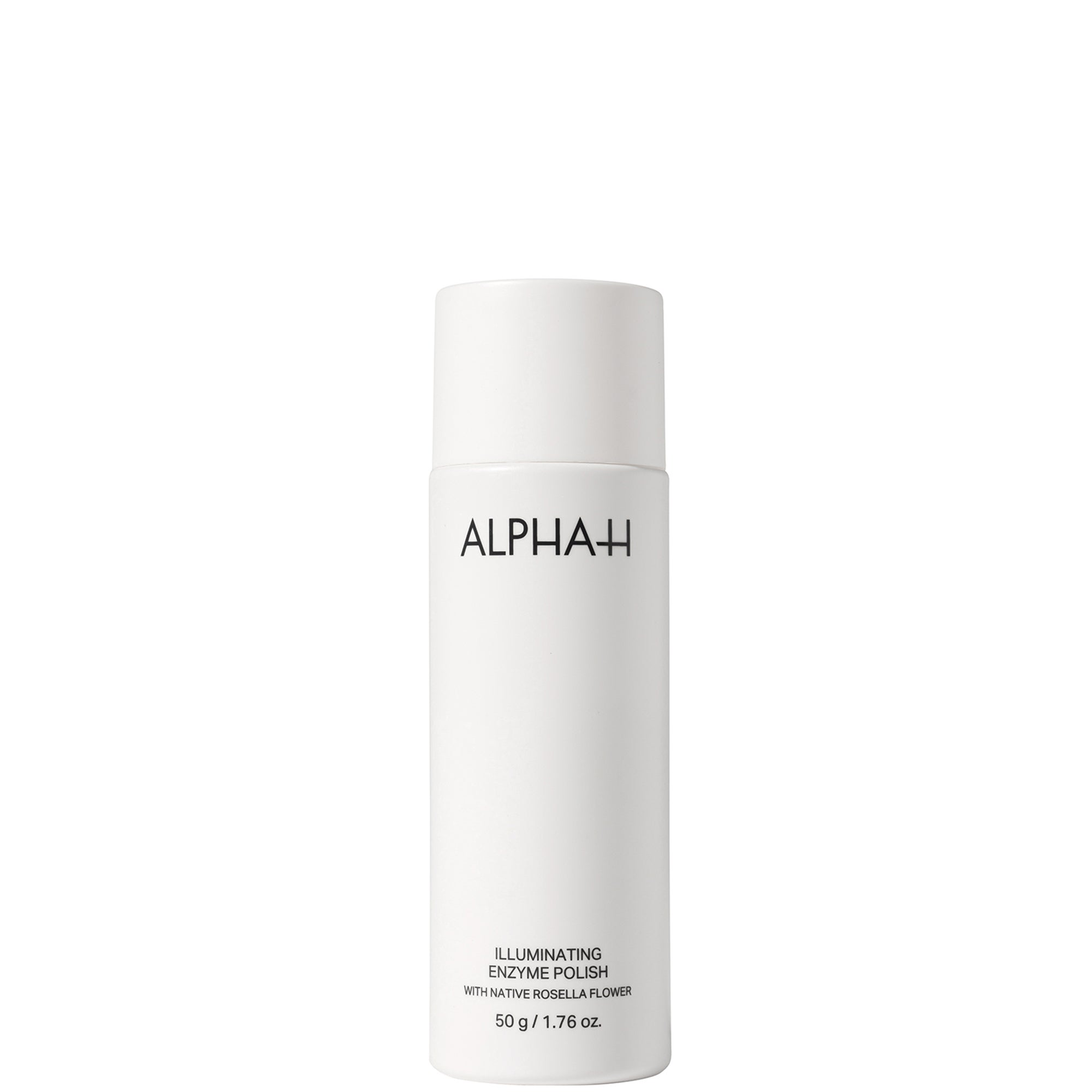
Alpha - H Illuminating Enzyme Polish with Native Rosella Flower
face neck exfoliator
Alpha-H
face neck exfoliator
Added Last edited
Fit by skin type
General, ingredient-based — not your personalized match.

See how this fits your skin
Take the skin test and I'll show you how suitable this product is for you.
Take the skin testLeave skin looking refreshed and more luminous with Alpha-H's Illuminating Enzyme Polish with Native Rosella Flower (50ml). Powered by a dual-action protease and lipase enzyme blend, this two-phase enzyme solution works to cleanse dead skin cells, excess oil, dirt and makeup residue. It's also infused with ultra-fine rice powder to help physically exfoliate the skin, while native rosella flower works to protect the moisture barrier. Plus, it's suitable for all skin types, including sensitive and menopausal skin.
Alpha - H Illuminating Enzyme Polish with Native Rosella Flower is a lightweight exfoliator from Alpha-H, a brand based in Australia. The ingredient list runs to 17 ingredients, each broken down in full below.
By its ingredient list the formula reads as light: water and humectants lead, with emollients kept lower in the order. The oils in it point to a dewy, emollient finish rather than a matte one.
Oil control: Moderate. Ingredients that moderate sebum or absorb shine, and here that comes from Kaolin and Maltodextrin.
On richness alone it suits Balanced skin best, and is the least natural fit for Dry and Combination (dry) skin. Nothing in the list is flagged as a common irritant, which is a reasonable starting point for reactive skin — though a patch test is still the only way to know.
The formula contributes little or nothing on barrier support, antioxidant protection, brightening and tone and cell renewal. That is not a fault — most products are not meant to do everything — but if one of those is your priority, this is not the product that will address it.
Reading the full list, the formula is essential-oil-free, no drying alcohol, paraben-free, silicone-free, microplastic-free and sulfate-free. Those claims come from the ingredient list itself, not from the packaging. It does contain fragrance, worth knowing if your skin reacts to any of them.
Use it in the evening. In a routine it goes after cleansing, before serums. Start at once or twice a week and build up only if skin stays comfortable. Wear sunscreen the next morning — fresh exfoliation raises UV sensitivity.
This summary is generated from the product's ingredient list. It is not a review, it is not the brand's own marketing claims, and it does not replace advice from a dermatologist.
Drawn purely from the ingredient list
Scored on how rich or light the formula reads from its INCI order.
No ingredient in this formula carries a common-irritant flag, making it a reasonable option for reactive skin. A patch test is still recommended, as individual skin reactivity varies.
Based on the curated benefits documented for this product's ingredients.
Regulates sebum production to reduce shine and greasiness
Boosts collagen and cell turnover to reduce fine lines and wrinkles
Attracts and locks in moisture to keep skin plump and dewy
Tightens and refines the look of enlarged pores
Calms redness, irritation, and inflammation for sensitive skin
None of the ingredients in this formula are associated with these benefits. This is not unusual, as most products are designed to target a limited number of concerns.
The actives, UV filters and benefit-carrying ingredients in this formula, in the order they are listed.
4th on the list, which puts it at an estimated 2–10% of the formula.
Naturally occurring substances, kaolin (CI 77004)
7th on the list, which puts it at an estimated 1–5% of the formula.
Maltodextrin
8th on the list, which puts it at an estimated 1–5% of the formula.
Naturally occurring substances oatmeal obtained from the Oat, Avena sativa L., Poaceae,
16th on the list, below the 1% line — present at under 1%, which for most ingredients is the level they work at.
Proteinase
Each axis is scored from the ingredients present and how high up the list they sit.
Ingredients that pull and hold water in the upper layers of skin
Lipids and repair signals that support skin barrier integrity
Ingredients that mop up free radicals from UV and pollution
Ingredients that moderate sebum or absorb shine
Ingredients that act on uneven tone and post-inflammatory marks
Ingredients aimed at visible redness and reactivity
Retinoids, acids and enzymes that speed surface turnover
Peptides and growth factors that signal for collagen support
Read from the full ingredient list. A brand's own claim may differ.
Parfum
CI 77491
Camellia Oleifera Seed Oil
Judged by the same curated rules our routine checker uses. It reads the ingredients, not the label.
Nothing in this formula belongs to a group our rules can put in conflict, so it layers freely. Order still matters — thinnest texture first.
This product is the "Exfoliate" step.
Flags to check, not verdicts. None of this is medical advice — if you are pregnant, breastfeeding or treating a skin condition, ask a doctor.
Most ingredients do more than one job, so these counts add up to more than the 17 ingredients on the label.
Sets the thickness, spread and stability of the formula
Loosens or dissolves dead surface cells
Lifts oil and dirt, or holds oil and water together
Changes how the product smells or looks
Forms a film that slows water loss
Softens and smooths by filling gaps between skin cells
Botanical material, usually for antioxidants or scent
Keeps the product free of microbial growth
Dissolves and carries everything else
Every ingredient on the label, in order, with what it does and roughly how much of it is likely to be there.
1st on the list, which puts it at an estimated 10–40% of the formula.
Cellulose
2nd on the list, which puts it at an estimated 5–20% of the formula.
Oryza Sativa Starch is a high-polymeric carbohydrate material derived from the peeled seeds of the Rice, Oryza sativa L., Poaceae
3rd on the list, which puts it at an estimated 5–20% of the formula.
Diatomaceous Earth is a mineral material consisting chiefly of the siliceous frustules and fragments of various species of diatoms
4th on the list, which puts it at an estimated 2–10% of the formula.
Naturally occurring substances, kaolin (CI 77004)
5th on the list, which puts it at an estimated 2–10% of the formula.
Disodium 4-dodecyl 2-sulphonatosuccinate
6th on the list, which puts it at an estimated 2–10% of the formula.
Fatty acids, coco, 2-sulfoethyl esters, sodium salts
7th on the list, which puts it at an estimated 1–5% of the formula.
Maltodextrin
8th on the list, which puts it at an estimated 1–5% of the formula.
Naturally occurring substances oatmeal obtained from the Oat, Avena sativa L., Poaceae,
9th on the list, below the 1% line — present at under 1%, which for most ingredients is the level they work at.
2-Phenoxyethanol
10th on the list, below the 1% line — present at under 1%, which for most ingredients is the level they work at.
Xanthan gum
11th on the list, below the 1% line — present at under 1%, which for most ingredients is the level they work at.
Octane-1,2-diol
12th on the list, below the 1% line — present at under 1%, which for most ingredients is the level they work at.
Camellia Oleifera Seed Oil is a fixed oil from the seeds of Camellia oleifera, Theaceae
13th on the list, below the 1% line — present at under 1%, which for most ingredients is the level they work at.
Hibiscus Sabdariffa Flower Extract is an extract of the flowers of the Red Sorrel, Hibiscus sabdariffa L., Malvaceae
14th on the list, below the 1% line — present at under 1%, which for most ingredients is the level they work at.
Parfum is a term for ingredient labelling used to identify that a product contains a material or a combination of materials normally added to a cosmetic to produce or to mask a particular odour. According to Article 19 of the Cosmetics Regulation, 'Perfume and aromatic compositions and their raw materials shall be referred to by the terms ‘parfum’ or ‘aroma’. '
15th on the list, below the 1% line — present at under 1%, which for most ingredients is the level they work at.
Lipase is an enzyme that hydrolyzes triglycerides
16th on the list, below the 1% line — present at under 1%, which for most ingredients is the level they work at.
Proteinase
17th on the list, below the 1% line — present at under 1%, which for most ingredients is the level they work at.
Diiron trioxide; Ferric oxide
CELLULOSE, ORYZA SATIVA STARCH, DIATOMACEOUS EARTH, KAOLIN, DISODIUM LAURYL SULFOSUCCINATE, SODIUM COCOYL ISETHIONATE, MALTODEXTRIN, COLLOIDAL OATMEAL, PHENOXYETHANOL, XANTHAN GUM, CAPRYLYL GLYCOL, CAMELLIA OLEIFERA SEED OIL, HIBISCUS SABDARIFFA FLOWER EXTRACT, PARFUM, LIPASE, PROTEASE, CI 77491.
illuminating Enzyme Polish is a wash-off exfoliating powder that activates when mixed with water. Step 1: Dampen palms with water, either at your basin or in the shower. Step 2: Dispense half a teaspoon of powder (or more depending on your desired consistency) into the palm of your hand. Step 3: Rub palms together and watch as the powder gradually transforms into a liquid paste with a soft lather. Step 4: Massage into wet skin, using circular motions over the face, neck and décolletage. Step 5: Rinse off or remove using a damp towel. This product can be used AM or PM, however, it is not recommended to use more than once a day. Use daily or every other day if Illuminating Enzyme Polish is your primary form of exfoliation. If cycling in a routine with other exfoliants, use 1-3 times a week based on your skin's tolerance.
Judged on how rich the formula reads from its ingredient list, it suits Balanced skin best. It is the least natural fit for Dry, Combination (dry) skin.
No ingredient in this formula carries a common-irritant flag, making it a reasonable option for reactive skin. A patch test is still recommended, as individual skin reactivity varies.
One ingredient could feed malassezia: Camellia Oleifera Seed Oil. That describes the yeast's food supply, not a prediction that it will cause a breakout.
Nothing in this formula is on the standard pregnancy-caution list. That is not medical clearance — check anything you use daily with your doctor or midwife.
No — it contains Parfum.
No. Reading the full ingredient list, this formula is no drying alcohol.
Yes. Reading the full ingredient list, this formula is silicone-free.
No. Reading the full ingredient list, this formula is essential-oil-free.
Yes. Reading the full ingredient list, this formula is paraben-free.
It layers well with Vitamin C (L-ascorbic acid), Retinoids (retinol, retinal), AHAs (glycolic, lactic), BHA (salicylic acid), PHAs (gluconolactone), Benzoyl peroxide.
Use it in the evening, after cleansing, before serums.
It lists 17 ingredients, of which 0 are recorded as actives.
Alpha-H, a brand based in Australia.
We can't find the internet
Attempting to reconnect
Something went wrong!
Attempting to reconnect