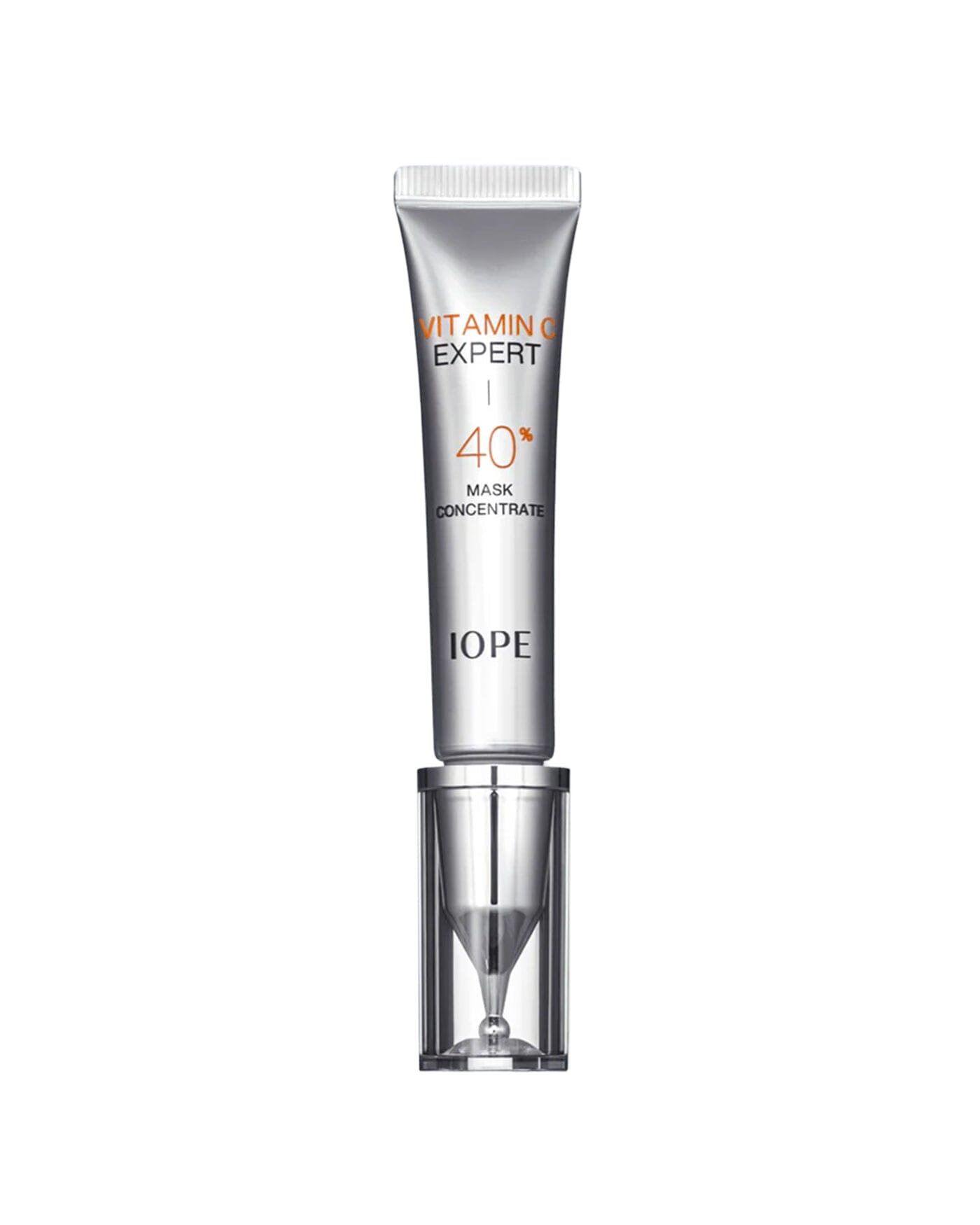
IOPE Vitamin C Expert 40% Mask Concentrate Cream

IOPE

Vitamin C Expert 40% Mask Concentrate Cream

face cream

Added Last edited

Fit by skin type

General, ingredient-based — not your personalized match.

Dry
83%
Combination (dry)
83%
Balanced
87%
Combination (oily)
57%
Oily
57%

See how this fits your skin

Take the skin test and I'll show you how suitable this product is for you.

Take the skin test
20
Ingredients
5
Benefits
2
Actives
Find Dupes

Meet Korea’s first stabilized 40% pure vitamin C cream. IOPE’s latest innovation is a high-performance brightening treatment that visibly reduces dark spots, evens tone, and restores radiance to dull, sun-damaged skin.

Key Insights

Benefits

5
Anti-Aging
Dark Spot Fading
Evens Skin Tone
Hydration
Soothing

Active Ingredients

2
Plant-derived peptides Vitamin C

Risks

2
Microplastic
Silicone

About Vitamin C Expert 40% Mask Concentrate Cream

Overview

Vitamin C Expert 40% Mask Concentrate Cream is a cushioning cream from IOPE, a brand based in Korea. The formula is built mainly around hydration. The ingredient list runs to 20 ingredients, each broken down in full below.

Texture and finish

By its ingredient list the formula reads as moderately cushioned — emollient enough to feel like a cream, without the heaviest occlusives near the top. Silicones in the formula tend to give a smooth, blurred finish and help it grip under makeup. Hydration is handled by Phenyl Trimethicone, Hydrogenated Polyisobutene and Caprylic/capric Triglyceride, humectants that pull water into the upper layers of skin rather than sealing it there.

What the formula does

Hydration: High. Ingredients that pull and hold water in the upper layers of skin, and here that comes from Phenyl Trimethicone, Hydrogenated Polyisobutene, Caprylic/capric Triglyceride and Caprylyl Methicone.

Antioxidant support: Moderate. Ingredients that mop up free radicals from UV and pollution, and here that comes from Ascorbic Acid and Resveratrol.

Brightening: Moderate. Ingredients that act on uneven tone and post-inflammatory marks, and here that comes from Ascorbic Acid and Resveratrol.

Oil control: Moderate. Ingredients that moderate sebum or absorb shine, and here that comes from Silica Dimethyl Silylate.

Who it suits

On richness alone it suits Dry, Combination (dry) and Balanced skin best, and is the least natural fit for Combination (oily) and Oily skin. Nothing in the list is flagged as a common irritant, which is a reasonable starting point for reactive skin — though a patch test is still the only way to know.

What it does not target

The formula contributes little or nothing on barrier support, cell renewal and firmness signalling. That is not a fault — most products are not meant to do everything — but if one of those is your priority, this is not the product that will address it.

What is not in it

Reading the full list, the formula is fragrance-free, essential-oil-free, no drying alcohol, paraben-free, sulfate-free and dye-free. Those claims come from the ingredient list itself, not from the packaging.

Where it fits in a routine

It can be used morning and evening. In a routine it goes after serums. Seal in your serums with it; in the morning, sunscreen still goes on top.

This summary is generated from the product's ingredient list. It is not a review, it is not the brand's own marketing claims, and it does not replace advice from a dermatologist.

Pros and cons

Drawn purely from the ingredient list

Pros

  • No fragrance or declared allergens
  • No essential oils
  • No drying alcohol
  • Strong humectant content for hydration
  • No common irritants flagged in the list

Things to know

  • Contains a solid synthetic polymer (microplastic)
  • 3 ingredients could feed malassezia (fungal acne)

Which skin types it suits

Scored on how rich or light the formula reads from its INCI order.

Suitable for

  • Dry skin
  • Combination (dry) skin
  • Balanced skin

Less suitable for

  • Combination (oily) skin
  • Oily skin

Sensitive skin

No ingredient in this formula carries a common-irritant flag, making it a reasonable option for reactive skin. A patch test is still recommended, as individual skin reactivity varies.

Skin concerns

Based on the curated benefits documented for this product's ingredients.

Helps with

  • Hydration 7 ingredients

    Attracts and locks in moisture to keep skin plump and dewy

  • Anti-Aging 2 ingredients

    Boosts collagen and cell turnover to reduce fine lines and wrinkles

  • Dark Spot Fading 2 ingredients

    Fades hyperpigmentation and evens out dark spots over time

  • Evens Skin Tone 1 ingredient

    Brightens and balances complexion for a more uniform appearance

  • Soothing 1 ingredient

    Calms redness, irritation, and inflammation for sensitive skin

Does not target

Anti-Acne Blackhead Reducing Oil Control Pore Minimizer Smooths Bumpy Skin

None of the ingredients in this formula are associated with these benefits. This is not unusual, as most products are designed to target a limited number of concerns.

Key ingredients

The actives, UV filters and benefit-carrying ingredients in this formula, in the order they are listed.

Ascorbic Acid Vitamin C

1st on the list, which puts it at an estimated 10–40% of the formula.

Ascorbic acid

Anti-Aging Dark Spot Fading Evens Skin Tone

2nd on the list, which puts it at an estimated 5–20% of the formula.

1,1,5,5,5-Hexamethyl-3-phenyl-3-[(trimethylsilyl)oxy]trisiloxane

Hydration

4th on the list, which puts it at an estimated 2–10% of the formula.

Propene, 2-methyl-, homopolymer

Hydration

5th on the list, which puts it at an estimated 2–10% of the formula.

Decanoic acid, ester with 1,2,3-propanetriol octanoate; Glycerides, mixed decanoyl and octanoyl

Hydration

7th on the list, which puts it at an estimated 1–5% of the formula.

1,1,1,3,5,5,5-Heptamethyl-3-octyl-trisiloxane

Hydration

8th on the list, which puts it at an estimated 1–5% of the formula.

Benzoic acid, C12-15 alkyl esters

Hydration

9th on the list, which puts it at an estimated 1–5% of the formula.

Hexadecyl 2-ethylhexanoate

Hydration

11th on the list, which puts it at an estimated 1–3% of the formula.

Propane-1,2,3-triyl 2-ethylhexanoate

Hydration

19th on the list, which puts it at an estimated under 1% of the formula.

1,3-Benzenediol, 5-[(1E)-2-(4-Hydroxyphenyl)ethenyl]-

Anti-Aging Dark Spot Fading Soothing
Glycine MAX Polypeptide Plant-derived peptides

20th on the list, which puts it at an estimated under 1% of the formula.

Glycine Max Polypeptide is a Polypeptide fraction isolated from glycine max soybean protein
Formula analysis

Each axis is scored from the ingredients present and how high up the list they sit.

Hydration High

Ingredients that pull and hold water in the upper layers of skin

Barrier support None

Lipids and repair signals that support skin barrier integrity

Antioxidant support Moderate

Ingredients that mop up free radicals from UV and pollution

Oil control Moderate

Ingredients that moderate sebum or absorb shine

Brightening Moderate

Ingredients that act on uneven tone and post-inflammatory marks

Soothing Low

Ingredients aimed at visible redness and reactivity

Cell renewal None

Retinoids, acids and enzymes that speed surface turnover

Firmness signalling None

Peptides and growth factors that signal for collagen support

Active and supporting ingredients

"Active" here means an ingredient carrying a recorded active type or a recognised UV filter.

Active ingredients (2)

Supporting ingredients (18)

Solvents, emollients, texture agents and preservatives — the formula that carries the actives.

Phenyl Trimethicone Silica Dimethyl Silylate Hydrogenated Polyisobutene Caprylic/capric Triglyceride Vinyl Dimethicone/methicone Silsesquioxane Crosspolymer Caprylyl Methicone C12-15 Alkyl Benzoate Cetyl Ethylhexanoate Hydrogenated Castor Oil Dimer Dilinoleate Triethylhexanoin Polyglyceryl-4 Diisostearate/polyhydroxystearate/sebacate Diisostearoyl Polyglyceryl-3 Dimer Dilinoleate Polymethyl Methacrylate Thymol Trimethoxycinnamate Kojyl Methylenedioxycinnamate Nicotinamide Mononucleotide Methyl Methacrylate/acrylonitrile Copolymer Resveratrol

What is and is not in it

Read from the full ingredient list. A brand's own claim may differ.

Free from

  • Fragrance-free
  • Essential-oil-free
  • No drying alcohol
  • Paraben-free
  • Sulfate-free
  • Dye-free
  • Oil-free
  • No animal-derived ingredients

Contains

  • Silicones

    Phenyl Trimethicone, Vinyl Dimethicone/methicone Silsesquioxane Crosspolymer, Caprylyl Methicone

  • Microplastics

    Vinyl Dimethicone/methicone Silsesquioxane Crosspolymer, Polymethyl Methacrylate, Methyl Methacrylate/acrylonitrile Copolymer

What to layer it with

Judged by the same curated rules our routine checker uses. It reads the ingredients, not the label.

Compatible with

  • Vitamin C (L-ascorbic acid)
  • PHAs (gluconolactone)
  • Azelaic acid
  • Copper peptides
  • Bakuchiol
  • Niacinamide
  • Hyaluronic acid
  • Ceramides
  • Signal peptides
  • Panthenol
  • Sunscreen

Use with caution

  • Benzoyl peroxide

    Best kept to separate routines — one in the morning, one at night, or on alternate days.

  • Retinoids (retinol, retinal)

    Can be layered, but the combination raises the irritation risk. Go slowly.

  • AHAs (glycolic, lactic)

    Can be layered, but the combination raises the irritation risk. Go slowly.

  • BHA (salicylic acid)

    Can be layered, but the combination raises the irritation risk. Go slowly.

Where it fits in a routine

Morning Evening
  1. Cleanse
  2. Toning
  3. Treat
  4. Moisturise
  5. Protect

This product is the "Moisturise" step.

  • Seal in your serums with it; in the morning, sunscreen still goes on top.

Safety and suitability

Flags to check, not verdicts. None of this is medical advice — if you are pregnant, breastfeeding or treating a skin condition, ask a doctor.

Pregnancy and breastfeeding
Nothing in this formula is on the standard pregnancy-caution list. That is not clearance — ask your doctor about anything you use daily.
Fungal acne (malassezia)
3 ingredients could feed malassezia: Hydrogenated Castor Oil Dimer Dilinoleate, Polyglyceryl-4 Diisostearate/polyhydroxystearate/sebacate, Diisostearoyl Polyglyceryl-3 Dimer Dilinoleate. That is about the yeast's food supply, not a prediction that you will break out.
Sensitive and reactive skin
No ingredient in this formula carries a common-irritant flag, making it a reasonable option for reactive skin. A patch test is still recommended, as individual skin reactivity varies.
Recorded ingredient risks
Microplastic, Silicone

Ingredients by function

Most ingredients do more than one job, so these counts add up to more than the 20 ingredients on the label.

5
Antioxidant

Neutralises free radicals from UV and pollution

5
Emollient

Softens and smooths by filling gaps between skin cells

4
Occlusive

Forms a film that slows water loss

4
Texture agent

Sets the thickness, spread and stability of the formula

2
Active

Changes how skin behaves rather than how it feels

1
Peptide

Amino-acid chains that signal for repair or firmness

1
pH adjuster

Sets the acidity the formula needs to work

1
Preservative

Keeps the product free of microbial growth

1
Surfactant

Lifts oil and dirt, or holds oil and water together

Ingredient breakdown

Every ingredient on the label, in order, with what it does and roughly how much of it is likely to be there.

Estimated level
10–40%
Confidence
Low — inferred from list position alone
Roles
Active, Antioxidant, pH adjuster

1st on the list, which puts it at an estimated 10–40% of the formula.

Ascorbic acid

Anti-Aging Dark Spot Fading Evens Skin Tone
12 scientific references
  • Drug Delivery, February 2021, pages 445-453
  • Journal of Cosmetic Dermatology, December 2020, pages 3, 262-3, 269
  • Journal of Oral and Maxillofacial Pathology, May-August 2020, pages 374-382
  • Journal of Cosmetic Dermatology, March 2020, pages 671-676
  • Journal of Clinical and Aesthetic Dermatology, July 2017 pages 14-17
  • Journal of Drugs in Dermatology, July 2016, pages 863-867
  • Clinical, Cosmetic, and Investigational Dermatology, September 2015, pages 463-470
  • Indian Dermatology Online Journal, April-June 2013, pages 143-146
  • AAPS PharmSciTech, July 2011, pages 917-923
  • Journal of Drugs in Dermatology, July 2008, Supplement, pages s2-s6
  • International Journal of Toxicology, Supplement 2, March 2005, pages 51-111
  • Skin Pharmacology and Physiology, July-August 2004, pages 200-206
Estimated level
5–20%
Confidence
Low — inferred from list position alone

2nd on the list, which puts it at an estimated 5–20% of the formula.

1,1,5,5,5-Hexamethyl-3-phenyl-3-[(trimethylsilyl)oxy]trisiloxane

Hydration Silicone
5 scientific references
  • International Journal of Toxicology, 2006, pages 1-89
  • https://onlinepersonalcarecouncilorg/ctfa-static/online/lists/cir-pdfs/PRNS513pdf
  • Journal of Cosmetic Science, June 2003, pages 335-351
  • Silicone Surfactants, 1999, page 190
  • International Journal of Toxicology, 1986, pages 353-371
Estimated level
5–20%
Confidence
Low — inferred from list position alone
Roles
Emollient, Texture agent

3rd on the list, which puts it at an estimated 5–20% of the formula.

Silane, dichlorodimethyl-, reaction products with silica

Estimated level
2–10%
Confidence
Low — inferred from list position alone
Roles
Emollient, Texture agent

4th on the list, which puts it at an estimated 2–10% of the formula.

Propene, 2-methyl-, homopolymer

Hydration
4 scientific references
  • https://thedermreviewcom/hydrogenated-polyisobutene/
  • CosmeticsInfoorg, Accessed March 2021, ePublication
  • International Journal of Toxicology, September 2020, pages 59S-90S
  • International Journal of Cosmetic Science, February 2010, pages 81-82
Estimated level
2–10%
Confidence
Low — inferred from list position alone

5th on the list, which puts it at an estimated 2–10% of the formula.

Decanoic acid, ester with 1,2,3-propanetriol octanoate; Glycerides, mixed decanoyl and octanoyl

Hydration
5 scientific references
  • International Journal of Toxicology, September 2020, pages 34-35
  • Periodica Polytechnica Chemical Engineering, 2014, pages 43-48
  • International Journal of Toxicology, January 2003, pages 4-5
  • Food and Chemical Toxicology, January 2000, pages 79-98
  • Journal of the Society of Cosmetic Chemists, August 1985, pages 303-311
Estimated level
2–10%
Confidence
Low — inferred from list position alone
Roles
Texture agent

6th on the list, which puts it at an estimated 2–10% of the formula.

Vinyl Dimethicone/Methicone Silsesquioxane Crosspolymer

Silicone Microplastic
Estimated level
1–5%
Confidence
Low — inferred from list position alone

7th on the list, which puts it at an estimated 1–5% of the formula.

1,1,1,3,5,5,5-Heptamethyl-3-octyl-trisiloxane

Hydration Silicone
Estimated level
1–5%
Confidence
Low — inferred from list position alone
Roles
Emollient, Preservative

8th on the list, which puts it at an estimated 1–5% of the formula.

Benzoic acid, C12-15 alkyl esters

Hydration
3 scientific references
  • The University of Toledo, May 2020, ePublication
  • Scientific Journal of the Faculty of Medicine in Nis, December 2013, pages 193-200
  • International Journal of Toxicology, November-December 2012, pages 342-372
Estimated level
1–5%
Confidence
Low — inferred from list position alone
Roles
Emollient

9th on the list, which puts it at an estimated 1–5% of the formula.

Hexadecyl 2-ethylhexanoate

Hydration
2 scientific references
  • Engineering in Life Sciences, March 2019, pages 370-388
  • International Journal of Toxicology, Nov-Dec 2015, pages 61S-73S
Estimated level
1–5%
Confidence
Low — inferred from list position alone

10th on the list, which puts it at an estimated 1–5% of the formula.

Hydrogenated Castor Oil Dimer Dilinoleate is the ester of Hydrogenated Castor Oil Dimer Dilinoleic Acid

Estimated level
1–3%
Confidence
Low — inferred from list position alone

11th on the list, which puts it at an estimated 1–3% of the formula.

Propane-1,2,3-triyl 2-ethylhexanoate

Hydration
2 scientific references
  • CosmeticsInfoorg, Accessed November 2021, ePublication
  • Cosmetic Ingredient Review, February 2018, pages 1-40
Estimated level
1–3%
Confidence
Low — inferred from list position alone
Roles
Surfactant, Texture agent

12th on the list, which puts it at an estimated 1–3% of the formula.

Polyglyceryl-4 Diisostearate/Polyhydroxystearate/Sebacate is a diester of a mixture of isostearic, polyhydroxystearic and sebacic acids with Polyglycerin-4

Estimated level
1–3%
Confidence
Low — inferred from list position alone
Roles
Emollient

13th on the list, which puts it at an estimated 1–3% of the formula.

Di-9,12-octadecadienoic acid diester with triglyceryl-di-16-methylheptadecanoate

Estimated level
under 1%
Confidence
Low — inferred from list position alone
Roles
Occlusive

14th on the list, which puts it at an estimated under 1% of the formula.

2-Propenoic acid, 2-methyl-, methyl ester, homopolymer

Microplastic
Estimated level
under 1%
Confidence
Low — inferred from list position alone
Roles
Occlusive, Antioxidant

15th on the list, which puts it at an estimated under 1% of the formula.

Thymol Trimethoxycinnamate

Estimated level
under 1%
Confidence
Low — inferred from list position alone
Roles
Antioxidant

16th on the list, which puts it at an estimated under 1% of the formula.

4-Oxo-5-hydroxy-4H-pyran-2-ylmethyl 3-(1,3-benzodioxol-5-yl)-2-propenoate

Estimated level
under 1%
Confidence
Low — inferred from list position alone
Roles
Antioxidant

17th on the list, which puts it at an estimated under 1% of the formula.

Niacinamide Mononucleotide,Niacinamide Ribonucleotide,Pyridinium, 3-(aminocarbonyl)-1-(5-O-phosphono-\b-D-ribofuranosyl)-, inner salt

Estimated level
under 1%
Confidence
Low — inferred from list position alone
Roles
Occlusive

18th on the list, which puts it at an estimated under 1% of the formula.

2-Propenoic acid, 2-methyl, methyl ester, polymer with 2-propenenitrile

Microplastic
19 Resveratrol Occlusive
Estimated level
under 1%
Confidence
Low — inferred from list position alone
Roles
Occlusive, Antioxidant

19th on the list, which puts it at an estimated under 1% of the formula.

1,3-Benzenediol, 5-[(1E)-2-(4-Hydroxyphenyl)ethenyl]-

Anti-Aging Dark Spot Fading Soothing
8 scientific references
  • Biomedicine and Pharmacotherapy, November 2021, ePublication
  • International Journal of Molecular Sciences, October 2021, pages 1–26
  • Phytotherapy Research, March 2020, pages 435–447
  • Biomolecules and Therapeutics, October 2018, pages 1–14
  • Journal of Cosmetic and Laser Therapy, May 2018 ePublication
  • Journal of Drugs in Dermatology, December 2013, pages 1389-1394
  • Archives of Biochemistry and Biophysics, April 2011, pages 164-170
  • Antioxidants and Redox Signaling, December 2001, pages 1041-1064
Estimated level
under 1%
Confidence
Low — inferred from list position alone
Roles
Active, Peptide

20th on the list, which puts it at an estimated under 1% of the formula.

Glycine Max Polypeptide is a Polypeptide fraction isolated from glycine max soybean protein

People also compare

Products in the same category that share this formula's distinguishing ingredients.

345 Relief Cream

Dr. Althea

Shares 3 key ingredients with Vitamin C Expert 40% Mask Concentrate Cream: Caprylic/capric Triglyceride, Caprylyl Methicone, Resveratrol

345 Relief Cream

Dr.Althea

Shares 3 key ingredients with Vitamin C Expert 40% Mask Concentrate Cream: Caprylic/capric Triglyceride, Caprylyl Methicone, Resveratrol

360º Shot PDRN Lifting Eye Cream

Centellian24

Shares 3 key ingredients with Vitamin C Expert 40% Mask Concentrate Cream: Hydrogenated Polyisobutene, Ascorbic Acid, Caprylic/capric Triglyceride

Bakuchiol Plumping Capsule Cream

Eqqualberry

Shares 3 key ingredients with Vitamin C Expert 40% Mask Concentrate Cream: Caprylic/capric Triglyceride, Cetyl Ethylhexanoate, Hydrogenated Polyisobutene

Frequently asked questions

What ingredients are in Vitamin C Expert 40% Mask Concentrate Cream?

ASCORBIC ACID, PHENYL TRIMETHICONE, SILICA DIMETHYL SILYLATE, HYDROGENATED POLYISOBUTENE, CAPRYLIC/CAPRIC TRIGLYCERIDE, VINYL DIMETHICONE/METHICONE SILSESQUIOXANE CROSSPOLYMER, CAPRYLYL METHICONE, C12-15 ALKYL BENZOATE, CETYL ETHYLHEXANOATE, HYDROGENATED CASTOR OIL DIMER DILINOLEATE, TRIETHYLHEXANOIN, POLYGLYCERYL-4 DIISOSTEARATE/POLYHYDROXYSTEARATE/SEBACATE, DIISOSTEAROYL POLYGLYCERYL-3 DIMER DILINOLEATE, POLYMETHYL METHACRYLATE, THYMOL TRIMETHOXYCINNAMATE, KOJYL METHYLENEDIOXYCINNAMATE, NICOTINAMIDE MONONUCLEOTIDE, METHYL METHACRYLATE/ACRYLONITRILE COPOLYMER, RESVERATROL, GLYCINE MAX POLYPEPTIDE.

What are the active ingredients in Vitamin C Expert 40% Mask Concentrate Cream?

ASCORBIC ACID, GLYCINE MAX POLYPEPTIDE.

How do I use Vitamin C Expert 40% Mask Concentrate Cream?

After serum and toner, apply the cream on the face. You can also mix the serum and this cream together for better absorption

What skin types is Vitamin C Expert 40% Mask Concentrate Cream good for?

Judged on how rich the formula reads from its ingredient list, it suits Dry, Combination (dry), Balanced skin best. It is the least natural fit for Combination (oily), Oily skin.

Is Vitamin C Expert 40% Mask Concentrate Cream good for sensitive skin?

No ingredient in this formula carries a common-irritant flag, making it a reasonable option for reactive skin. A patch test is still recommended, as individual skin reactivity varies.

Is Vitamin C Expert 40% Mask Concentrate Cream fungal acne safe?

3 ingredients could feed malassezia: Hydrogenated Castor Oil Dimer Dilinoleate, Polyglyceryl-4 Diisostearate/polyhydroxystearate/sebacate, Diisostearoyl Polyglyceryl-3 Dimer Dilinoleate. That describes the yeast's food supply, not a prediction that they will cause a breakout.

Can I use Vitamin C Expert 40% Mask Concentrate Cream while pregnant?

Nothing in this formula is on the standard pregnancy-caution list. That is not medical clearance — check anything you use daily with your doctor or midwife.

Is Vitamin C Expert 40% Mask Concentrate Cream fragrance free?

Yes. Reading the full ingredient list, this formula is fragrance-free.

Does Vitamin C Expert 40% Mask Concentrate Cream contain alcohol?

No. Reading the full ingredient list, this formula is no drying alcohol.

Is Vitamin C Expert 40% Mask Concentrate Cream silicone free?

No — it contains Phenyl Trimethicone, Vinyl Dimethicone/methicone Silsesquioxane Crosspolymer, Caprylyl Methicone.

Does Vitamin C Expert 40% Mask Concentrate Cream contain essential oils?

No. Reading the full ingredient list, this formula is essential-oil-free.

Is Vitamin C Expert 40% Mask Concentrate Cream paraben free?

Yes. Reading the full ingredient list, this formula is paraben-free.

What can I layer with Vitamin C Expert 40% Mask Concentrate Cream?

It layers well with Vitamin C (L-ascorbic acid), PHAs (gluconolactone), Azelaic acid, Copper peptides, Bakuchiol, Niacinamide. Take more care combining it with Benzoyl peroxide, Retinoids (retinol, retinal), AHAs (glycolic, lactic), BHA (salicylic acid) — use them in separate routines or on alternate days.

When should I apply Vitamin C Expert 40% Mask Concentrate Cream?

Use it morning and evening, after serums.

How many ingredients does Vitamin C Expert 40% Mask Concentrate Cream have?

It lists 20 ingredients, of which 2 are recorded as actives.

Who makes Vitamin C Expert 40% Mask Concentrate Cream?

IOPE, a brand based in Korea.

Brand
IOPE
Country
Korea

Reviews

0 total

Log in to leave a review.

No reviews yet. Be the first to share your thoughts.