1st on the list, which puts it at an estimated 30–80% of the formula.
Aqua (EU),Deionized Water,Distilled Water,Micromatrix Fractile AN,Onsen-Sui (JPN),Purified Water
Hydration
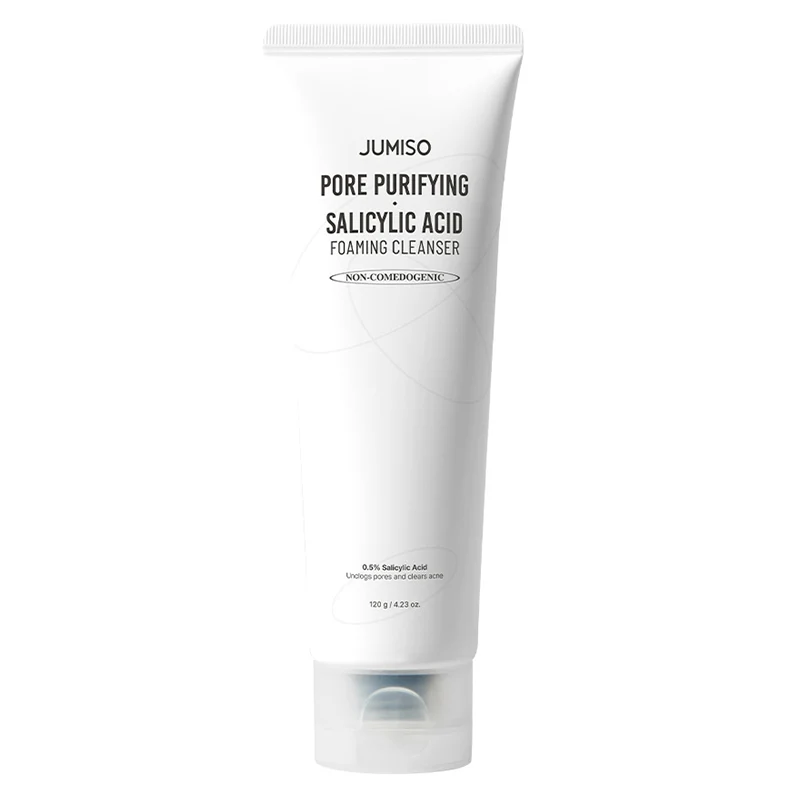
JUMISO
Pore-Purifying Salicylic Acid Foaming Cleanser
face foam cleanser
JUMISO
face foam cleanser
Added Last edited
Fit by skin type
General, ingredient-based — not your personalized match.

See how this fits your skin
Take the skin test and I'll show you how suitable this product is for you.
Take the skin testThe Jumiso Pore-Purifying Salicylic Acid Foaming Cleanser is a gentle, low pH cleanser designed to purify and exfoliate without drying out the skin. Featuring 0.5% salicylic acid and blue clay, this non-comedogenic formula unclogs pores, controls oil, and removes dead skin cells, revealing a smoother, brighter complexion. Enriched with apple extract and Coptis japonica root extract, it offers soothing and moisturizing benefits, making it ideal for all skin types, including acne-prone skin. This cleanser leaves skin refreshed and balanced, promoting a glass-skin glow and refined texture with each use.
Pore-Purifying Salicylic Acid Foaming Cleanser is a watery-light foam cleanser from JUMISO. The formula is built mainly around hydration. The ingredient list runs to 17 ingredients, each broken down in full below.
By its ingredient list the formula reads as very light — essentially a water-and-humectant base with little emollient weight. With almost no emollient load it should absorb quickly and finish close to matte. Hydration is handled by Glycerin, Butylene Glycol and Water, humectants that pull water into the upper layers of skin rather than sealing it there.
Hydration: High. Ingredients that pull and hold water in the upper layers of skin, and here that comes from Glycerin, Butylene Glycol, Water and Glyceryl Stearate.
On richness alone it suits Combination (oily) and Oily skin best, and is the least natural fit for Dry and Combination (dry) skin. Nothing in the list is flagged as a common irritant, which is a reasonable starting point for reactive skin — though a patch test is still the only way to know.
The formula contributes little or nothing on barrier support, antioxidant protection, brightening and tone and soothing. That is not a fault — most products are not meant to do everything — but if one of those is your priority, this is not the product that will address it.
Reading the full list, the formula is fragrance-free, essential-oil-free, no drying alcohol, paraben-free, silicone-free and microplastic-free. Those claims come from the ingredient list itself, not from the packaging.
It can be used morning and evening. In a routine it goes first step. Use on damp skin and rinse thoroughly. Follow with a toner or essence while skin is still slightly damp.
This summary is generated from the product's ingredient list. It is not a review, it is not the brand's own marketing claims, and it does not replace advice from a dermatologist.
Drawn purely from the ingredient list
Scored on how rich or light the formula reads from its INCI order.
No ingredient in this formula carries a common-irritant flag, making it a reasonable option for reactive skin. A patch test is still recommended, as individual skin reactivity varies.
Based on the curated benefits documented for this product's ingredients.
Attracts and locks in moisture to keep skin plump and dewy
Boosts collagen and cell turnover to reduce fine lines and wrinkles
Regulates sebum production to reduce shine and greasiness
Targets breakouts by reducing bacteria and unclogging pores
Helps unclog pores and reduce blackheads for clearer skin
Brightens and balances complexion for a more uniform appearance
Refines texture by gently exfoliating rough, uneven patches
None of the ingredients in this formula are associated with these benefits. This is not unusual, as most products are designed to target a limited number of concerns.
The actives, UV filters and benefit-carrying ingredients in this formula, in the order they are listed.
1st on the list, which puts it at an estimated 30–80% of the formula.
Aqua (EU),Deionized Water,Distilled Water,Micromatrix Fractile AN,Onsen-Sui (JPN),Purified Water
2nd on the list, which puts it at an estimated 5–20% of the formula.
Glycerine ;Glycerol (INN); Glycerol (RIFM); Glycerolum (EP); Glycyl Alcohol; 1,2,3-Propanetriol; 1,2,3-Trihydroxypropane
6th on the list, which puts it at an estimated 2–10% of the formula.
Butane-1,3-diol (CAS No. 107-88-0/ EC No. 203-529-7) (R)-(-)-butane-1,3-diol” (CAS No. 6290-03-5/ EC No. 228-532-0)
7th on the list, which puts it at an estimated 1–5% of the formula.
Stearic acid, monoester with glycerol
9th on the list, below the 1% line — present at under 1%, which for most ingredients is the level they work at.
Salicylic acid
10th on the list, below the 1% line — present at under 1%, which for most ingredients is the level they work at.
2-Hydroxy-1,2,3-propanetricarboxylic acid
12th on the list, below the 1% line — present at under 1%, which for most ingredients is the level they work at.
Montmorillonite
13th on the list, below the 1% line — present at under 1%, which for most ingredients is the level they work at.
Clay mineral having an intermediate composition between montmorillonite and muscovite
14th on the list, below the 1% line — present at under 1%, which for most ingredients is the level they work at.
Dextrin
16th on the list, below the 1% line — present at under 1%, which for most ingredients is the level they work at.
Butenedioic acid, hydroxy-, (2S)-
17th on the list, below the 1% line — present at under 1%, which for most ingredients is the level they work at.
Pyrus Malus Fruit Extract is an extract of the fruit of the Apple, Pyrus malus L., Rosaceae
Each axis is scored from the ingredients present and how high up the list they sit.
Ingredients that pull and hold water in the upper layers of skin
Lipids and repair signals that support skin barrier integrity
Ingredients that mop up free radicals from UV and pollution
Ingredients that moderate sebum or absorb shine
Ingredients that act on uneven tone and post-inflammatory marks
Ingredients aimed at visible redness and reactivity
Retinoids, acids and enzymes that speed surface turnover
Peptides and growth factors that signal for collagen support
"Active" here means an ingredient carrying a recorded active type or a recognised UV filter.
Solvents, emollients, texture agents and preservatives — the formula that carries the actives.
Read from the full ingredient list. A brand's own claim may differ.
Judged by the same curated rules our routine checker uses. It reads the ingredients, not the label.
Best kept to separate routines — one in the morning, one at night, or on alternate days.
Can be layered, but the combination raises the irritation risk. Go slowly.
Can be layered, but the combination raises the irritation risk. Go slowly.
Can be layered, but the combination raises the irritation risk. Go slowly.
Can be layered, but the combination raises the irritation risk. Go slowly.
Can be layered, but the combination raises the irritation risk. Go slowly.
This product is the "Cleanse" step.
Flags to check, not verdicts. None of this is medical advice — if you are pregnant, breastfeeding or treating a skin condition, ask a doctor.
Most ingredients do more than one job, so these counts add up to more than the 17 ingredients on the label.
Sets the thickness, spread and stability of the formula
Dissolves and carries everything else
Lifts oil and dirt, or holds oil and water together
Changes how skin behaves rather than how it feels
Draws water into the upper layers of skin
Loosens or dissolves dead surface cells
Sets the acidity the formula needs to work
Botanical material, usually for antioxidants or scent
Softens and smooths by filling gaps between skin cells
Binds trace metals that would otherwise spoil the formula
Forms a film that slows water loss
Keeps the product free of microbial growth
Every ingredient on the label, in order, with what it does and roughly how much of it is likely to be there.
1st on the list, which puts it at an estimated 30–80% of the formula.
Aqua (EU),Deionized Water,Distilled Water,Micromatrix Fractile AN,Onsen-Sui (JPN),Purified Water
2nd on the list, which puts it at an estimated 5–20% of the formula.
Glycerine ;Glycerol (INN); Glycerol (RIFM); Glycerolum (EP); Glycyl Alcohol; 1,2,3-Propanetriol; 1,2,3-Trihydroxypropane
3rd on the list, which puts it at an estimated 5–20% of the formula.
Glycine, N-coco acyl derivs., sodium salts
4th on the list, which puts it at an estimated 2–10% of the formula.
Sodium hydrogen N-(1-oxododecyl)-L-glutamate
5th on the list, which puts it at an estimated 2–10% of the formula.
Sodium Methyl Cocoyl Taurate is the sodium salt of the coconut fatty acid amide of N-methyltaurine. It conforms generally to the formula
6th on the list, which puts it at an estimated 2–10% of the formula.
Butane-1,3-diol (CAS No. 107-88-0/ EC No. 203-529-7) (R)-(-)-butane-1,3-diol” (CAS No. 6290-03-5/ EC No. 228-532-0)
7th on the list, which puts it at an estimated 1–5% of the formula.
Stearic acid, monoester with glycerol
8th on the list, below the 1% line — present at under 1%, which for most ingredients is the level they work at.
9th on the list, below the 1% line — present at under 1%, which for most ingredients is the level they work at.
Salicylic acid
10th on the list, below the 1% line — present at under 1%, which for most ingredients is the level they work at.
2-Hydroxy-1,2,3-propanetricarboxylic acid
11th on the list, below the 1% line — present at under 1%, which for most ingredients is the level they work at.
Dimethyl sulphone
12th on the list, below the 1% line — present at under 1%, which for most ingredients is the level they work at.
Montmorillonite
13th on the list, below the 1% line — present at under 1%, which for most ingredients is the level they work at.
Clay mineral having an intermediate composition between montmorillonite and muscovite
14th on the list, below the 1% line — present at under 1%, which for most ingredients is the level they work at.
Dextrin
15th on the list, below the 1% line — present at under 1%, which for most ingredients is the level they work at.
Gardenia Florida Fruit Extract is an extract of the fruit of the Cape Jasmine, Gardenia Florida L., Rubiaceae
16th on the list, below the 1% line — present at under 1%, which for most ingredients is the level they work at.
Butenedioic acid, hydroxy-, (2S)-
17th on the list, below the 1% line — present at under 1%, which for most ingredients is the level they work at.
Pyrus Malus Fruit Extract is an extract of the fruit of the Apple, Pyrus malus L., Rosaceae
Products in the same category that share this formula's distinguishing ingredients.
BANILA CO
Shares 8 key ingredients with Pore-Purifying Salicylic Acid Foaming Cleanser: Water, Glycerin, Glyceryl Stearate, Salicylic Acid, Illite
Heimish
Shares 7 key ingredients with Pore-Purifying Salicylic Acid Foaming Cleanser: Water, Glycerin, Citric Acid, Glyceryl Stearate, Salicylic Acid
SKIN1004
Shares 7 key ingredients with Pore-Purifying Salicylic Acid Foaming Cleanser: Water, Glycerin, Glyceryl Stearate, Salicylic Acid, Butylene Glycol
d'Alba
Shares 7 key ingredients with Pore-Purifying Salicylic Acid Foaming Cleanser: Water, Glycerin, Glyceryl Stearate, Salicylic Acid, Butylene Glycol
MIXSOON
Shares 6 key ingredients with Pore-Purifying Salicylic Acid Foaming Cleanser: Water, Glycerin, Salicylic Acid, Glyceryl Stearate, Citric Acid
Goodal
Shares 6 key ingredients with Pore-Purifying Salicylic Acid Foaming Cleanser: Glycerin, Water, Butylene Glycol, Dextrin, Glyceryl Stearate
WATER, GLYCERIN, SODIUM COCOYL GLYCINATE, SODIUM LAUROYL GLUTAMATE, SODIUM METHYL COCOYL TAURATE, BUTYLENE GLYCOL, GLYCERYL STEARATE, 1,2-HEXANEDIOL, SALICYLIC ACID, CITRIC ACID, DIMETHYL SULFONE, MONTMORILLONITE, ILLITE, DEXTRIN, GARDENIA FLORIDA FRUIT EXTRACT, MALIC ACID, PYRUS MALUS FRUIT EXTRACT.
SALICYLIC ACID, CITRIC ACID, MALIC ACID.
Use as first step of skincare. Can be used as morning cleanser or 2nd cleanser in double cleansing.
Judged on how rich the formula reads from its ingredient list, it suits Combination (oily), Oily skin best. It is the least natural fit for Dry, Combination (dry) skin.
No ingredient in this formula carries a common-irritant flag, making it a reasonable option for reactive skin. A patch test is still recommended, as individual skin reactivity varies.
One ingredient could feed malassezia: Glyceryl Stearate. That describes the yeast's food supply, not a prediction that it will cause a breakout.
It contains Salicylic Acid, which are usually reviewed with a doctor during pregnancy. Ask your doctor or midwife before using it.
Yes. Reading the full ingredient list, this formula is fragrance-free.
No. Reading the full ingredient list, this formula is no drying alcohol.
Yes. Reading the full ingredient list, this formula is silicone-free.
No. Reading the full ingredient list, this formula is essential-oil-free.
Yes. Reading the full ingredient list, this formula is paraben-free.
It layers well with Azelaic acid, Copper peptides, Bakuchiol, Niacinamide, Hyaluronic acid, Ceramides. Take more care combining it with Retinoids (retinol, retinal), Vitamin C (L-ascorbic acid), AHAs (glycolic, lactic), BHA (salicylic acid), PHAs (gluconolactone), Benzoyl peroxide — use them in separate routines or on alternate days.
Use it morning and evening, first step.
It lists 17 ingredients, of which 3 are recorded as actives.
JUMISO.
We can't find the internet
Attempting to reconnect
Something went wrong!
Attempting to reconnect