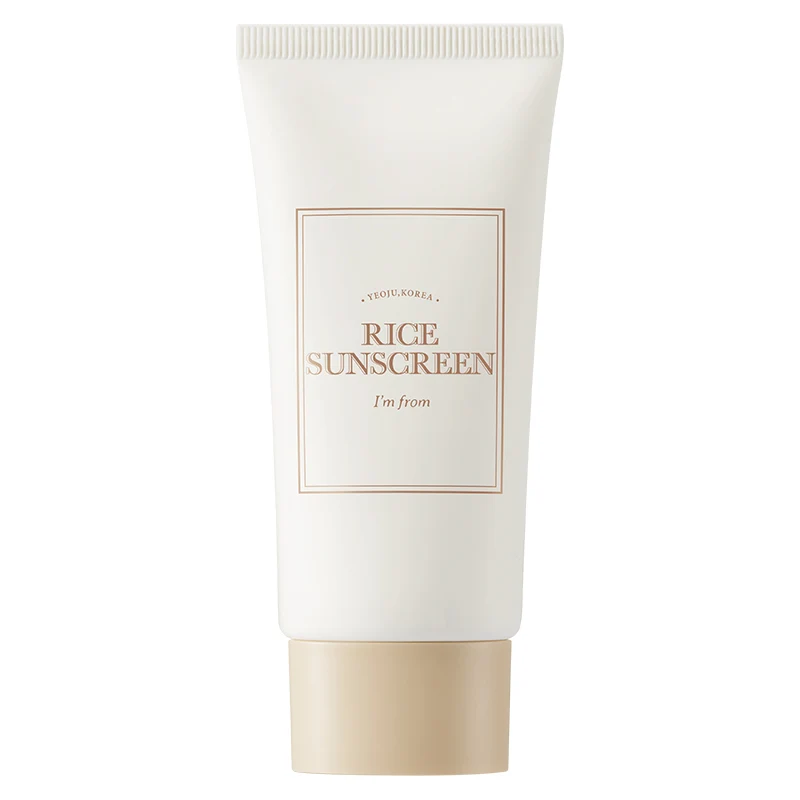
I'M FROM Rice Sunscreen SPF 50+ PA++++

I'M FROM

Rice Sunscreen SPF 50+ PA++++

face body sunscreen

Added Last edited

Fit by skin type

General, ingredient-based — not your personalized match.

Dry
66%
Combination (dry)
66%
Balanced
96%
Combination (oily)
74%
Oily
74%

See how this fits your skin

Take the skin test and I'll show you how suitable this product is for you.

Take the skin test
25
Ingredients
5
Benefits
1
Actives
Find Dupes

The I'm From Rice Sunscreen offers powerful sun protection with SPF 50+ PA++++ while nourishing the skin with 41% Goami Rice Extract. This lightweight, non-nano mineral sunscreen shields against harmful UVA and UVB rays without irritating sensitive skin. Its hydrating formula, rich in amino acids and gamma-oryzanol, smooths skin texture, brightens the complexion, and provides a natural matte finish without stickiness. Safe for both your skin and the environment, this reef-friendly sunscreen is free of oxybenzone, octinoxate, and other harmful ingredients, making it ideal for daily use.

Key Insights

Benefits

5
Anti-Aging
Evens Skin Tone
Hydration
Oil Control
Soothing

Active Ingredients

1
Hyaluronic acid

Risks

3
Microplastic
Silicone
Sulfate

About Rice Sunscreen SPF 50+ PA++++

Overview

Rice Sunscreen SPF 50+ PA++++ is a cushioning sunscreen from I'M FROM. It is rated SPF 50+ PA++++, meaning it is tested to the top of both the UVB and the UVA scales used in Asia. Its job is UV protection, with the rest of the formula working on hydration. The ingredient list runs to 25 ingredients, each broken down in full below.

Texture and finish

By its ingredient list the formula reads as moderately cushioned — emollient enough to feel like a cream, without the heaviest occlusives near the top. Silicones in the formula tend to give a smooth, blurred finish and help it grip under makeup. Hydration is handled by Propanediol, Sodium Hyaluronate and Ethylhexylglycerin, humectants that pull water into the upper layers of skin rather than sealing it there.

UV filter system

It is a mineral sunscreen, filtering with Zinc Oxide. Between them those filters cover UVB, UVA II and UVA I, so the formula is broad-spectrum in the meaningful sense: it reaches past 340 nm, where the ageing wavelengths sit. Every filter in the formula is photostable, so its protection does not fall away over the first hour in the sun — reapplication is still about sweat, water and rubbing rather than degradation.

What the formula does

Hydration: High. Ingredients that pull and hold water in the upper layers of skin, and here that comes from Propanediol, Sodium Hyaluronate, Ethylhexylglycerin and Cyclohexasiloxane.

Soothing: Moderate. Ingredients aimed at visible redness and reactivity, and here that comes from Zinc Oxide, Sodium Hyaluronate and Tocopherol.

Oil control: Moderate. Ingredients that moderate sebum or absorb shine, and here that comes from Zinc Oxide.

Who it suits

On richness alone it suits Balanced skin best, and is the least natural fit for Dry, Combination (dry), Combination (oily) and Oily skin. Nothing in the list is flagged as a common irritant, which is a reasonable starting point for reactive skin — though a patch test is still the only way to know.

What it does not target

The formula contributes little or nothing on barrier support, antioxidant protection, brightening and tone and cell renewal. That is not a fault — most products are not meant to do everything — but if one of those is your priority, this is not the product that will address it.

What is not in it

Reading the full list, the formula is essential-oil-free, no drying alcohol, paraben-free, sulfate-free, dye-free and oil-free. Those claims come from the ingredient list itself, not from the packaging. It does contain fragrance, worth knowing if your skin reacts to any of them.

Where it fits in a routine

Use it in the morning. In a routine it goes final morning step, before makeup. Apply about two finger-lengths for the face and neck — under-application is the single most common reason sunscreen underperforms. Reapply every two hours of sun exposure, and after swimming or towelling off. Let it set for a couple of minutes before makeup so it does not pill.

This summary is generated from the product's ingredient list. It is not a review, it is not the brand's own marketing claims, and it does not replace advice from a dermatologist.

Pros and cons

Drawn purely from the ingredient list

Pros

  • Broad-spectrum coverage that reaches into UVA I
  • Every UV filter in it is photostable
  • No essential oils
  • No drying alcohol
  • Strong humectant content for hydration
  • No common irritants flagged in the list

Things to know

  • Contains fragrance or declared fragrance allergens
  • Contains a solid synthetic polymer (microplastic)
  • 3 ingredients could feed malassezia (fungal acne)

Which skin types it suits

Scored on how rich or light the formula reads from its INCI order.

Suitable for

  • Balanced skin

Less suitable for

  • Dry skin
  • Combination (dry) skin
  • Combination (oily) skin
  • Oily skin

Sensitive skin

No ingredient in this formula carries a common-irritant flag, making it a reasonable option for reactive skin. A patch test is still recommended, as individual skin reactivity varies.

Skin concerns

Based on the curated benefits documented for this product's ingredients.

Helps with

  • Hydration 10 ingredients

    Attracts and locks in moisture to keep skin plump and dewy

  • Anti-Aging 3 ingredients

    Boosts collagen and cell turnover to reduce fine lines and wrinkles

  • Soothing 3 ingredients

    Calms redness, irritation, and inflammation for sensitive skin

  • Evens Skin Tone 1 ingredient

    Brightens and balances complexion for a more uniform appearance

  • Oil Control 1 ingredient

    Regulates sebum production to reduce shine and greasiness

Does not target

Anti-Acne Blackhead Reducing Dark Spot Fading Pore Minimizer Smooths Bumpy Skin

None of the ingredients in this formula are associated with these benefits. This is not unusual, as most products are designed to target a limited number of concerns.

UV filters

Mineral filter system · broad-spectrum through UVA I

Zinc Oxide

zinc oxide
Protects from
UVB (290–320 nm), UVA II (320–340 nm), UVA I (340–400 nm)
Photostable
Yes — photostable
Generation
Mineral (inorganic) filter
Approved in
Approved worldwide
Maximum permitted level
Up to 25% (EU, US, KR)

The only single filter that covers the whole UVB–UVA1 range on its own. Scatters and absorbs rather than purely absorbing, and can leave a white cast at high loads.

Key ingredients

The actives, UV filters and benefit-carrying ingredients in this formula, in the order they are listed.

2nd on the list, which puts it at an estimated 5–20% of the formula.

Zinc oxide (CI 77947)

Anti-Aging Soothing Oil Control

3rd on the list, which puts it at an estimated 5–20% of the formula.

Dodecamethylcyclohexasiloxane

Hydration

4th on the list, which puts it at an estimated 2–10% of the formula.

Benzoic acid, 2-hydroxy-, 2-butyloctyl ester

Hydration

5th on the list, which puts it at an estimated 2–10% of the formula.

1,3-dihydroxypropane

Hydration

9th on the list, which puts it at an estimated 1–5% of the formula.

1,1,1,3,5,5,5-Heptamethyl-3-(trimethylsilyloxy)trisiloxane

Hydration

10th on the list, which puts it at an estimated 1–5% of the formula.

1,1,1,3,5,5,5-Heptamethyl-3-octyl-trisiloxane

Hydration

12th on the list, which puts it at an estimated 1–3% of the formula.

Aqua (EU),Deionized Water,Distilled Water,Micromatrix Fractile AN,Onsen-Sui (JPN),Purified Water

Hydration
Sodium Hyaluronate Hyaluronic acid

14th on the list, which puts it at an estimated 1–3% of the formula.

Hyaluronic acid, sodium, salt

Hydration Anti-Aging Soothing

21st on the list, below the 1% line — present at under 1%, which for most ingredients is the level they work at.

Octanoic acid, monoester with glycerol

Hydration

23rd on the list, below the 1% line — present at under 1%, which for most ingredients is the level they work at.

1,2-Propanediol, 3-(2-ethylhexyloxy)

Hydration

24th on the list, below the 1% line — present at under 1%, which for most ingredients is the level they work at.

3,4-Dihydro-2,5,7,8-tetramethyl-2-(4,8,12-trimethyltridecyl)-2H-benzopyran-6-ol; .alpha.-tocopherol; Vitamin E

Anti-Aging Evens Skin Tone Soothing

Formula analysis

Each axis is scored from the ingredients present and how high up the list they sit.

Hydration High

Ingredients that pull and hold water in the upper layers of skin

Barrier support None

Lipids and repair signals that support skin barrier integrity

Antioxidant support None

Ingredients that mop up free radicals from UV and pollution

Oil control Moderate

Ingredients that moderate sebum or absorb shine

Brightening None

Ingredients that act on uneven tone and post-inflammatory marks

Soothing Moderate

Ingredients aimed at visible redness and reactivity

Cell renewal None

Retinoids, acids and enzymes that speed surface turnover

Firmness signalling None

Peptides and growth factors that signal for collagen support

Photostability Very high

Every filter in this formula is photostable

Active and supporting ingredients

"Active" here means an ingredient carrying a recorded active type or a recognised UV filter.

Active ingredients (2)

Supporting ingredients (23)

Solvents, emollients, texture agents and preservatives — the formula that carries the actives.

Oryza Sativa Extract Cyclohexasiloxane Butyloctyl Salicylate Propanediol Propylheptyl Caprylate Isododecane Polyglyceryl-3 Polydimethylsiloxyethyl Dimethicone Methyl Trimethicone Caprylyl Methicone Methyl Methacrylate Crosspolymer Water Polymethylsilsesquioxane Disteardimonium Hectorite Magnesium Sulfate Triethoxycaprylylsilane 1,2-hexanediol Polyglyceryl-2 Dipolyhydroxystearate Lauryl Polyglyceryl-3 Polydimethylsiloxyethyl Dimethicone Glyceryl Caprylate Caprylyl Glycol Ethylhexylglycerin Tocopherol Parfum

What is and is not in it

Read from the full ingredient list. A brand's own claim may differ.

Free from

  • Essential-oil-free
  • No drying alcohol
  • Paraben-free
  • Sulfate-free
  • Dye-free
  • Oil-free
  • No animal-derived ingredients

Contains

  • Fragrance

    Parfum

  • Silicones

    Cyclohexasiloxane, Polyglyceryl-3 Polydimethylsiloxyethyl Dimethicone, Methyl Trimethicone, Caprylyl Methicone, Polymethylsilsesquioxane

  • Microplastics

    Methyl Methacrylate Crosspolymer, Polymethylsilsesquioxane

What to layer it with

Judged by the same curated rules our routine checker uses. It reads the ingredients, not the label.

Compatible with

  • Vitamin C (L-ascorbic acid)
  • Retinoids (retinol, retinal)
  • AHAs (glycolic, lactic)
  • BHA (salicylic acid)
  • PHAs (gluconolactone)
  • Benzoyl peroxide
  • Azelaic acid
  • Copper peptides
  • Bakuchiol
  • Niacinamide
  • Hyaluronic acid
  • Ceramides
  • Signal peptides
  • Panthenol
  • Sunscreen

Nothing in this formula belongs to a group our rules can put in conflict, so it layers freely. Order still matters — thinnest texture first.

Where it fits in a routine

Morning
  1. Cleanse
  2. Toning
  3. Treat
  4. Moisturise
  5. Protect

This product is the "Protect" step.

  • Apply about two finger-lengths for the face and neck — under-application is the single most common reason sunscreen underperforms.
  • Reapply every two hours of sun exposure, and after swimming or towelling off.
  • Let it set for a couple of minutes before makeup so it does not pill.

Safety and suitability

Flags to check, not verdicts. None of this is medical advice — if you are pregnant, breastfeeding or treating a skin condition, ask a doctor.

Pregnancy and breastfeeding
Nothing in this formula is on the standard pregnancy-caution list. That is not clearance — ask your doctor about anything you use daily.
Fungal acne (malassezia)
3 ingredients could feed malassezia: Propylheptyl Caprylate, Polyglyceryl-2 Dipolyhydroxystearate, Glyceryl Caprylate. That is about the yeast's food supply, not a prediction that you will break out.
Sensitive and reactive skin
No ingredient in this formula carries a common-irritant flag, making it a reasonable option for reactive skin. A patch test is still recommended, as individual skin reactivity varies.
Recorded ingredient risks
Microplastic, Silicone, Sulfate

Ingredients by function

Most ingredients do more than one job, so these counts add up to more than the 25 ingredients on the label.

7
Solvent

Dissolves and carries everything else

7
Texture agent

Sets the thickness, spread and stability of the formula

5
Emollient

Softens and smooths by filling gaps between skin cells

2
Occlusive

Forms a film that slows water loss

2
Surfactant

Lifts oil and dirt, or holds oil and water together

1
Active

Changes how skin behaves rather than how it feels

1
Fragrance / colour

Changes how the product smells or looks

1
Antioxidant

Neutralises free radicals from UV and pollution

1
Humectant

Draws water into the upper layers of skin

1
Exfoliant

Loosens or dissolves dead surface cells

1
Plant extract

Botanical material, usually for antioxidants or scent

1
Preservative

Keeps the product free of microbial growth

1
UV filter

Absorbs or scatters ultraviolet light

Ingredient breakdown

Every ingredient on the label, in order, with what it does and roughly how much of it is likely to be there.

Estimated level
10–40%
Confidence
Moderate — INCI order above the 1% line
Roles
Exfoliant, Plant extract, Texture agent

1st on the list, which puts it at an estimated 10–40% of the formula.

Oryza Sativa Extract is an extract of the grains of the Rice, Oryza sativa L., Poaceae

2 Zinc Oxide UV filter
Estimated level
5–20%
Confidence
Moderate — INCI order above the 1% line
Roles
UV filter, Occlusive, Texture agent, Preservative

2nd on the list, which puts it at an estimated 5–20% of the formula.

Zinc oxide (CI 77947)

Anti-Aging Soothing Oil Control
9 scientific references
  • Journal of Investigative Dermatology, February 2019, pages 277-278
  • Nanomaterials, March 2017, pages 27-31
  • Particle and Fibre Toxicology, August 2016, page 44
  • International Journal of Cosmetic Science, June 2014, pages 273-283
  • Indian Journal of Dermatology, September-October 2012, pages 335-342
  • Archives of Toxicology, July 2012, pages 1063-1075
  • Photodermatology, Photoimmunology, & Photomedicine, April 2011, pages 58-67
  • American Journal of Clinical Dermatology, December 2010, pages 413-421
  • https://cosmeticsinfoorg/ingredient/zinc-oxide-0?gclid=CjwKCAjw3_KIBhA2EiwAaAAlipF1YpJBfZrmUbDnK6jm68_2f-GfsdZ770fVI15BFzZJtiFcCJjAWxoC3SkQAvD_BwE
Estimated level
5–20%
Confidence
Moderate — INCI order above the 1% line
Roles
Emollient, Solvent

3rd on the list, which puts it at an estimated 5–20% of the formula.

Dodecamethylcyclohexasiloxane

Hydration
2 scientific references
  • Dow (supplier info), Accessed September 2021, ePublication
  • International Journal of Toxicology, December 2011, pages 149S-227S
Estimated level
2–10%
Confidence
Moderate — INCI order above the 1% line
Roles
Solvent

4th on the list, which puts it at an estimated 2–10% of the formula.

Benzoic acid, 2-hydroxy-, 2-butyloctyl ester

Hydration
4 scientific references
  • Cosmetic Ingredient Review, June 2019, pages 1-60
  • https://onlinepersonalcarecouncilorg/ctfa-static/online/lists/cir-pdfs/FR766pdf
  • International Journal of Toxicology, 2003, pages 1-108
  • https://wwwdeepdyvecom/lp/sage/safety-assessment-of-salicylic-acid-butyloctyl-salicylate-calcium-klHNmxZGsR?articleList=%2Fsearch%3Fquery%3Dbutyloctyl%2Bsalicylate
5 Propanediol Texture agent
Estimated level
2–10%
Confidence
Moderate — INCI order above the 1% line
Roles
Texture agent, Solvent

5th on the list, which puts it at an estimated 2–10% of the formula.

1,3-dihydroxypropane

Hydration
4 scientific references
  • PubChem Compound Summary, April 2021, ePublication
  • SpecialChem, Accessed April 2021, ePublication
  • Cosmetic Ingredient Review, June 2018, pages 1-73
  • Cosmetics & Toiletries, May 2013, pages 81-86
Estimated level
2–10%
Confidence
Moderate — INCI order above the 1% line
Roles
Emollient

6th on the list, which puts it at an estimated 2–10% of the formula.

Hydration
7 Isododecane Emollient
Estimated level
1–5%
Confidence
Moderate — INCI order above the 1% line
Roles
Emollient, Solvent

7th on the list, which puts it at an estimated 1–5% of the formula.

2,2,4,6,6-Pentamethylheptane; Hydrocarbons, C4, 1,3-butadiene-free, polymd., triisobutylene fraction, hydrogenated

Estimated level
1–5%
Confidence
Moderate — INCI order above the 1% line

8th on the list, which puts it at an estimated 1–5% of the formula.

Siloxanes and Silicones, 3-(tri(oxy-2-hydroxypropylene))oxypropyl methyl, 2-trimethylsilylpoly(oxydimethylsilyl)ethyl methyl, dimethyl

Silicone
Estimated level
1–5%
Confidence
Moderate — INCI order above the 1% line
Roles
Solvent

9th on the list, which puts it at an estimated 1–5% of the formula.

1,1,1,3,5,5,5-Heptamethyl-3-(trimethylsilyloxy)trisiloxane

Hydration Silicone
8 scientific references
  • Supercharged Hydration
  • How Hyaluronic Acid Benefits Skin
  • What is Dehydrated Skin & How to Choose the Best Products
  • What Your Moisturizer Must Contain
  • Moisturizer Myths You Should Stop Believing Now
  • The Benefits of Glycerin in Skin Care
  • The Best Face Oils for Skin
  • How Facial Oils Help Skin
Estimated level
1–5%
Confidence
Moderate — INCI order above the 1% line

10th on the list, which puts it at an estimated 1–5% of the formula.

1,1,1,3,5,5,5-Heptamethyl-3-octyl-trisiloxane

Hydration Silicone
Estimated level
1–3%
Confidence
Moderate — INCI order above the 1% line
Roles
Occlusive

11th on the list, which puts it at an estimated 1–3% of the formula.

2-Propenoic acid, 2-methyl-, 1,2-ethanediyl ester, polymer with methyl 2-methyl-2-propenoate

Microplastic
12 Water Solvent
Estimated level
1–3%
Confidence
Moderate — INCI order above the 1% line
Roles
Solvent

12th on the list, which puts it at an estimated 1–3% of the formula.

Aqua (EU),Deionized Water,Distilled Water,Micromatrix Fractile AN,Onsen-Sui (JPN),Purified Water

Hydration
3 scientific references
  • Skin Research and Technology, May 2015, pages 131-136
  • Skin Pharmacology and Applied Skin Physiology, November-December 1999, pages 344-351
  • Journal of Cosmetic Science, September-October 1993, pages 249-262
Estimated level
1–3%
Confidence
Moderate — INCI order above the 1% line
Roles
Texture agent

13th on the list, which puts it at an estimated 1–3% of the formula.

Polymer formed by hydrolysis and condensation of methyltrimethoxysilane

Microplastic
Estimated level
1–3%
Confidence
Moderate — INCI order above the 1% line
Roles
Humectant, Active

14th on the list, which puts it at an estimated 1–3% of the formula.

Hyaluronic acid, sodium, salt

Hydration Anti-Aging Soothing
5 scientific references
  • Der Hautarzt; Zeitschrift fur Dermatologie, Venerologie, und Verwandte Gebiete, December 2017, pages 987-993
  • Journal of Cosmetic Dermatology, July 2014, pages 277-287
  • Journal of Clinical and Aesthetic Dermatology, October 2012, pages 20-23
  • DermatoEndocrinology, July-December 2012, pages 253-258
  • Journal of Drugs in Dermatology, September 2011, pages 990-1000
Estimated level
1–3%
Confidence
Moderate — INCI order above the 1% line
Roles
Texture agent

15th on the list, which puts it at an estimated 1–3% of the formula.

1-Octadecanaminium, N,N-dimethyl-N-octadecyl-, chloride, reaction products with hectorite

16 Magnesium Sulfate Texture agent
Estimated level
1–3%
Confidence
Moderate — INCI order above the 1% line
Roles
Texture agent

16th on the list, which puts it at an estimated 1–3% of the formula.

Magnesium sulphate

Sulfate
17 Triethoxycaprylylsilane Texture agent
Estimated level
1–3%
Confidence
Moderate — INCI order above the 1% line
Roles
Texture agent

17th on the list, which puts it at an estimated 1–3% of the formula.

Silane, triethoxyoctyl-

18 1,2-hexanediol Solvent
Estimated level
under 1%
Confidence
Moderate — listed below the 1% line
Roles
Solvent

18th on the list, below the 1% line — present at under 1%, which for most ingredients is the level they work at.

Estimated level
under 1%
Confidence
Moderate — listed below the 1% line

19th on the list, below the 1% line — present at under 1%, which for most ingredients is the level they work at.

Octadecanoic acid, 12-hydroxy-, homopolymer, ester with oxybis(propanediol)

Estimated level
under 1%
Confidence
Moderate — listed below the 1% line
Roles
Surfactant

20th on the list, below the 1% line — present at under 1%, which for most ingredients is the level they work at.

Siloxanes and Silicones, dodecyl methyl, 3-(tri(oxy-2-hydroxypropylene))oxypropyl methyl, 2-trimethylsilylpoly(oxydimethylsilyl)ethyl methyl, dimethyl

Silicone
Estimated level
under 1%
Confidence
Moderate — listed below the 1% line
Roles
Emollient, Surfactant

21st on the list, below the 1% line — present at under 1%, which for most ingredients is the level they work at.

Octanoic acid, monoester with glycerol

Hydration
22 Caprylyl Glycol Emollient
Estimated level
under 1%
Confidence
Moderate — listed below the 1% line
Roles
Emollient

22nd on the list, below the 1% line — present at under 1%, which for most ingredients is the level they work at.

Octane-1,2-diol

Estimated level
under 1%
Confidence
Moderate — listed below the 1% line

23rd on the list, below the 1% line — present at under 1%, which for most ingredients is the level they work at.

1,2-Propanediol, 3-(2-ethylhexyloxy)

Hydration
5 scientific references
  • PLoS One, October 2016, ePublication
  • Contact Dermatitis, May 2016, pages 281-288
  • International Journal of Toxicology, September 2013, pages 5S-21S
  • Personal Care, 2008, pages 1-4
  • Cosmetic Science Technology, 2006, pages 1-11
24 Tocopherol Antioxidant
Estimated level
under 1%
Confidence
Moderate — listed below the 1% line
Roles
Antioxidant

24th on the list, below the 1% line — present at under 1%, which for most ingredients is the level they work at.

3,4-Dihydro-2,5,7,8-tetramethyl-2-(4,8,12-trimethyltridecyl)-2H-benzopyran-6-ol; .alpha.-tocopherol; Vitamin E

Anti-Aging Evens Skin Tone Soothing
4 scientific references
  • Journal or Agricultural and Food Chemistry, June 2010, pages 7013-7020
  • Journal of Investigative Dermatology, November 2001, pages 1212-1217
  • Canadian Family Physician, July 2006, pages 855-856
  • Dermatologic Surgery, April 1999, pages 311-315
25 Parfum Fragrance / colour
Estimated level
under 1%
Confidence
Moderate — listed below the 1% line
Roles
Fragrance / colour

25th on the list, below the 1% line — present at under 1%, which for most ingredients is the level they work at.

Parfum is a term for ingredient labelling used to identify that a product contains a material or a combination of materials normally added to a cosmetic to produce or to mask a particular odour. According to Article 19 of the Cosmetics Regulation, 'Perfume and aromatic compositions and their raw materials shall be referred to by the terms ‘parfum’ or ‘aroma’. '

People also compare

Products in the same category that share this formula's distinguishing ingredients.

DIVE-IN Mild Sun Cream SPF50+ PA++++

Torriden

Shares 11 key ingredients with Rice Sunscreen SPF 50+ PA++++: Water, Zinc Oxide, Cyclohexasiloxane, Butyloctyl Salicylate, Propylheptyl Caprylate

Frequently asked questions

What ingredients are in Rice Sunscreen SPF 50+ PA++++?

ORYZA SATIVA EXTRACT, ZINC OXIDE, CYCLOHEXASILOXANE, BUTYLOCTYL SALICYLATE, PROPANEDIOL, PROPYLHEPTYL CAPRYLATE, ISODODECANE, POLYGLYCERYL-3 POLYDIMETHYLSILOXYETHYL DIMETHICONE, METHYL TRIMETHICONE, CAPRYLYL METHICONE, METHYL METHACRYLATE CROSSPOLYMER, WATER, POLYMETHYLSILSESQUIOXANE, SODIUM HYALURONATE, DISTEARDIMONIUM HECTORITE, MAGNESIUM SULFATE, TRIETHOXYCAPRYLYLSILANE, 1,2-HEXANEDIOL, POLYGLYCERYL-2 DIPOLYHYDROXYSTEARATE, LAURYL POLYGLYCERYL-3 POLYDIMETHYLSILOXYETHYL DIMETHICONE, GLYCERYL CAPRYLATE, CAPRYLYL GLYCOL, ETHYLHEXYLGLYCERIN, TOCOPHEROL, PARFUM.

What are the active ingredients in Rice Sunscreen SPF 50+ PA++++?

SODIUM HYALURONATE.

How do I use Rice Sunscreen SPF 50+ PA++++?

After your daytime moisturizer, use a sufficient amount and spread gently on the face, and body parts easily exposed to sunlight. Add another coat to areas more vulnerable to UV rays, such as the forehead and nose. For outdoor activities, reapply every 4 hours to block UV rays more effectively.

What skin types is Rice Sunscreen SPF 50+ PA++++ good for?

Judged on how rich the formula reads from its ingredient list, it suits Balanced skin best. It is the least natural fit for Dry, Combination (dry), Combination (oily), Oily skin.

Is Rice Sunscreen SPF 50+ PA++++ good for sensitive skin?

No ingredient in this formula carries a common-irritant flag, making it a reasonable option for reactive skin. A patch test is still recommended, as individual skin reactivity varies.

Is Rice Sunscreen SPF 50+ PA++++ fungal acne safe?

3 ingredients could feed malassezia: Propylheptyl Caprylate, Polyglyceryl-2 Dipolyhydroxystearate, Glyceryl Caprylate. That describes the yeast's food supply, not a prediction that they will cause a breakout.

Can I use Rice Sunscreen SPF 50+ PA++++ while pregnant?

Nothing in this formula is on the standard pregnancy-caution list. That is not medical clearance — check anything you use daily with your doctor or midwife.

Is Rice Sunscreen SPF 50+ PA++++ fragrance free?

No — it contains Parfum.

Does Rice Sunscreen SPF 50+ PA++++ contain alcohol?

No. Reading the full ingredient list, this formula is no drying alcohol.

Is Rice Sunscreen SPF 50+ PA++++ silicone free?

No — it contains Cyclohexasiloxane, Polyglyceryl-3 Polydimethylsiloxyethyl Dimethicone, Methyl Trimethicone, Caprylyl Methicone, Polymethylsilsesquioxane.

Does Rice Sunscreen SPF 50+ PA++++ contain essential oils?

No. Reading the full ingredient list, this formula is essential-oil-free.

Is Rice Sunscreen SPF 50+ PA++++ paraben free?

Yes. Reading the full ingredient list, this formula is paraben-free.

What can I layer with Rice Sunscreen SPF 50+ PA++++?

It layers well with Vitamin C (L-ascorbic acid), Retinoids (retinol, retinal), AHAs (glycolic, lactic), BHA (salicylic acid), PHAs (gluconolactone), Benzoyl peroxide.

When should I apply Rice Sunscreen SPF 50+ PA++++?

Use it in the morning, final morning step, before makeup.

How many ingredients does Rice Sunscreen SPF 50+ PA++++ have?

It lists 25 ingredients, of which 2 are recorded as actives.

Who makes Rice Sunscreen SPF 50+ PA++++?

I'M FROM.

What UV filters are in Rice Sunscreen SPF 50+ PA++++?

It filters UV with Zinc Oxide (zinc oxide).

Is Rice Sunscreen SPF 50+ PA++++ broad spectrum?

Yes. Its filters cover UVB, UVA II and UVA I, so protection reaches past 340 nm into the deep-UVA range associated with ageing and pigmentation.

Does Rice Sunscreen SPF 50+ PA++++ leave a white cast?

Possibly. It filters with mineral UV filters, which sit on the surface and can leave a visible cast on deeper skin tones, especially at high SPF.

Is Rice Sunscreen SPF 50+ PA++++ reef safe?

It contains none of the filters named in the Hawaii and Key West reef legislation (oxybenzone and octinoxate). "Reef safe" is not a regulated term, so treat that as a fact about the filter list rather than a certification.

Can I wear Rice Sunscreen SPF 50+ PA++++ under makeup?

Yes. Let it set for a couple of minutes before foundation so it does not pill, and reapply over makeup with a stick or powder rather than rubbing more in.

How often should I reapply Rice Sunscreen SPF 50+ PA++++?

Every two hours of sun exposure, and immediately after swimming, sweating heavily or towelling off.

Brand
I'M FROM

Reviews

0 total

Log in to leave a review.

No reviews yet. Be the first to share your thoughts.