1st on the list, which puts it at an estimated 30–80% of the formula.
Aqua (EU),Deionized Water,Distilled Water,Micromatrix Fractile AN,Onsen-Sui (JPN),Purified Water
Hydration
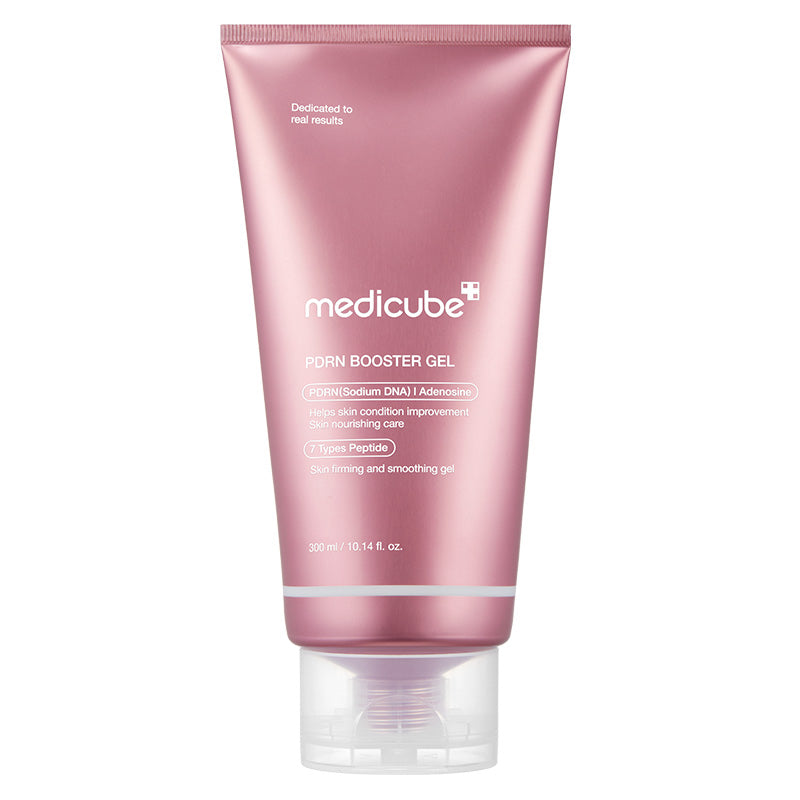
Medicube
PDRN Booster Gel
face moisturizer
Medicube
face moisturizer
Added Last edited
Fit by skin type
General, ingredient-based — not your personalized match.

See how this fits your skin
Take the skin test and I'll show you how suitable this product is for you.
Take the skin testPDRN Booster Gel is your daily skin revival in a gel. Packed with PDRN, this lightweight formula delivers intense hydration, strengthens the skin barrier, and supports cellular regeneration. Its soothing texture calms redness and irritation, leaving your skin soft, plump, and visibly healthier. Perfect for combination or sensitive skin, it works as a booster step to amplify your existing routine. This gel absorbs instantly without stickiness, making it ideal for layering under serums, creams, or makeup.
PDRN Booster Gel is a lightweight moisturizer from Medicube, a brand based in Korea. The formula is built mainly around hydration. The ingredient list runs to 32 ingredients, each broken down in full below.
By its ingredient list the formula reads as light: water and humectants lead, with emollients kept lower in the order. Hydration is handled by Glycerin, Ethylhexylglycerin and Butylene Glycol, humectants that pull water into the upper layers of skin rather than sealing it there.
Hydration: High. Ingredients that pull and hold water in the upper layers of skin, and here that comes from Glycerin, Ethylhexylglycerin, Butylene Glycol and Betaine.
Soothing: Moderate. Ingredients aimed at visible redness and reactivity, and here that comes from Niacinamide, Adenosine and Acetyl Tetrapeptide-5.
Firmness signalling: Moderate. Peptides and growth factors that signal for collagen support, and here that comes from Adenosine, Acetyl Hexapeptide-8, Copper Tripeptide-1 and Acetyl Tetrapeptide-5.
Barrier support: Moderate. Lipids and repair signals that support skin barrier integrity, and here that comes from Niacinamide.
On richness alone it suits Balanced, Combination (oily) and Oily skin best, and is the least natural fit for Dry and Combination (dry) skin. Nothing in the list is flagged as a common irritant, which is a reasonable starting point for reactive skin — though a patch test is still the only way to know.
The formula contributes little or nothing on antioxidant protection and cell renewal. That is not a fault — most products are not meant to do everything — but if one of those is your priority, this is not the product that will address it.
Reading the full list, the formula is fragrance-free, essential-oil-free, no drying alcohol, paraben-free, silicone-free and microplastic-free. Those claims come from the ingredient list itself, not from the packaging.
It can be used morning and evening. In a routine it goes after serums. Seal in your serums with it; in the morning, sunscreen still goes on top.
This summary is generated from the product's ingredient list. It is not a review, it is not the brand's own marketing claims, and it does not replace advice from a dermatologist.
Drawn purely from the ingredient list
Scored on how rich or light the formula reads from its INCI order.
No ingredient in this formula carries a common-irritant flag, making it a reasonable option for reactive skin. A patch test is still recommended, as individual skin reactivity varies.
Based on the curated benefits documented for this product's ingredients.
Attracts and locks in moisture to keep skin plump and dewy
Boosts collagen and cell turnover to reduce fine lines and wrinkles
Calms redness, irritation, and inflammation for sensitive skin
Tightens and refines the look of enlarged pores
None of the ingredients in this formula are associated with these benefits. This is not unusual, as most products are designed to target a limited number of concerns.
The actives, UV filters and benefit-carrying ingredients in this formula, in the order they are listed.
1st on the list, which puts it at an estimated 30–80% of the formula.
Aqua (EU),Deionized Water,Distilled Water,Micromatrix Fractile AN,Onsen-Sui (JPN),Purified Water
2nd on the list, which puts it at an estimated 5–20% of the formula.
Glycerine ;Glycerol (INN); Glycerol (RIFM); Glycerolum (EP); Glycyl Alcohol; 1,2,3-Propanetriol; 1,2,3-Trihydroxypropane
3rd on the list, which puts it at an estimated 5–20% of the formula.
Niacinamide (vitamin B3) is a gentle skincare active that repairs the skin barrier, calms redness, controls oil and evens tone at 2–5%. Official IUPAC name: **3-Pyridinecarboxamide**
8th on the list, below the 1% line — present at under 1%, which for most ingredients is the level they work at.
1,2-Propanediol, 3-(2-ethylhexyloxy)
9th on the list, below the 1% line — present at under 1%, which for most ingredients is the level they work at.
6-Amino-9-beta-D-ribofuranosyl-9H-purine
13th on the list, below the 1% line — present at under 1%, which for most ingredients is the level they work at.
Butane-1,3-diol (CAS No. 107-88-0/ EC No. 203-529-7) (R)-(-)-butane-1,3-diol” (CAS No. 6290-03-5/ EC No. 228-532-0)
15th on the list, below the 1% line — present at under 1%, which for most ingredients is the level they work at.
1,2-Dihydroxypentane
17th on the list, below the 1% line — present at under 1%, which for most ingredients is the level they work at.
Sucrose
20th on the list, below the 1% line — present at under 1%, which for most ingredients is the level they work at.
Methanaminium, 1-carboxy-N,N,N-trimethyl-, hydroxide, inner salt
26th on the list, below the 1% line — present at under 1%, which for most ingredients is the level they work at.
Acetyl hexapeptide-8 is the synthetic peptide consisting of arginine, methionine, and acetylated glutamic acid residues
27th on the list, below the 1% line — present at under 1%, which for most ingredients is the level they work at.
Copper Tripeptide-1 is a copper complex of Tripeptide-1
28th on the list, below the 1% line — present at under 1%, which for most ingredients is the level they work at.
Acetyl Tetrapeptide-5 is product obtained by the acetylation of Tetrapeptide-5
Each axis is scored from the ingredients present and how high up the list they sit.
Ingredients that pull and hold water in the upper layers of skin
Lipids and repair signals that support skin barrier integrity
Ingredients that mop up free radicals from UV and pollution
Ingredients that moderate sebum or absorb shine
Ingredients that act on uneven tone and post-inflammatory marks
Ingredients aimed at visible redness and reactivity
Retinoids, acids and enzymes that speed surface turnover
Peptides and growth factors that signal for collagen support
"Active" here means an ingredient carrying a recorded active type or a recognised UV filter.
Solvents, emollients, texture agents and preservatives — the formula that carries the actives.
Read from the full ingredient list. A brand's own claim may differ.
Judged by the same curated rules our routine checker uses. It reads the ingredients, not the label.
Best kept to separate routines — one in the morning, one at night, or on alternate days.
This product is the "Moisturise" step.
Flags to check, not verdicts. None of this is medical advice — if you are pregnant, breastfeeding or treating a skin condition, ask a doctor.
Most ingredients do more than one job, so these counts add up to more than the 32 ingredients on the label.
Botanical material, usually for antioxidants or scent
Amino-acid chains that signal for repair or firmness
Sets the thickness, spread and stability of the formula
Draws water into the upper layers of skin
Dissolves and carries everything else
Changes how skin behaves rather than how it feels
Forms a film that slows water loss
Calms visible redness and irritation
Softens and smooths by filling gaps between skin cells
Binds trace metals that would otherwise spoil the formula
Sets the acidity the formula needs to work
Keeps the product free of microbial growth
Every ingredient on the label, in order, with what it does and roughly how much of it is likely to be there.
1st on the list, which puts it at an estimated 30–80% of the formula.
Aqua (EU),Deionized Water,Distilled Water,Micromatrix Fractile AN,Onsen-Sui (JPN),Purified Water
2nd on the list, which puts it at an estimated 5–20% of the formula.
Glycerine ;Glycerol (INN); Glycerol (RIFM); Glycerolum (EP); Glycyl Alcohol; 1,2,3-Propanetriol; 1,2,3-Trihydroxypropane
3rd on the list, which puts it at an estimated 5–20% of the formula.
Niacinamide (vitamin B3) is a gentle skincare active that repairs the skin barrier, calms redness, controls oil and evens tone at 2–5%. Official IUPAC name: **3-Pyridinecarboxamide**
4th on the list, which puts it at an estimated 2–10% of the formula.
2-Propenoic acid, polymer with 2,2-bis(hydroxymethyl)propane-1,3-diol 2-propenyl ether
5th on the list, below the 1% line — present at under 1%, which for most ingredients is the level they work at.
1,2-Propanediol, 3-(4-chlorophenoxy)-
6th on the list, below the 1% line — present at under 1%, which for most ingredients is the level they work at.
Potassium hydroxide
7th on the list, below the 1% line — present at under 1%, which for most ingredients is the level they work at.
C10-30 alkyl propenoate, polymer with propenoic acid, butenoic acidand/or alkyl propenoates, product with propenyl sucrose ether or propenyl 2,2-dihydroxymethyl-1,3-propanediol
8th on the list, below the 1% line — present at under 1%, which for most ingredients is the level they work at.
1,2-Propanediol, 3-(2-ethylhexyloxy)
9th on the list, below the 1% line — present at under 1%, which for most ingredients is the level they work at.
6-Amino-9-beta-D-ribofuranosyl-9H-purine
10th on the list, below the 1% line — present at under 1%, which for most ingredients is the level they work at.
Disodium dihydrogen ethylenediaminetetraacetate
11th on the list, below the 1% line — present at under 1%, which for most ingredients is the level they work at.
Deoxyribonucleic acid, sodium salts
12th on the list, below the 1% line — present at under 1%, which for most ingredients is the level they work at.
1,1'-Oxydipropan-2-ol; Oxydipropan-2-ol; Hydroxypropyloxypropanol
13th on the list, below the 1% line — present at under 1%, which for most ingredients is the level they work at.
Butane-1,3-diol (CAS No. 107-88-0/ EC No. 203-529-7) (R)-(-)-butane-1,3-diol” (CAS No. 6290-03-5/ EC No. 228-532-0)
14th on the list, below the 1% line — present at under 1%, which for most ingredients is the level they work at.
15th on the list, below the 1% line — present at under 1%, which for most ingredients is the level they work at.
1,2-Dihydroxypentane
16th on the list, below the 1% line — present at under 1%, which for most ingredients is the level they work at.
Hibiscus Esculentus Fruit Extract is an extract of the fruit of the Hibiscus, Hibiscus esculentus L., Malvaceae
17th on the list, below the 1% line — present at under 1%, which for most ingredients is the level they work at.
Sucrose
18th on the list, below the 1% line — present at under 1%, which for most ingredients is the level they work at.
Morus Bombycis Leaf Extract is an extract of the dried leaves of the Mulberry, Morus bombycis, Moraceae
19th on the list, below the 1% line — present at under 1%, which for most ingredients is the level they work at.
Citrus Junos Peel Extract is an extract of the peel of Citrus junos, Rutaceae
20th on the list, below the 1% line — present at under 1%, which for most ingredients is the level they work at.
Methanaminium, 1-carboxy-N,N,N-trimethyl-, hydroxide, inner salt
21st on the list, below the 1% line — present at under 1%, which for most ingredients is the level they work at.
Castanea Crenata Shell Extract is an extract of the shell of the chestnut, Castanea crenata, Fagaceae
22nd on the list, below the 1% line — present at under 1%, which for most ingredients is the level they work at.
Polygonum Fagopyrum Seed Extract is an extract of the seeds of the Buckwheat, Polygonum fagopyrum L., Polygonaceae
23rd on the list, below the 1% line — present at under 1%, which for most ingredients is the level they work at.
Fragaria Ananassa Fruit Extract is the extract of the Strawberry, Fragaria ananassa, Rosaceae
24th on the list, below the 1% line — present at under 1%, which for most ingredients is the level they work at.
Anacardium Occidentale Extract is an extract of the seeds or the fruit of the Cashew, Anacardium occidentale L., Anacardiaceae
25th on the list, below the 1% line — present at under 1%, which for most ingredients is the level they work at.
Moringa Oleifera Seed Extract is the extract of the seeds of Moringa oleifera, Moringaceae.
26th on the list, below the 1% line — present at under 1%, which for most ingredients is the level they work at.
Acetyl hexapeptide-8 is the synthetic peptide consisting of arginine, methionine, and acetylated glutamic acid residues
27th on the list, below the 1% line — present at under 1%, which for most ingredients is the level they work at.
Copper Tripeptide-1 is a copper complex of Tripeptide-1
28th on the list, below the 1% line — present at under 1%, which for most ingredients is the level they work at.
Acetyl Tetrapeptide-5 is product obtained by the acetylation of Tetrapeptide-5
29th on the list, below the 1% line — present at under 1%, which for most ingredients is the level they work at.
Lysine, synthetic pentapeptide with serine, and threonine, hexadecanoyl derivatives
30th on the list, below the 1% line — present at under 1%, which for most ingredients is the level they work at.
Hexapeptide-9 is a synthetic peptide containing Glutamine, Glycine and Proline residues
31st on the list, below the 1% line — present at under 1%, which for most ingredients is the level they work at.
Glycine, N-(1-oxohexadecyl)-L-valylglycyl-L-valyl-L-alanyl-L-prolyl-
32nd on the list, below the 1% line — present at under 1%, which for most ingredients is the level they work at.
Palmitoyl Tripeptide-5 is the reaction product of palmitic acid and Tripeptide-5
Products in the same category that share this formula's distinguishing ingredients.
Eqqualberry
Shares 11 key ingredients with PDRN Booster Gel: Water, Glycerin, Butylene Glycol, Niacinamide, Pentylene Glycol
Medicube
Shares 9 key ingredients with PDRN Booster Gel: Water, Glycerin, Niacinamide, Butylene Glycol, Ethylhexylglycerin
Dr.Melaxin
Shares 8 key ingredients with PDRN Booster Gel: Water, Glycerin, Niacinamide, Butylene Glycol, Ethylhexylglycerin
SKIN1004
Shares 8 key ingredients with PDRN Booster Gel: Water, Butylene Glycol, Niacinamide, Glycerin, Ethylhexylglycerin
Dr.Melaxin
Shares 7 key ingredients with PDRN Booster Gel: Water, Glycerin, Niacinamide, Butylene Glycol, Betaine
Dr.Althea
Shares 7 key ingredients with PDRN Booster Gel: Water, Butylene Glycol, Glycerin, Niacinamide, Pentylene Glycol
WATER, GLYCERIN, NIACINAMIDE, CARBOMER, CHLORPHENESIN, POTASSIUM HYDROXIDE, ACRYLATES/C10-30 ALKYL ACRYLATE CROSSPOLYMER, ETHYLHEXYLGLYCERIN, ADENOSINE, DISODIUM EDTA, SODIUM DNA, DIPROPYLENE GLYCOL, BUTYLENE GLYCOL, 1,2-HEXANEDIOL, PENTYLENE GLYCOL, HIBISCUS ESCULENTUS FRUIT EXTRACT, SUCROSE, MORUS BOMBYCIS LEAF EXTRACT, CITRUS JUNOS PEEL EXTRACT, BETAINE, CASTANEA CRENATA SHELL EXTRACT, POLYGONUM FAGOPYRUM SEED EXTRACT, FRAGARIA ANANASSA FRUIT EXTRACT, ANACARDIUM OCCIDENTALE EXTRACT, MORINGA OLEIFERA SEED EXTRACT, ACETYL HEXAPEPTIDE-8, COPPER TRIPEPTIDE-1, ACETYL TETRAPEPTIDE-5, PALMITOYL PENTAPEPTIDE-4, HEXAPEPTIDE-9, PALMITOYL HEXAPEPTIDE-12, PALMITOYL TRIPEPTIDE-5.
NIACINAMIDE, ACETYL HEXAPEPTIDE-8, COPPER TRIPEPTIDE-1, PALMITOYL PENTAPEPTIDE-4.
Apply an appropriate amount onto cleansed skin and gently pat until fully absorbed. Can be used daily morning and at night. Tip: Keep it in the fridge for an extra cooling effect that soothes irritation and tightens pores instantly.
Judged on how rich the formula reads from its ingredient list, it suits Balanced, Combination (oily), Oily skin best. It is the least natural fit for Dry, Combination (dry) skin.
No ingredient in this formula carries a common-irritant flag, making it a reasonable option for reactive skin. A patch test is still recommended, as individual skin reactivity varies.
No ingredient in this formula is a recognised food source for malassezia, the yeast behind fungal acne.
Nothing in this formula is on the standard pregnancy-caution list. That is not medical clearance — check anything you use daily with your doctor or midwife.
Yes. Reading the full ingredient list, this formula is fragrance-free.
No. Reading the full ingredient list, this formula is no drying alcohol.
Yes. Reading the full ingredient list, this formula is silicone-free.
No. Reading the full ingredient list, this formula is essential-oil-free.
Yes. Reading the full ingredient list, this formula is paraben-free.
It layers well with Vitamin C (L-ascorbic acid), Retinoids (retinol, retinal), AHAs (glycolic, lactic), BHA (salicylic acid), PHAs (gluconolactone), Azelaic acid. Take more care combining it with Benzoyl peroxide — use them in separate routines or on alternate days.
Use it morning and evening, after serums.
It lists 32 ingredients, of which 4 are recorded as actives.
Medicube, a brand based in Korea.
We can't find the internet
Attempting to reconnect
Something went wrong!
Attempting to reconnect