4th on the list, which puts it at an estimated 2–10% of the formula.
Glycerine ;Glycerol (INN); Glycerol (RIFM); Glycerolum (EP); Glycyl Alcohol; 1,2,3-Propanetriol; 1,2,3-Trihydroxypropane
Hydration
Anti-Aging
Allies of Skin
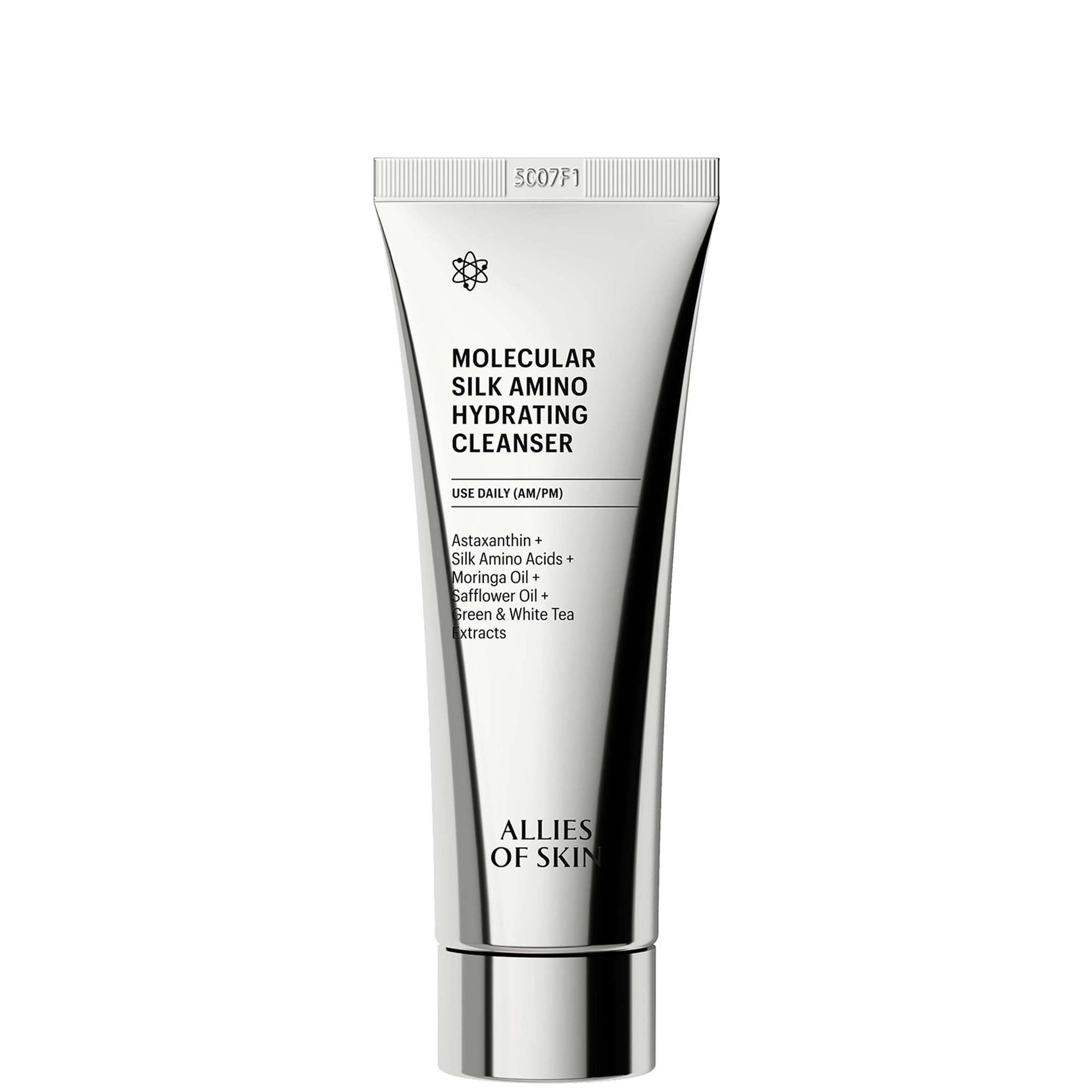
Molecular Silk Amino Hydrating Cleanser
face cleanser
Allies of Skin
face cleanser
Added Last edited
Fit by skin type
General, ingredient-based — not your personalized match.

See how this fits your skin
Take the skin test and I'll show you how suitable this product is for you.
Take the skin testAllies of Skin's sought-after cleanser has just had a revitalising revamp and believe it or not, it's even better than before! Enriched with a hydrating blend of antioxidants, phospholipids and hydrators like hyaluronic acid, organic safflower + moringa oil, the Molecular Silk Amino Hydrating Cleanser deftly removes dirt, grime and make up without stripping skin. Now four times richer in Silk Amino Acids this cult-favourite cleanser just got a serious skin-loving upgrade. The improvements don't stop there though... This brightening cleanser now contains a more stable form of vitamin C - ethylated L-ascorbic acid - thereby boosting collagen production and fading imperfections. Transforming from a thick gel into a soft gentle foam this is the cleansing hero that just keeps on giving...
Molecular Silk Amino Hydrating Cleanser is a lightweight cleanser from Allies of Skin. The formula is built mainly around hydration. The ingredient list runs to 34 ingredients, each broken down in full below.
By its ingredient list the formula reads as light: water and humectants lead, with emollients kept lower in the order. Hydration is handled by Glycerin, Propanediol and Cocodimonium Hydroxypropyl Silk Amino Acids, humectants that pull water into the upper layers of skin rather than sealing it there.
Hydration: High. Ingredients that pull and hold water in the upper layers of skin, and here that comes from Glycerin, Propanediol, Cocodimonium Hydroxypropyl Silk Amino Acids and Sodium Hyaluronate.
On richness alone it suits Balanced, Combination (oily) and Oily skin best, and is the least natural fit for Dry and Combination (dry) skin. Nothing in the list is flagged as a common irritant, which is a reasonable starting point for reactive skin — though a patch test is still the only way to know.
The formula contributes little or nothing on barrier support, oil control and firmness signalling. That is not a fault — most products are not meant to do everything — but if one of those is your priority, this is not the product that will address it.
Reading the full list, the formula is fragrance-free, essential-oil-free, no drying alcohol, paraben-free, silicone-free and microplastic-free. Those claims come from the ingredient list itself, not from the packaging.
It can be used morning and evening. In a routine it goes first step. Use on damp skin and rinse thoroughly. Follow with a toner or essence while skin is still slightly damp.
This summary is generated from the product's ingredient list. It is not a review, it is not the brand's own marketing claims, and it does not replace advice from a dermatologist.
Drawn purely from the ingredient list
Scored on how rich or light the formula reads from its INCI order.
No ingredient in this formula carries a common-irritant flag, making it a reasonable option for reactive skin. A patch test is still recommended, as individual skin reactivity varies.
Based on the curated benefits documented for this product's ingredients.
Attracts and locks in moisture to keep skin plump and dewy
Boosts collagen and cell turnover to reduce fine lines and wrinkles
Calms redness, irritation, and inflammation for sensitive skin
Brightens and balances complexion for a more uniform appearance
Fades hyperpigmentation and evens out dark spots over time
None of the ingredients in this formula are associated with these benefits. This is not unusual, as most products are designed to target a limited number of concerns.
The actives, UV filters and benefit-carrying ingredients in this formula, in the order they are listed.
4th on the list, which puts it at an estimated 2–10% of the formula.
Glycerine ;Glycerol (INN); Glycerol (RIFM); Glycerolum (EP); Glycyl Alcohol; 1,2,3-Propanetriol; 1,2,3-Trihydroxypropane
8th on the list, which puts it at an estimated 1–5% of the formula.
1,3-dihydroxypropane
9th on the list, which puts it at an estimated 1–5% of the formula.
Helianthus Annuus Seed Oil is the oil expressed from the seeds of the Sunflower, Helianthus annuus L., Compositae
11th on the list, which puts it at an estimated 1–3% of the formula.
Propanoic acid, 2-hydroxy-
12th on the list, which puts it at an estimated 1–3% of the formula.
Hydrolyzed Jojoba Esters is the hydrolysate of Jojoba Esters derived by acid, enzyme or other method of hydrolysis
13th on the list, which puts it at an estimated 1–3% of the formula.
Moringa Oleifera Seed Oil is the oil expressed from the seeds of Moringa oleifera, Moringaceae
14th on the list, which puts it at an estimated 1–3% of the formula.
3-O-Ethyl Ascorbic Acid is the organic compound.
16th on the list, which puts it at an estimated 1–3% of the formula.
Protein hydrolyzates, silk
17th on the list, which puts it at an estimated 1–3% of the formula.
Camellia Sinensis Leaf Extract is an extract of the leaves of the Tea, Camellia sinensis, Theaceae
18th on the list, which puts it at an estimated 1–3% of the formula.
Hyaluronic acid, sodium, salt
19th on the list, which puts it at an estimated 1–3% of the formula.
Lecithins. The complex combination of diglycerides of fatty acids linked to the choline ester of phosphoric acid
20th on the list, which puts it at an estimated 1–3% of the formula.
3,3'-Dihydroxy-beta,beta-carotene-4,4'-dione
Each axis is scored from the ingredients present and how high up the list they sit.
Ingredients that pull and hold water in the upper layers of skin
Lipids and repair signals that support skin barrier integrity
Ingredients that mop up free radicals from UV and pollution
Ingredients that moderate sebum or absorb shine
Ingredients that act on uneven tone and post-inflammatory marks
Ingredients aimed at visible redness and reactivity
Retinoids, acids and enzymes that speed surface turnover
Peptides and growth factors that signal for collagen support
"Active" here means an ingredient carrying a recorded active type or a recognised UV filter.
Solvents, emollients, texture agents and preservatives — the formula that carries the actives.
Read from the full ingredient list. A brand's own claim may differ.
Carthamus Tinctorius Seed Oil, Helianthus Annuus Seed Oil, Moringa Oleifera Seed Oil
Hydrolyzed Silk
Judged by the same curated rules our routine checker uses. It reads the ingredients, not the label.
Best kept to separate routines — one in the morning, one at night, or on alternate days.
Can be layered, but the combination raises the irritation risk. Go slowly.
Can be layered, but the combination raises the irritation risk. Go slowly.
Can be layered, but the combination raises the irritation risk. Go slowly.
Can be layered, but the combination raises the irritation risk. Go slowly.
Can be layered, but the combination raises the irritation risk. Go slowly.
This product is the "Cleanse" step.
Flags to check, not verdicts. None of this is medical advice — if you are pregnant, breastfeeding or treating a skin condition, ask a doctor.
Most ingredients do more than one job, so these counts add up to more than the 34 ingredients on the label.
Lifts oil and dirt, or holds oil and water together
Sets the thickness, spread and stability of the formula
Draws water into the upper layers of skin
Keeps the product free of microbial growth
Changes how skin behaves rather than how it feels
Softens and smooths by filling gaps between skin cells
Forms a film that slows water loss
Sets the acidity the formula needs to work
Binds trace metals that would otherwise spoil the formula
Dissolves and carries everything else
Botanical material, usually for antioxidants or scent
Neutralises free radicals from UV and pollution
Absorbs or scatters ultraviolet light
Every ingredient on the label, in order, with what it does and roughly how much of it is likely to be there.
1st on the list, which puts it at an estimated 30–80% of the formula.
Water
2nd on the list, which puts it at an estimated 5–20% of the formula.
Polyacrylate-1 Crosspolymer is a copolymer of one or more simple esters of acrylic or methacrylic acid, C1-4 dialkylamino C1-6 alkyl methacrylate, PEG/PPG-30/5 allyl ether, PEG 20-25 C10-30 alkyl ether methacrylate, hydroxy C2-6 alkyl methacrylate crosslinked with ethylene glycol dimethacrylate
3rd on the list, which puts it at an estimated 5–20% of the formula.
Sulfonic acids, C14-16-alkane hydroxy and C14-16-alkene, sodium salts
4th on the list, which puts it at an estimated 2–10% of the formula.
Glycerine ;Glycerol (INN); Glycerol (RIFM); Glycerolum (EP); Glycyl Alcohol; 1,2,3-Propanetriol; 1,2,3-Trihydroxypropane
5th on the list, which puts it at an estimated 2–10% of the formula.
1-Propanaminium, N-(3-aminopropyl)-2-hydroxy-N,N-dimethyl-3-sulfo-, N-coco acyl derivs., hydroxides, inner salts
6th on the list, which puts it at an estimated 2–10% of the formula.
Glycine, N-(2-aminoethyl)-N-(2-hydroxyethyl)-, N-coco-acyl derivatives, monosodium salts
7th on the list, which puts it at an estimated 1–5% of the formula.
Carthamus Tinctorius Seed Oil is the oily liquid obtained from the seeds of Safflower, Carthamus tinctorius L., Compositae. It consists principally of the triglycerides of linoleic acid
8th on the list, which puts it at an estimated 1–5% of the formula.
1,3-dihydroxypropane
9th on the list, which puts it at an estimated 1–5% of the formula.
Helianthus Annuus Seed Oil is the oil expressed from the seeds of the Sunflower, Helianthus annuus L., Compositae
10th on the list, which puts it at an estimated 1–5% of the formula.
Leuconostoc/Radish Root Ferment Filtrate is a filtrate of the product obtained by the fermentation of Raphanus sativus roots by the microorganism, Leuconostoc
11th on the list, which puts it at an estimated 1–3% of the formula.
Propanoic acid, 2-hydroxy-
12th on the list, which puts it at an estimated 1–3% of the formula.
Hydrolyzed Jojoba Esters is the hydrolysate of Jojoba Esters derived by acid, enzyme or other method of hydrolysis
13th on the list, which puts it at an estimated 1–3% of the formula.
Moringa Oleifera Seed Oil is the oil expressed from the seeds of Moringa oleifera, Moringaceae
14th on the list, which puts it at an estimated 1–3% of the formula.
3-O-Ethyl Ascorbic Acid is the organic compound.
15th on the list, which puts it at an estimated 1–3% of the formula.
2-Hydroxy-1-propanaminium, N,N-dimethyl-N-(coco-alkyl)-, 3-silk-amino-acids, chlorides
16th on the list, which puts it at an estimated 1–3% of the formula.
Protein hydrolyzates, silk
17th on the list, which puts it at an estimated 1–3% of the formula.
Camellia Sinensis Leaf Extract is an extract of the leaves of the Tea, Camellia sinensis, Theaceae
18th on the list, which puts it at an estimated 1–3% of the formula.
Hyaluronic acid, sodium, salt
19th on the list, which puts it at an estimated 1–3% of the formula.
Lecithins. The complex combination of diglycerides of fatty acids linked to the choline ester of phosphoric acid
20th on the list, which puts it at an estimated 1–3% of the formula.
3,3'-Dihydroxy-beta,beta-carotene-4,4'-dione
21st on the list, below the 1% line — present at under 1%, which for most ingredients is the level they work at.
Xanthan gum
22nd on the list, below the 1% line — present at under 1%, which for most ingredients is the level they work at.
2-Hydroxy-1,2,3-propanetricarboxylic acid
23rd on the list, below the 1% line — present at under 1%, which for most ingredients is the level they work at.
D-Glucose homopolymer, dodecyl ether
24th on the list, below the 1% line — present at under 1%, which for most ingredients is the level they work at.
L-Glutamic acid, N-coco acyl derivs., monosodium salts
25th on the list, below the 1% line — present at under 1%, which for most ingredients is the level they work at.
Sodium carboxymethyl ether of Lauryl Glucoside
26th on the list, below the 1% line — present at under 1%, which for most ingredients is the level they work at.
4-Isopropyl-m-cresol
27th on the list, below the 1% line — present at under 1%, which for most ingredients is the level they work at.
Sorbitan, monododecanoate, poly(oxy-1,2-ethanediyl) derivs.
28th on the list, below the 1% line — present at under 1%, which for most ingredients is the level they work at.
Tetrasodium ethylenediaminetetraacetate
29th on the list, below the 1% line — present at under 1%, which for most ingredients is the level they work at.
Disodium dihydrogen ethylenediaminetetraacetate
30th on the list, below the 1% line — present at under 1%, which for most ingredients is the level they work at.
1,2-Propanediol, 3-(2-ethylhexyloxy)
31st on the list, below the 1% line — present at under 1%, which for most ingredients is the level they work at.
Glycolic acid, monosodium salt
32nd on the list, below the 1% line — present at under 1%, which for most ingredients is the level they work at.
Sodium hydroxide
33rd on the list, below the 1% line — present at under 1%, which for most ingredients is the level they work at.
Sodium benzoate
34th on the list, below the 1% line — present at under 1%, which for most ingredients is the level they work at.
2-Phenoxyethanol
Products in the same category that share this formula's distinguishing ingredients.
Arencia
Shares 5 key ingredients with Molecular Silk Amino Hydrating Cleanser: Glycerin, Propanediol, Helianthus Annuus Seed Oil, Sodium Hyaluronate, Camellia Sinensis Leaf Extract
Missha
Shares 4 key ingredients with Molecular Silk Amino Hydrating Cleanser: Glycerin, Propanediol, Citric Acid, Sodium Hyaluronate
Hyeja Skincare
Shares 4 key ingredients with Molecular Silk Amino Hydrating Cleanser: Helianthus Annuus Seed Oil, Glycerin, Propanediol, Sodium Hyaluronate
SKIN1004
Shares 4 key ingredients with Molecular Silk Amino Hydrating Cleanser: Propanediol, Glycerin, Citric Acid, Moringa Oleifera Seed Oil
Round Lab
Shares 3 key ingredients with Molecular Silk Amino Hydrating Cleanser: Glycerin, Citric Acid, Sodium Hyaluronate
Pyunkang Yul
Shares 3 key ingredients with Molecular Silk Amino Hydrating Cleanser: Glycerin, Camellia Sinensis Leaf Extract, Citric Acid
AQUA, POLYACRYLATE-1 CROSSPOLYMER, SODIUM C14-16 OLEFIN SULFONATE, GLYCERIN, COCAMIDOPROPYL HYDROXYSULTAINE, SODIUM COCOAMPHOACETATE, CARTHAMUS TINCTORIUS SEED OIL, PROPANEDIOL, HELIANTHUS ANNUUS SEED OIL, LEUCONOSTOC/RADISH ROOT FERMENT FILTRATE, LACTIC ACID, HYDROLYZED JOJOBA ESTERS, MORINGA OLEIFERA SEED OIL, 3-O-ETHYL ASCORBIC ACID, COCODIMONIUM HYDROXYPROPYL SILK AMINO ACIDS, HYDROLYZED SILK, CAMELLIA SINENSIS LEAF EXTRACT, SODIUM HYALURONATE, LECITHIN, ASTAXANTHIN, XANTHAN GUM, CITRIC ACID, LAURYL GLUCOSIDE, SODIUM COCOYL GLUTAMATE, SODIUM LAURYL GLUCOSE CARBOXYLATE, O-CYMEN-5-OL, POLYSORBATE 20, TETRASODIUM EDTA, DISODIUM EDTA, ETHYLHEXYLGLYCERIN, SODIUM GLYCOLATE, SODIUM HYDROXIDE, SODIUM BENZOATE, PHENOXYETHANOL.
LACTIC ACID, 3-O-ETHYL ASCORBIC ACID, SODIUM HYALURONATE, CITRIC ACID.
Can be used daily AM/PM as a first and/or second cleanse. To remove makeup and sunscreen, massage a dime-sized amount first onto dry skin, then add water and massage again to dissolve daily grime, pollution, sunscreen, and makeup. Rinse and repeat if necessary. For daily cleansing, massage a dime-sized amount onto damp skin, leave on for 1 or 2 minutes for extra silkiness and rinse.
Judged on how rich the formula reads from its ingredient list, it suits Balanced, Combination (oily), Oily skin best. It is the least natural fit for Dry, Combination (dry) skin.
No ingredient in this formula carries a common-irritant flag, making it a reasonable option for reactive skin. A patch test is still recommended, as individual skin reactivity varies.
4 ingredients could feed malassezia: Carthamus Tinctorius Seed Oil, Helianthus Annuus Seed Oil, Moringa Oleifera Seed Oil, Polysorbate 20. That describes the yeast's food supply, not a prediction that they will cause a breakout.
Nothing in this formula is on the standard pregnancy-caution list. That is not medical clearance — check anything you use daily with your doctor or midwife.
Yes. Reading the full ingredient list, this formula is fragrance-free.
No. Reading the full ingredient list, this formula is no drying alcohol.
Yes. Reading the full ingredient list, this formula is silicone-free.
No. Reading the full ingredient list, this formula is essential-oil-free.
Yes. Reading the full ingredient list, this formula is paraben-free.
It layers well with Azelaic acid, Copper peptides, Bakuchiol, Niacinamide, Hyaluronic acid, Ceramides. Take more care combining it with Retinoids (retinol, retinal), Vitamin C (L-ascorbic acid), AHAs (glycolic, lactic), BHA (salicylic acid), PHAs (gluconolactone), Benzoyl peroxide — use them in separate routines or on alternate days.
Use it morning and evening, first step.
It lists 34 ingredients, of which 4 are recorded as actives.
Allies of Skin.
We can't find the internet
Attempting to reconnect
Something went wrong!
Attempting to reconnect