1st on the list, which puts it at an estimated 30–80% of the formula.
Aqua (EU),Deionized Water,Distilled Water,Micromatrix Fractile AN,Onsen-Sui (JPN),Purified Water
Hydration
Ameliorate
Transforming Body Lotion
body lotion
Ameliorate
body lotion
Added Last edited
Fit by skin type
General, ingredient-based — not your personalized match.

See how this fits your skin
Take the skin test and I'll show you how suitable this product is for you.
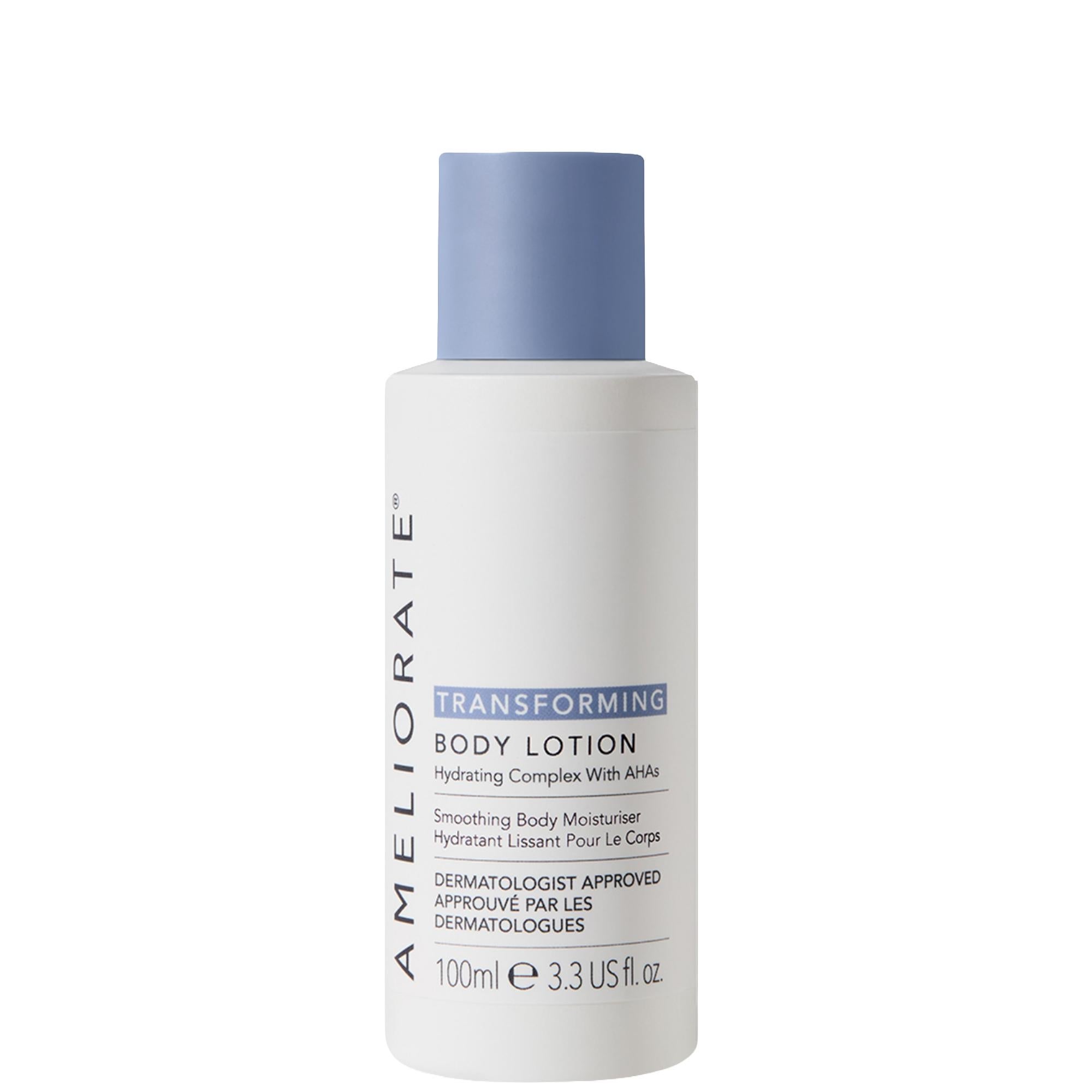
Take the skin testNourish dry skin with Ameliorate’s Transforming Body Lotion (100ml). Developed to improve the appearance of dry and bumpy skin, it gently decongests clogged pores with AHAs to promote a smoother surface. Infused with sweet almond oil and a skin hydration complex, it provides an intense moisture-binding boost, while its silky texture glides effortlessly across your body to replenish.
Transforming Body Lotion is a lightweight lotion from Ameliorate. The formula is built mainly around hydration. The ingredient list runs to 38 ingredients, each broken down in full below.
By its ingredient list the formula reads as light: water and humectants lead, with emollients kept lower in the order. It contains both silicones and oils, a combination that usually finishes smooth and slightly satin and sits well under makeup. Hydration is handled by Glycerin, Urea and Water, humectants that pull water into the upper layers of skin rather than sealing it there.
Hydration: High. Ingredients that pull and hold water in the upper layers of skin, and here that comes from Glycerin, Urea, Water and C12-15 Alkyl Benzoate.
Soothing: Moderate. Ingredients aimed at visible redness and reactivity, and here that comes from C12-15 Alkyl Benzoate, Sodium Benzoate, Allantoin and Tocopheryl Acetate.
On richness alone it suits Balanced skin best, and is the least natural fit for Dry and Combination (dry) skin. Several ingredients carry irritation flags. If your skin is reactive, this is one to patch test carefully or approach slowly.
The formula contributes little or nothing on barrier support, antioxidant protection, oil control and firmness signalling. That is not a fault — most products are not meant to do everything — but if one of those is your priority, this is not the product that will address it.
Reading the full list, the formula is no drying alcohol, paraben-free, microplastic-free, sulfate-free, dye-free and no animal-derived ingredients. Those claims come from the ingredient list itself, not from the packaging. It does contain fragrance and essential oils, worth knowing if your skin reacts to any of them.
It can be used morning and evening. In a routine it goes after serums. Seal in your serums with it; in the morning, sunscreen still goes on top.
This summary is generated from the product's ingredient list. It is not a review, it is not the brand's own marketing claims, and it does not replace advice from a dermatologist.
Drawn purely from the ingredient list
Scored on how rich or light the formula reads from its INCI order.
Several ingredients here carry irritation flags. If your skin is reactive or you have rosacea, introduce this slowly, or ask a dermatologist first.
Based on the curated benefits documented for this product's ingredients.
Attracts and locks in moisture to keep skin plump and dewy
Boosts collagen and cell turnover to reduce fine lines and wrinkles
Brightens and balances complexion for a more uniform appearance
Calms redness, irritation, and inflammation for sensitive skin
Refines texture by gently exfoliating rough, uneven patches
None of the ingredients in this formula are associated with these benefits. This is not unusual, as most products are designed to target a limited number of concerns.
The actives, UV filters and benefit-carrying ingredients in this formula, in the order they are listed.
1st on the list, which puts it at an estimated 30–80% of the formula.
Aqua (EU),Deionized Water,Distilled Water,Micromatrix Fractile AN,Onsen-Sui (JPN),Purified Water
3rd on the list, which puts it at an estimated 5–20% of the formula.
Benzoic acid, C12-15 alkyl esters
4th on the list, which puts it at an estimated 2–10% of the formula.
Glycerine ;Glycerol (INN); Glycerol (RIFM); Glycerolum (EP); Glycyl Alcohol; 1,2,3-Propanetriol; 1,2,3-Trihydroxypropane
6th on the list, which puts it at an estimated 2–10% of the formula.
Hexadecanoic acid, 2-ethylhexyl ester; Octyl palmitate
7th on the list, which puts it at an estimated 1–5% of the formula.
Alcohols, C16-18
9th on the list, below the 1% line — present at under 1%, which for most ingredients is the level they work at.
Stearic acid, monoester with glycerol
11th on the list, below the 1% line — present at under 1%, which for most ingredients is the level they work at.
Dimethicone
17th on the list, below the 1% line — present at under 1%, which for most ingredients is the level they work at.
Sodium hydrogen N-(1-oxooctadecyl)-L-glutamate
18th on the list, below the 1% line — present at under 1%, which for most ingredients is the level they work at.
3,4-Dihydro-2,5,7,8-tetramethyl-2-(4,8,12-trimethyltridecyl)-2H-benzopyran-6-yl acetate
20th on the list, below the 1% line — present at under 1%, which for most ingredients is the level they work at.
1,2-Dihydroxypentane
23rd on the list, below the 1% line — present at under 1%, which for most ingredients is the level they work at.
Propanoic acid, 2-hydroxy-
24th on the list, below the 1% line — present at under 1%, which for most ingredients is the level they work at.
2-Amino-3-hydroxypropanoic acid
Each axis is scored from the ingredients present and how high up the list they sit.
Ingredients that pull and hold water in the upper layers of skin
Lipids and repair signals that support skin barrier integrity
Ingredients that mop up free radicals from UV and pollution
Ingredients that moderate sebum or absorb shine
Ingredients that act on uneven tone and post-inflammatory marks
Ingredients aimed at visible redness and reactivity
Retinoids, acids and enzymes that speed surface turnover
Peptides and growth factors that signal for collagen support
"Active" here means an ingredient carrying a recorded active type or a recognised UV filter.
Solvents, emollients, texture agents and preservatives — the formula that carries the actives.
Read from the full ingredient list. A brand's own claim may differ.
Parfum, Benzyl Salicylate, Limonene, Hexyl Cinnamal, Geraniol
Benzyl Salicylate, Limonene, Hexyl Cinnamal, Geraniol, Citral
Dimethicone
Moringa Oleifera Seed Oil
Judged by the same curated rules our routine checker uses. It reads the ingredients, not the label.
Best kept to separate routines — one in the morning, one at night, or on alternate days.
Can be layered, but the combination raises the irritation risk. Go slowly.
Can be layered, but the combination raises the irritation risk. Go slowly.
Can be layered, but the combination raises the irritation risk. Go slowly.
Can be layered, but the combination raises the irritation risk. Go slowly.
Can be layered, but the combination raises the irritation risk. Go slowly.
This product is the "Moisturise" step.
Flags to check, not verdicts. None of this is medical advice — if you are pregnant, breastfeeding or treating a skin condition, ask a doctor.
Most ingredients do more than one job, so these counts add up to more than the 38 ingredients on the label.
Lifts oil and dirt, or holds oil and water together
Changes how the product smells or looks
Draws water into the upper layers of skin
Softens and smooths by filling gaps between skin cells
Sets the acidity the formula needs to work
Sets the thickness, spread and stability of the formula
Forms a film that slows water loss
Keeps the product free of microbial growth
Dissolves and carries everything else
Loosens or dissolves dead surface cells
Changes how skin behaves rather than how it feels
Neutralises free radicals from UV and pollution
Calms visible redness and irritation
Binds trace metals that would otherwise spoil the formula
Absorbs or scatters ultraviolet light
Every ingredient on the label, in order, with what it does and roughly how much of it is likely to be there.
1st on the list, which puts it at an estimated 30–80% of the formula.
Aqua (EU),Deionized Water,Distilled Water,Micromatrix Fractile AN,Onsen-Sui (JPN),Purified Water
2nd on the list, which puts it at an estimated 5–20% of the formula.
Propanoic acid, 2-hydroxy-, ammonium salt
3rd on the list, which puts it at an estimated 5–20% of the formula.
Benzoic acid, C12-15 alkyl esters
4th on the list, which puts it at an estimated 2–10% of the formula.
Glycerine ;Glycerol (INN); Glycerol (RIFM); Glycerolum (EP); Glycyl Alcohol; 1,2,3-Propanetriol; 1,2,3-Trihydroxypropane
5th on the list, which puts it at an estimated 2–10% of the formula.
Prunus Amygdalus Dulcis Oil is the fixed oil obtained from the ripe seed kernel of the Sweet Almond Tree, Prunus amygdalus var. dulcis, Rosaceae
6th on the list, which puts it at an estimated 2–10% of the formula.
Hexadecanoic acid, 2-ethylhexyl ester; Octyl palmitate
7th on the list, which puts it at an estimated 1–5% of the formula.
Alcohols, C16-18
8th on the list, below the 1% line — present at under 1%, which for most ingredients is the level they work at.
Parfum is a term for ingredient labelling used to identify that a product contains a material or a combination of materials normally added to a cosmetic to produce or to mask a particular odour. According to Article 19 of the Cosmetics Regulation, 'Perfume and aromatic compositions and their raw materials shall be referred to by the terms ‘parfum’ or ‘aroma’. '
9th on the list, below the 1% line — present at under 1%, which for most ingredients is the level they work at.
Stearic acid, monoester with glycerol
10th on the list, below the 1% line — present at under 1%, which for most ingredients is the level they work at.
Poly(oxy-1,2-ethanediyl), .alpha.-(1-oxooctadecyl)-.omega.-hydroxy- (100 mol EO average molar ratio)
11th on the list, below the 1% line — present at under 1%, which for most ingredients is the level they work at.
Dimethicone
12th on the list, below the 1% line — present at under 1%, which for most ingredients is the level they work at.
2-Phenoxyethanol
13th on the list, below the 1% line — present at under 1%, which for most ingredients is the level they work at.
Cellulose, 2-hydroxyethyl ether
14th on the list, below the 1% line — present at under 1%, which for most ingredients is the level they work at.
D-Glucopyranose, C16-18 alkyl glycosides
15th on the list, below the 1% line — present at under 1%, which for most ingredients is the level they work at.
Xanthan gum
16th on the list, below the 1% line — present at under 1%, which for most ingredients is the level they work at.
Sodium benzoate
17th on the list, below the 1% line — present at under 1%, which for most ingredients is the level they work at.
Sodium hydrogen N-(1-oxooctadecyl)-L-glutamate
18th on the list, below the 1% line — present at under 1%, which for most ingredients is the level they work at.
3,4-Dihydro-2,5,7,8-tetramethyl-2-(4,8,12-trimethyltridecyl)-2H-benzopyran-6-yl acetate
19th on the list, below the 1% line — present at under 1%, which for most ingredients is the level they work at.
Potassium (E,E)-hexa-2,4-dienoate
20th on the list, below the 1% line — present at under 1%, which for most ingredients is the level they work at.
1,2-Dihydroxypentane
21st on the list, below the 1% line — present at under 1%, which for most ingredients is the level they work at.
Disodium dihydrogen ethylenediaminetetraacetate
22nd on the list, below the 1% line — present at under 1%, which for most ingredients is the level they work at.
Protein hydrolyzates, milk. Substance obtained by acidic, alkaline, or enzymatic hydrolysis of milk composed primarily of amino acids, peptides, and proteins. It may contain impurities consisting chiefly of carbohydrates and lipids along with smaller quantities of miscellaneous organic substances of biological origin.
23rd on the list, below the 1% line — present at under 1%, which for most ingredients is the level they work at.
Propanoic acid, 2-hydroxy-
24th on the list, below the 1% line — present at under 1%, which for most ingredients is the level they work at.
2-Amino-3-hydroxypropanoic acid
25th on the list, below the 1% line — present at under 1%, which for most ingredients is the level they work at.
Sodium lactate
26th on the list, below the 1% line — present at under 1%, which for most ingredients is the level they work at.
D-Glucitol
27th on the list, below the 1% line — present at under 1%, which for most ingredients is the level they work at.
Urea
28th on the list, below the 1% line — present at under 1%, which for most ingredients is the level they work at.
Benzyl salicylate
29th on the list, below the 1% line — present at under 1%, which for most ingredients is the level they work at.
1-Methyl-4-Isopropenylcyclohexene; dipentene
30th on the list, below the 1% line — present at under 1%, which for most ingredients is the level they work at.
2-Phenylmethyleneoctanal; alpha-Hexylcinnamaldehyde; 2-Benzylideneoctanal; alpha-n-hexyl-beta-phenylacrolein
31st on the list, below the 1% line — present at under 1%, which for most ingredients is the level they work at.
Sodium chloride
32nd on the list, below the 1% line — present at under 1%, which for most ingredients is the level they work at.
2,6-Octadien-1-ol, 3,7-dimethyl-, (2E)-
33rd on the list, below the 1% line — present at under 1%, which for most ingredients is the level they work at.
Disodium hydrogenorthophosphate
34th on the list, below the 1% line — present at under 1%, which for most ingredients is the level they work at.
Sodium dihydrogenorthophosphate
35th on the list, below the 1% line — present at under 1%, which for most ingredients is the level they work at.
Sorbitan, monooctadecanoate, poly(oxy-1,2-ethanediyl) derivs.
36th on the list, below the 1% line — present at under 1%, which for most ingredients is the level they work at.
2,6-Octadienal, 3,7-dimethyl-; 3,7-Dimethyl-2,6-octadienal
37th on the list, below the 1% line — present at under 1%, which for most ingredients is the level they work at.
Urea, (2,5-dioxo-4-imidazolidinyl)-
38th on the list, below the 1% line — present at under 1%, which for most ingredients is the level they work at.
Moringa Oleifera Seed Oil is the oil expressed from the seeds of Moringa oleifera, Moringaceae
Products in the same category that share this formula's distinguishing ingredients.
Ameliorate
Shares 12 key ingredients with Transforming Body Lotion: Water, C12-15 Alkyl Benzoate, Glycerin, Ethylhexyl Palmitate, Cetearyl Alcohol
Ameliorate
Shares 12 key ingredients with Transforming Body Lotion: Water, C12-15 Alkyl Benzoate, Glycerin, Ethylhexyl Palmitate, Cetearyl Alcohol
Ameliorate
Shares 12 key ingredients with Transforming Body Lotion: Water, C12-15 Alkyl Benzoate, Glycerin, Ethylhexyl Palmitate, Cetearyl Alcohol
La Roche-Posay
Shares 6 key ingredients with Transforming Body Lotion: Water, C12-15 Alkyl Benzoate, Glycerin, Dimethicone, Glyceryl Stearate
Elizabeth Arden
Shares 6 key ingredients with Transforming Body Lotion: Water, Glycerin, Dimethicone, Glyceryl Stearate, Cetearyl Alcohol
LA MER
Shares 6 key ingredients with Transforming Body Lotion: Water, Glycerin, Dimethicone, Cetearyl Alcohol, Glyceryl Stearate
WATER, AMMONIUM LACTATE, C12-15 ALKYL BENZOATE, GLYCERIN, PRUNUS AMYGDALUS DULCIS OIL, ETHYLHEXYL PALMITATE, CETEARYL ALCOHOL, PARFUM, GLYCERYL STEARATE, PEG-100 STEARATE, DIMETHICONE, PHENOXYETHANOL, HYDROXYETHYLCELLULOSE, CETEARYL GLUCOSIDE, XANTHAN GUM, SODIUM BENZOATE, SODIUM STEAROYL GLUTAMATE, TOCOPHERYL ACETATE, POTASSIUM SORBATE, PENTYLENE GLYCOL, DISODIUM EDTA, HYDROLYZED MILK PROTEIN, LACTIC ACID, SERINE, SODIUM LACTATE, SORBITOL, UREA, BENZYL SALICYLATE, LIMONENE, HEXYL CINNAMAL, SODIUM CHLORIDE, GERANIOL, DISODIUM PHOSPHATE, SODIUM PHOSPHATE, POLYSORBATE 60, CITRAL, ALLANTOIN, MORINGA OLEIFERA SEED OIL.
LACTIC ACID.
Apply twice daily to clean skin.
Judged on how rich the formula reads from its ingredient list, it suits Balanced skin best. It is the least natural fit for Dry, Combination (dry) skin.
Some ingredients here carry irritation flags, so sensitive skin should patch test on the jawline for a few days before applying it to the whole face.
5 ingredients could feed malassezia: Ethylhexyl Palmitate, Glyceryl Stearate, Peg-100 Stearate, Polysorbate 60, Moringa Oleifera Seed Oil. That describes the yeast's food supply, not a prediction that they will cause a breakout.
Nothing in this formula is on the standard pregnancy-caution list. That is not medical clearance — check anything you use daily with your doctor or midwife.
No — it contains Parfum, Benzyl Salicylate, Limonene, Hexyl Cinnamal, Geraniol.
No. Reading the full ingredient list, this formula is no drying alcohol.
No — it contains Dimethicone.
Yes — it contains Benzyl Salicylate, Limonene, Hexyl Cinnamal, Geraniol, Citral.
Yes. Reading the full ingredient list, this formula is paraben-free.
It layers well with Azelaic acid, Copper peptides, Bakuchiol, Niacinamide, Hyaluronic acid, Ceramides. Take more care combining it with Retinoids (retinol, retinal), Vitamin C (L-ascorbic acid), AHAs (glycolic, lactic), BHA (salicylic acid), PHAs (gluconolactone), Benzoyl peroxide — use them in separate routines or on alternate days.
Use it morning and evening, after serums.
It lists 38 ingredients, of which 1 are recorded as actives.
Ameliorate.
We can't find the internet
Attempting to reconnect
Something went wrong!
Attempting to reconnect