2nd on the list, which puts it at an estimated 5–20% of the formula.
Carbonic Acid, Dicaprylyl Ester
Hydration
Alpha-H
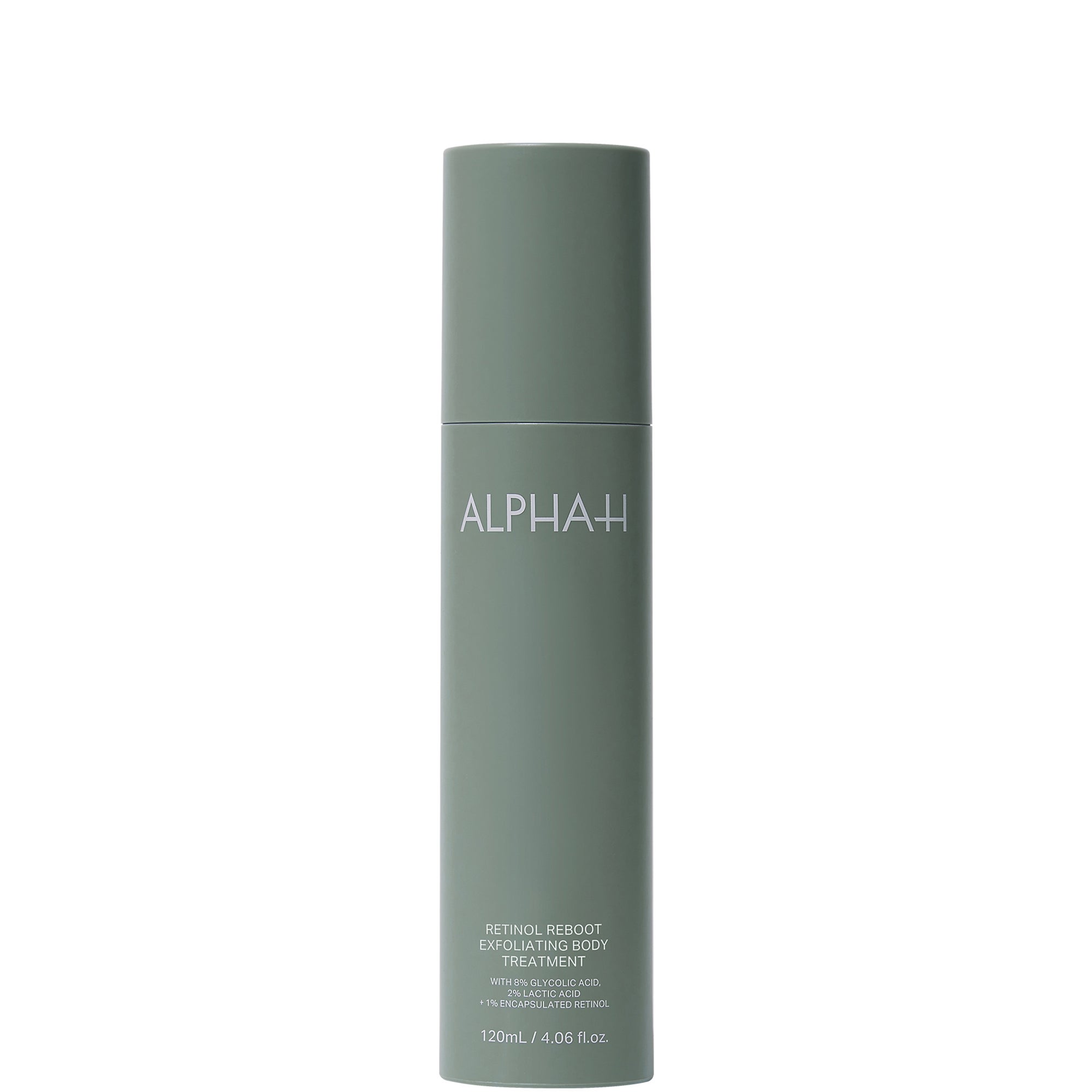
Retinol Reboot Exfoliating Body Treatment with 8% Glycolic Acid 2% Lactic Acid + 1% Encapsuladed Retinol
body neck exfoliator
Alpha-H
body neck exfoliator
Added Last edited
Fit by skin type
General, ingredient-based — not your personalized match.

See how this fits your skin
Take the skin test and I'll show you how suitable this product is for you.
Take the skin testUpgrade your top-to-toe skin care regime with Alpha-H's Retinol Reboot Exfoliating Body Treatment (120ml). Powered by retinol and glycolic acid, this formula works while you sleep to dissolve and resurface dead skin cells to unveil smoother, more even toned skin. What's more, thanks to the infusion of coenzyme Q 10, this hero reduces the appearance of fine lines, pigmentation and redness. And finally, to ensure your skin remains moisturised and hydrated after exfoliation, it also calls on a blend of plumping glycerin, nourishing watermelon seed oil and antioxidant-rich seabuckthorn oil, which all protect your delicate barrier too!
Retinol Reboot Exfoliating Body Treatment with 8% Glycolic Acid 2% Lactic Acid + 1% Encapsuladed Retinol is a cushioning exfoliator from Alpha-H, a brand based in Australia. The formula is built mainly around hydration. The ingredient list runs to 39 ingredients, each broken down in full below.
By its ingredient list the formula reads as moderately cushioned — emollient enough to feel like a cream, without the heaviest occlusives near the top. It contains both silicones and oils, a combination that usually finishes smooth and slightly satin and sits well under makeup. Hydration is handled by Glycerin, Propanediol and Dicaprylyl Carbonate, humectants that pull water into the upper layers of skin rather than sealing it there.
Hydration: High. Ingredients that pull and hold water in the upper layers of skin, and here that comes from Glycerin, Propanediol, Dicaprylyl Carbonate and Dimethicone.
Cell renewal: Moderate. Retinoids, acids and enzymes that speed surface turnover, and here that comes from Glycolic Acid, Lactic Acid and Retinol.
Brightening: Moderate. Ingredients that act on uneven tone and post-inflammatory marks, and here that comes from Glycolic Acid and Lactic Acid.
On richness alone it suits Balanced skin best, and is the least natural fit for Dry, Combination (dry), Combination (oily) and Oily skin. A few ingredients carry irritation flags, so reactive skin should patch test before using it on the whole face.
The formula contributes little or nothing on barrier support, antioxidant protection and firmness signalling. That is not a fault — most products are not meant to do everything — but if one of those is your priority, this is not the product that will address it.
Reading the full list, the formula is no drying alcohol, paraben-free, microplastic-free, sulfate-free, dye-free and no animal-derived ingredients. Those claims come from the ingredient list itself, not from the packaging. It does contain fragrance and essential oils, worth knowing if your skin reacts to any of them.
Use it in the evening. In a routine it goes after cleansing, before serums. Start at once or twice a week and build up only if skin stays comfortable. Wear sunscreen the next morning — fresh exfoliation raises UV sensitivity.
This summary is generated from the product's ingredient list. It is not a review, it is not the brand's own marketing claims, and it does not replace advice from a dermatologist.
Drawn purely from the ingredient list
Scored on how rich or light the formula reads from its INCI order.
A few ingredients here carry irritation flags. Reactive skin should patch test on the jawline for a few days before using it on the whole face.
Based on the curated benefits documented for this product's ingredients.
Attracts and locks in moisture to keep skin plump and dewy
Boosts collagen and cell turnover to reduce fine lines and wrinkles
Calms redness, irritation, and inflammation for sensitive skin
Brightens and balances complexion for a more uniform appearance
Targets breakouts by reducing bacteria and unclogging pores
Regulates sebum production to reduce shine and greasiness
Tightens and refines the look of enlarged pores
Refines texture by gently exfoliating rough, uneven patches
None of the ingredients in this formula are associated with these benefits. This is not unusual, as most products are designed to target a limited number of concerns.
The actives, UV filters and benefit-carrying ingredients in this formula, in the order they are listed.
2nd on the list, which puts it at an estimated 5–20% of the formula.
Carbonic Acid, Dicaprylyl Ester
3rd on the list, which puts it at an estimated 5–20% of the formula.
Acetic acid, hydroxy-
4th on the list, which puts it at an estimated 2–10% of the formula.
Dimethicone
5th on the list, which puts it at an estimated 2–10% of the formula.
Glycerine ;Glycerol (INN); Glycerol (RIFM); Glycerolum (EP); Glycyl Alcohol; 1,2,3-Propanetriol; 1,2,3-Trihydroxypropane
6th on the list, which puts it at an estimated 2–10% of the formula.
2-Octyldodecan-1-ol
7th on the list, which puts it at an estimated 1–5% of the formula.
Alcohols, C16-18
9th on the list, which puts it at an estimated 1–5% of the formula.
Oils, vegetable, hydrogenated
10th on the list, which puts it at an estimated 1–5% of the formula.
1,3-dihydroxypropane
11th on the list, which puts it at an estimated 1–3% of the formula.
Propanoic acid, 2-hydroxy-
17th on the list, below the 1% line — present at under 1%, which for most ingredients is the level they work at.
3,4-Dihydro-2,5,7,8-tetramethyl-2-(4,8,12-trimethyltridecyl)-2H-benzopyran-6-yl acetate
21st on the list, below the 1% line — present at under 1%, which for most ingredients is the level they work at.
Acacia Senegal Gum is the dried, gummy exudate of the acacia, Acacia senegal, Leguminosae
22nd on the list, below the 1% line — present at under 1%, which for most ingredients is the level they work at.
Lecithins. The complex combination of diglycerides of fatty acids linked to the choline ester of phosphoric acid
Each axis is scored from the ingredients present and how high up the list they sit.
Ingredients that pull and hold water in the upper layers of skin
Lipids and repair signals that support skin barrier integrity
Ingredients that mop up free radicals from UV and pollution
Ingredients that moderate sebum or absorb shine
Ingredients that act on uneven tone and post-inflammatory marks
Ingredients aimed at visible redness and reactivity
Retinoids, acids and enzymes that speed surface turnover
Peptides and growth factors that signal for collagen support
"Active" here means an ingredient carrying a recorded active type or a recognised UV filter.
Solvents, emollients, texture agents and preservatives — the formula that carries the actives.
Read from the full ingredient list. A brand's own claim may differ.
Parfum, Citronellol, Limonene, Linalool
Citronellol, Limonene, Linalool
Dimethicone
Citrullus Lanatus Seed Oil, Hippophae Rhamnoides Fruit Oil
Judged by the same curated rules our routine checker uses. It reads the ingredients, not the label.
Best kept to separate routines — one in the morning, one at night, or on alternate days.
Best kept to separate routines — one in the morning, one at night, or on alternate days.
Best kept to separate routines — one in the morning, one at night, or on alternate days.
Best kept to separate routines — one in the morning, one at night, or on alternate days.
Best kept to separate routines — one in the morning, one at night, or on alternate days.
Can be layered, but the combination raises the irritation risk. Go slowly.
Can be layered, but the combination raises the irritation risk. Go slowly.
This product is the "Exfoliate" step.
Flags to check, not verdicts. None of this is medical advice — if you are pregnant, breastfeeding or treating a skin condition, ask a doctor.
Most ingredients do more than one job, so these counts add up to more than the 39 ingredients on the label.
Softens and smooths by filling gaps between skin cells
Sets the thickness, spread and stability of the formula
Lifts oil and dirt, or holds oil and water together
Forms a film that slows water loss
Dissolves and carries everything else
Changes how the product smells or looks
Changes how skin behaves rather than how it feels
Neutralises free radicals from UV and pollution
Draws water into the upper layers of skin
Sets the acidity the formula needs to work
Loosens or dissolves dead surface cells
Keeps the product free of microbial growth
Every ingredient on the label, in order, with what it does and roughly how much of it is likely to be there.
1st on the list, which puts it at an estimated 30–80% of the formula.
Water
2nd on the list, which puts it at an estimated 5–20% of the formula.
Carbonic Acid, Dicaprylyl Ester
3rd on the list, which puts it at an estimated 5–20% of the formula.
Acetic acid, hydroxy-
4th on the list, which puts it at an estimated 2–10% of the formula.
Dimethicone
5th on the list, which puts it at an estimated 2–10% of the formula.
Glycerine ;Glycerol (INN); Glycerol (RIFM); Glycerolum (EP); Glycyl Alcohol; 1,2,3-Propanetriol; 1,2,3-Trihydroxypropane
6th on the list, which puts it at an estimated 2–10% of the formula.
2-Octyldodecan-1-ol
7th on the list, which puts it at an estimated 1–5% of the formula.
Alcohols, C16-18
8th on the list, which puts it at an estimated 1–5% of the formula.
Citrullus Lanatus Seed Oil is the fixed oil obtained from the seeds of the Watermelon, Citrullus lanatus, Cucurbitaceae. The Citrullus vulgaris seed oil name is associated with Citrullus lanatus Seed Oil as a technical synonym.
9th on the list, which puts it at an estimated 1–5% of the formula.
Oils, vegetable, hydrogenated
10th on the list, which puts it at an estimated 1–5% of the formula.
1,3-dihydroxypropane
11th on the list, which puts it at an estimated 1–3% of the formula.
Propanoic acid, 2-hydroxy-
12th on the list, below the 1% line — present at under 1%, which for most ingredients is the level they work at.
Potassium hydroxide
13th on the list, below the 1% line — present at under 1%, which for most ingredients is the level they work at.
Octyldodecyl Xyloside is the ether formed by the reaction of Xylose and Octyldodecanol
14th on the list, below the 1% line — present at under 1%, which for most ingredients is the level they work at.
12-Hydroxyoctadecanoic acid, homopolymer, diesters with .alpha.-hydro-.omega.-hydroxypoly(oxy-1,2-ethanediyl) (30 mol EO average molar ratio)
15th on the list, below the 1% line — present at under 1%, which for most ingredients is the level they work at.
2-Phenoxyethanol
16th on the list, below the 1% line — present at under 1%, which for most ingredients is the level they work at.
Xanthan gum
17th on the list, below the 1% line — present at under 1%, which for most ingredients is the level they work at.
3,4-Dihydro-2,5,7,8-tetramethyl-2-(4,8,12-trimethyltridecyl)-2H-benzopyran-6-yl acetate
18th on the list, below the 1% line — present at under 1%, which for most ingredients is the level they work at.
Hippophae Rhamnoides Fruit Oil is the oil expressed from the fruit of the Sea Buckthorn, Hippophae rhamnoides L., Elaeagnaceae
19th on the list, below the 1% line — present at under 1%, which for most ingredients is the level they work at.
Octane-1,2-diol
20th on the list, below the 1% line — present at under 1%, which for most ingredients is the level they work at.
Cellulose, acetates, butanoates
21st on the list, below the 1% line — present at under 1%, which for most ingredients is the level they work at.
Acacia Senegal Gum is the dried, gummy exudate of the acacia, Acacia senegal, Leguminosae
22nd on the list, below the 1% line — present at under 1%, which for most ingredients is the level they work at.
Lecithins. The complex combination of diglycerides of fatty acids linked to the choline ester of phosphoric acid
23rd on the list, below the 1% line — present at under 1%, which for most ingredients is the level they work at.
Scleroglucan
24th on the list, below the 1% line — present at under 1%, which for most ingredients is the level they work at.
Pullulan is a polysaccharide produced from starch by cultivating the yeast, Aureobasidium pullulans
25th on the list, below the 1% line — present at under 1%, which for most ingredients is the level they work at.
Parfum is a term for ingredient labelling used to identify that a product contains a material or a combination of materials normally added to a cosmetic to produce or to mask a particular odour. According to Article 19 of the Cosmetics Regulation, 'Perfume and aromatic compositions and their raw materials shall be referred to by the terms ‘parfum’ or ‘aroma’. '
26th on the list, below the 1% line — present at under 1%, which for most ingredients is the level they work at.
2,5-Cyclohexadiene-1,4-dione, 2-(3,7,11,15,19,23,27,31,35,39-decamethyl-2,6,10,14,18,22,26,30,34,38-tetracontadecaenyl)-5,6-dimethoxy-3-methyl-, (all-E)-
27th on the list, below the 1% line — present at under 1%, which for most ingredients is the level they work at.
Lecithins, egg yolk
28th on the list, below the 1% line — present at under 1%, which for most ingredients is the level they work at.
1,2-Dihydroxypentane
29th on the list, below the 1% line — present at under 1%, which for most ingredients is the level they work at.
Retinol; vitamin A
30th on the list, below the 1% line — present at under 1%, which for most ingredients is the level they work at.
1,2,3-Propanetriol, homopolymer, dodecanoates (1:1) (10 mol glycerol average molar ratio)
31st on the list, below the 1% line — present at under 1%, which for most ingredients is the level they work at.
Glycerol trioctanoate
32nd on the list, below the 1% line — present at under 1%, which for most ingredients is the level they work at.
Benzenepropanoic acid, 3,5-bis(1,1-dimethylethyl)-4-hydroxy-, 2,2-bis[[3-[3,5-bis(1,1-dimethylethyl)-4-hydroxyphenyl]-1-oxopropoxy] methyl]-1,3-propanediyl ester
33rd on the list, below the 1% line — present at under 1%, which for most ingredients is the level they work at.
Hexadecan-1-ol
34th on the list, below the 1% line — present at under 1%, which for most ingredients is the level they work at.
Amorphous silica, reaction products with trimethylsilane
35th on the list, below the 1% line — present at under 1%, which for most ingredients is the level they work at.
Silicon dioxide
36th on the list, below the 1% line — present at under 1%, which for most ingredients is the level they work at.
Magnesium distearate
37th on the list, below the 1% line — present at under 1%, which for most ingredients is the level they work at.
3,7-Dimethyl-6-octen-1-ol
38th on the list, below the 1% line — present at under 1%, which for most ingredients is the level they work at.
1-Methyl-4-Isopropenylcyclohexene; dipentene
39th on the list, below the 1% line — present at under 1%, which for most ingredients is the level they work at.
3,7-Dimethyl octa-1,6-diene-3-ol
Products in the same category that share this formula's distinguishing ingredients.
Alpha-H
Shares 5 key ingredients with Retinol Reboot Exfoliating Body Treatment with 8% Glycolic Acid 2% Lactic Acid + 1% Encapsuladed Retinol: Propanediol, Glycerin, Octyldodecanol, Acacia Senegal Gum, Lactic Acid
LA MER
Shares 5 key ingredients with Retinol Reboot Exfoliating Body Treatment with 8% Glycolic Acid 2% Lactic Acid + 1% Encapsuladed Retinol: Glycolic Acid, Propanediol, Glycerin, Lactic Acid, Lecithin
The Ordinary
Shares 4 key ingredients with Retinol Reboot Exfoliating Body Treatment with 8% Glycolic Acid 2% Lactic Acid + 1% Encapsuladed Retinol: Glycolic Acid, Propanediol, Lactic Acid, Glycerin
The Ordinary
Shares 4 key ingredients with Retinol Reboot Exfoliating Body Treatment with 8% Glycolic Acid 2% Lactic Acid + 1% Encapsuladed Retinol: Lactic Acid, Glycerin, Propanediol, Acacia Senegal Gum
Ameliorate
Shares 4 key ingredients with Retinol Reboot Exfoliating Body Treatment with 8% Glycolic Acid 2% Lactic Acid + 1% Encapsuladed Retinol: Glycerin, Cetearyl Alcohol, Dimethicone, Lactic Acid
BE THE SKIN
Shares 3 key ingredients with Retinol Reboot Exfoliating Body Treatment with 8% Glycolic Acid 2% Lactic Acid + 1% Encapsuladed Retinol: Glycerin, Glycolic Acid, Propanediol
AQUA, DICAPRYLYL CARBONATE, GLYCOLIC ACID, DIMETHICONE, GLYCERIN, OCTYLDODECANOL, CETEARYL ALCOHOL, CITRULLUS LANATUS SEED OIL, HYDROGENATED VEGETABLE OIL, PROPANEDIOL, LACTIC ACID, POTASSIUM HYDROXIDE, OCTYLDODECYL XYLOSIDE, PEG-30 DIPOLYHYDROXYSTEARATE, PHENOXYETHANOL, XANTHAN GUM, TOCOPHERYL ACETATE, HIPPOPHAE RHAMNOIDES FRUIT OIL, CAPRYLYL GLYCOL, CELLULOSE ACETATE BUTYRATE, ACACIA SENEGAL GUM, LECITHIN, SCLEROTIUM GUM, PULLULAN, PARFUM, UBIQUINONE, PHOSPHATIDYLCHOLINE, PENTYLENE GLYCOL, RETINOL, POLYGLYCERYL-10 LAURATE, TRICAPRYLIN, PENTAERYTHRITYL TETRA-DI-T-BUTYL HYDROXYHYDROCINNAMATE, CETYL ALCOHOL, SILICA SILYLATE, SILICA, MAGNESIUM STEARATE, CITRONELLOL, LIMONENE, LINALOOL.
GLYCOLIC ACID, LACTIC ACID, RETINOL.
Apply to body, paying particular attention to neck, décolletage and arms. Do not rinse after application. Always apply broad spectrum sunscreen while using this product.
Judged on how rich the formula reads from its ingredient list, it suits Balanced skin best. It is the least natural fit for Dry, Combination (dry), Combination (oily), Oily skin.
Some ingredients here carry irritation flags, so sensitive skin should patch test on the jawline for a few days before applying it to the whole face.
4 ingredients could feed malassezia: Citrullus Lanatus Seed Oil, Peg-30 Dipolyhydroxystearate, Hippophae Rhamnoides Fruit Oil, Polyglyceryl-10 Laurate. That describes the yeast's food supply, not a prediction that they will cause a breakout.
It contains Retinol, which are usually reviewed with a doctor during pregnancy. Ask your doctor or midwife before using it.
No — it contains Parfum, Citronellol, Limonene, Linalool.
No. Reading the full ingredient list, this formula is no drying alcohol.
No — it contains Dimethicone.
Yes — it contains Citronellol, Limonene, Linalool.
Yes. Reading the full ingredient list, this formula is paraben-free.
It layers well with Copper peptides, Bakuchiol, Niacinamide, Hyaluronic acid, Ceramides, Signal peptides. Take more care combining it with Retinoids (retinol, retinal), AHAs (glycolic, lactic), BHA (salicylic acid), PHAs (gluconolactone), Benzoyl peroxide, Vitamin C (L-ascorbic acid), Azelaic acid — use them in separate routines or on alternate days.
Use it in the evening, after cleansing, before serums.
It lists 39 ingredients, of which 3 are recorded as actives.
Alpha-H, a brand based in Australia.
We can't find the internet
Attempting to reconnect
Something went wrong!
Attempting to reconnect