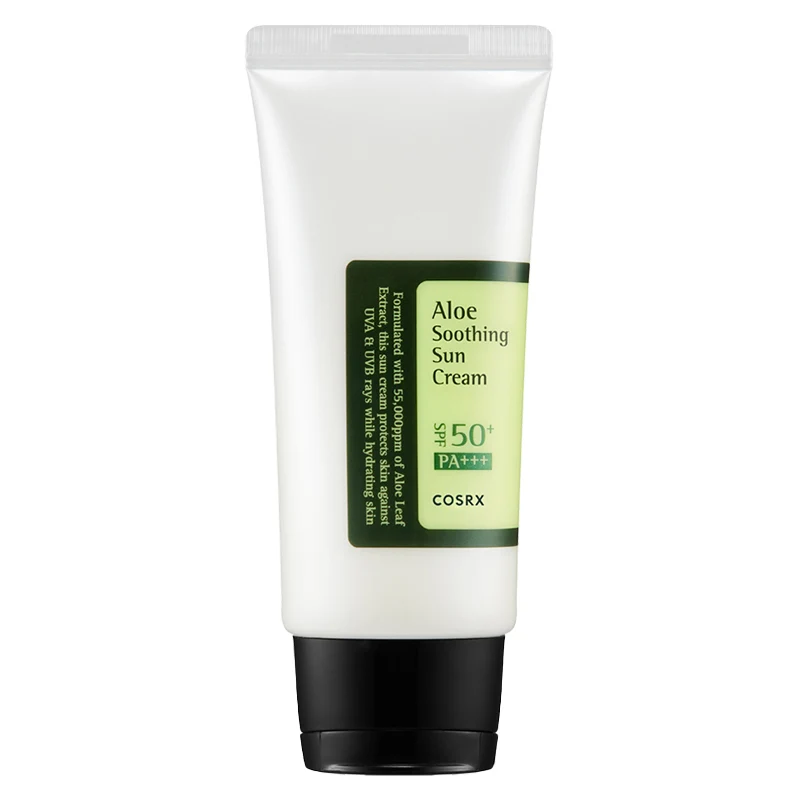
COSRX Aloe Soothing Sun Cream SPF50+ PA+++

COSRX

Aloe Soothing Sun Cream SPF50+ PA+++

face sunscreen

Added Last edited

Fit by skin type

General, ingredient-based — not your personalized match.

Dry
61%
Combination (dry)
61%
Balanced
91%
Combination (oily)
79%
Oily
79%

See how this fits your skin

Take the skin test and I'll show you how suitable this product is for you.

Take the skin test
45
Ingredients
5
Benefits
0
Actives
Find Dupes

Experience ultimate sun protection with the Aloe Soothing Sun Cream SPF50+ PA+++. This lightweight and hydrating formula is carefully crafted with a blend of nourishing ingredients to shield your skin from harmful UV rays. Formulated with soothing botanical extracts including Aloe, Evening Primrose, and Tea Tree, it calms and nourishes your skin, leaving it feeling refreshed and protected. With its high SPF50, this sun cream is your go-to companion for daily sun care. Embrace the sun while keeping your skin healthy and radiant with the Aloe Soothing Sun Cream SPF50.

Key Insights

Benefits

5
Anti-Aging
Dark Spot Fading
Hydration
Oil Control
Soothing

Risks

5
Alcohol
Allergen
Microplastic
Silicone
Synthetic polymer

About Aloe Soothing Sun Cream SPF50+ PA+++

Overview

Aloe Soothing Sun Cream SPF50+ PA+++ is a lightweight sunscreen from COSRX, a brand based in Korea. It is rated SPF 50+ PA+++, meaning it is tested to the top of both the UVB and the UVA scales used in Asia. Its job is UV protection, with the rest of the formula working on hydration. The ingredient list runs to 45 ingredients, each broken down in full below.

Texture and finish

By its ingredient list the formula reads as light: water and humectants lead, with emollients kept lower in the order. Silicones in the formula tend to give a smooth, blurred finish and help it grip under makeup. Hydration is handled by Glycerin, Butylene Glycol and Water, humectants that pull water into the upper layers of skin rather than sealing it there.

UV filter system

It uses a hybrid filter system — Octinoxate, Ensulizole, Tinosorb S, Amiloxate and Titanium Dioxide — combining mineral and organic filters. Between them those filters cover UVB, UVA II and UVA I, so the formula is broad-spectrum in the meaningful sense: it reaches past 340 nm, where the ageing wavelengths sit. The formula contains a photounstable filter alongside a stabiliser, which is the standard and effective way to keep it from degrading in sunlight.

What the formula does

Hydration: High. Ingredients that pull and hold water in the upper layers of skin, and here that comes from Glycerin, Butylene Glycol, Water and Propylene Glycol.

Who it suits

On richness alone it suits Balanced skin best, and is the least natural fit for Dry and Combination (dry) skin. Several ingredients carry irritation flags. If your skin is reactive, this is one to patch test carefully or approach slowly.

What it does not target

The formula contributes little or nothing on barrier support, antioxidant protection, brightening and tone and cell renewal. That is not a fault — most products are not meant to do everything — but if one of those is your priority, this is not the product that will address it.

What is not in it

Reading the full list, the formula is paraben-free, sulfate-free, dye-free, oil-free and no animal-derived ingredients. Those claims come from the ingredient list itself, not from the packaging. It does contain fragrance, essential oils and drying alcohol, worth knowing if your skin reacts to any of them.

Where it fits in a routine

Use it in the morning. In a routine it goes final morning step, before makeup. Apply about two finger-lengths for the face and neck — under-application is the single most common reason sunscreen underperforms. Reapply every two hours of sun exposure, and after swimming or towelling off. Let it set for a couple of minutes before makeup so it does not pill.

This summary is generated from the product's ingredient list. It is not a review, it is not the brand's own marketing claims, and it does not replace advice from a dermatologist.

Pros and cons

Drawn purely from the ingredient list

Pros

  • Broad-spectrum coverage that reaches into UVA I
  • Strong humectant content for hydration

Things to know

  • Contains fragrance or declared fragrance allergens
  • Contains essential oils, a common source of reactivity
  • Contains drying alcohol high in the list
  • Contains a solid synthetic polymer (microplastic)
  • 2 ingredients could feed malassezia (fungal acne)
  • Several ingredients carry irritation flags

Which skin types it suits

Scored on how rich or light the formula reads from its INCI order.

Suitable for

  • Balanced skin

May suit

  • Combination (oily) skin
  • Oily skin

Less suitable for

  • Dry skin
  • Combination (dry) skin

Sensitive skin

Several ingredients here carry irritation flags. If your skin is reactive or you have rosacea, introduce this slowly, or ask a dermatologist first.

Skin concerns

Based on the curated benefits documented for this product's ingredients.

Helps with

  • Hydration 11 ingredients

    Attracts and locks in moisture to keep skin plump and dewy

  • Anti-Aging 5 ingredients

    Boosts collagen and cell turnover to reduce fine lines and wrinkles

  • Oil Control 2 ingredients

    Regulates sebum production to reduce shine and greasiness

  • Soothing 2 ingredients

    Calms redness, irritation, and inflammation for sensitive skin

  • Dark Spot Fading 1 ingredient

    Fades hyperpigmentation and evens out dark spots over time

Does not target

Anti-Acne Blackhead Reducing Evens Skin Tone Pore Minimizer Smooths Bumpy Skin

None of the ingredients in this formula are associated with these benefits. This is not unusual, as most products are designed to target a limited number of concerns.

UV filters

Hybrid mineral and organic filter system · broad-spectrum through UVA I

Octinoxate

ethylhexyl methoxycinnamate
Protects from
UVB (290–320 nm)
Photostable
No — degrades in sunlight
Generation
First-generation UVB filter
Approved in
EU, UK, Korea, Japan, US — banned in Hawaii and Key West
Maximum permitted level
Up to 10% (EU), 7.5% (US)

Efficient UVB absorber that degrades in sunlight on its own, and destabilises avobenzone when the two are formulated together without a quencher.

Ensulizole

phenylbenzimidazole sulfonic acid
Protects from
UVB (290–320 nm)
Photostable
Yes — photostable
Generation
First-generation UVB filter
Approved in
Approved worldwide
Maximum permitted level
Up to 8% (EU), 4% (US)

Water-soluble, which makes it the filter of choice for gel and lotion textures that have to feel weightless.

Tinosorb S

bis-ethylhexyloxyphenol methoxyphenyl triazine
Protects from
UVB (290–320 nm), UVA II (320–340 nm), UVA I (340–400 nm)
Photostable
Yes — photostable
Generation
Next-generation broad-spectrum filter
Approved in
EU, UK, Korea, Japan, Australia — not FDA-approved in the US
Maximum permitted level
Up to 10% (EU)

One of the most photostable filters in use, and it stabilises avobenzone and octinoxate alongside it. Oil-soluble, cosmetically light, no white cast.

Amiloxate

isoamyl p-methoxycinnamate
Protects from
UVB (290–320 nm)
Photostable
No — degrades in sunlight
Generation
First-generation UVB filter
Approved in
EU, UK, Korea, Japan — not FDA-approved in the US
Maximum permitted level
Up to 10% (EU)

Closely related to octinoxate, with the same photostability caveat.

Titanium Dioxide

titanium dioxide
Protects from
UVB (290–320 nm), UVA II (320–340 nm)
Photostable
Yes — photostable
Generation
Mineral (inorganic) filter
Approved in
Approved worldwide
Maximum permitted level
Up to 25% (EU, US, KR)

Strong UVB and short-UVA protection, but it stops before UVA I — a mineral formula leaning on titanium dioxide alone needs zinc oxide beside it for deep UVA.

Key ingredients

The actives, UV filters and benefit-carrying ingredients in this formula, in the order they are listed.

1st on the list, which puts it at an estimated 30–80% of the formula.

Aqua (EU),Deionized Water,Distilled Water,Micromatrix Fractile AN,Onsen-Sui (JPN),Purified Water

Hydration

2nd on the list. Regulation caps it at 10%, so it is present at roughly 5–10%.

2-Ethylhexyl 4-methoxycinnamate

Anti-Aging

3rd on the list, which puts it at an estimated 5–20% of the formula.

Glycerine ;Glycerol (INN); Glycerol (RIFM); Glycerolum (EP); Glycyl Alcohol; 1,2,3-Propanetriol; 1,2,3-Trihydroxypropane

Hydration Anti-Aging

4th on the list, which puts it at an estimated 2–10% of the formula.

Propane-1,2-diol

Hydration

5th on the list, which puts it at an estimated 2–10% of the formula.

Decamethylcyclopentasiloxane

Hydration

8th on the list, which puts it at an estimated 1–5% of the formula.

Carbonic Acid, Dicaprylyl Ester

Hydration

11th on the list, which puts it at an estimated 1–3% of the formula.

Ethanol

Hydration

12th on the list, which puts it at an estimated 1–3% of the formula.

Dimethicone

Hydration

13th on the list, which puts it at an estimated 1–3% of the formula.

Butane-1,3-diol (CAS No. 107-88-0/ EC No. 203-529-7) (R)-(-)-butane-1,3-diol” (CAS No. 6290-03-5/ EC No. 228-532-0)

Hydration

Formula analysis

Each axis is scored from the ingredients present and how high up the list they sit.

Hydration High

Ingredients that pull and hold water in the upper layers of skin

Barrier support None

Lipids and repair signals that support skin barrier integrity

Antioxidant support None

Ingredients that mop up free radicals from UV and pollution

Oil control Low

Ingredients that moderate sebum or absorb shine

Brightening None

Ingredients that act on uneven tone and post-inflammatory marks

Soothing Low

Ingredients aimed at visible redness and reactivity

Cell renewal None

Retinoids, acids and enzymes that speed surface turnover

Firmness signalling None

Peptides and growth factors that signal for collagen support

Photostability High

A photounstable filter is present, paired with a stabiliser

Active and supporting ingredients

"Active" here means an ingredient carrying a recorded active type or a recognised UV filter.

Supporting ingredients (40)

Solvents, emollients, texture agents and preservatives — the formula that carries the actives.

Water Glycerin Propylene Glycol Cyclopentasiloxane Dicaprylyl Carbonate Potassium Cetyl Phosphate Alcohol Dimethicone Butylene Glycol Glyceryl Stearate C14-22 Alcohols Polymethyl Methacrylate Cetearyl Alcohol Peg-100 Stearate Triethanolamine Silica Sodium Hydroxide Dimethicone/vinyl Dimethicone Crosspolymer C12-20 Alkyl Glucoside Aluminum Hydroxide Stearic Acid Parfum Caprylyl Glycol Phenoxyethanol Acrylates/c10-30 Alkyl Acrylate Crosspolymer Aloe Arborescens Leaf Extract Dipotassium Glycyrrhizate Carbomer Xanthan Gum Limonene Tocopheryl Acetate Disodium Edta Hexyl Cinnamal Linalool Benzyl Salicylate Geraniol Benzyl Alcohol Citronellol Benzyl Benzoate Citral

What is and is not in it

Read from the full ingredient list. A brand's own claim may differ.

Free from

  • Paraben-free
  • Sulfate-free
  • Dye-free
  • Oil-free
  • No animal-derived ingredients

Contains

  • Fragrance

    Parfum, Limonene, Hexyl Cinnamal, Linalool, Benzyl Salicylate

  • Essential oils

    Limonene, Hexyl Cinnamal, Linalool, Benzyl Salicylate, Geraniol

  • Drying alcohol

    Alcohol

  • Silicones

    Cyclopentasiloxane, Dimethicone, Dimethicone/vinyl Dimethicone Crosspolymer

  • Microplastics

    Polymethyl Methacrylate

What to layer it with

Judged by the same curated rules our routine checker uses. It reads the ingredients, not the label.

Compatible with

  • Vitamin C (L-ascorbic acid)
  • Retinoids (retinol, retinal)
  • AHAs (glycolic, lactic)
  • BHA (salicylic acid)
  • PHAs (gluconolactone)
  • Benzoyl peroxide
  • Azelaic acid
  • Copper peptides
  • Bakuchiol
  • Niacinamide
  • Hyaluronic acid
  • Ceramides
  • Signal peptides
  • Panthenol
  • Sunscreen

Nothing in this formula belongs to a group our rules can put in conflict, so it layers freely. Order still matters — thinnest texture first.

Where it fits in a routine

Morning
  1. Cleanse
  2. Toning
  3. Treat
  4. Moisturise
  5. Protect

This product is the "Protect" step.

  • Apply about two finger-lengths for the face and neck — under-application is the single most common reason sunscreen underperforms.
  • Reapply every two hours of sun exposure, and after swimming or towelling off.
  • Let it set for a couple of minutes before makeup so it does not pill.

Safety and suitability

Flags to check, not verdicts. None of this is medical advice — if you are pregnant, breastfeeding or treating a skin condition, ask a doctor.

Pregnancy and breastfeeding
Nothing in this formula is on the standard pregnancy-caution list. That is not clearance — ask your doctor about anything you use daily.
Fungal acne (malassezia)
2 ingredients could feed malassezia: Glyceryl Stearate, Peg-100 Stearate. That is about the yeast's food supply, not a prediction that you will break out.
Sensitive and reactive skin
Several ingredients here carry irritation flags. If your skin is reactive or you have rosacea, introduce this slowly, or ask a dermatologist first.
Recorded ingredient risks
Alcohol, Allergen, Microplastic, Silicone, Synthetic polymer

Ingredients by function

Most ingredients do more than one job, so these counts add up to more than the 45 ingredients on the label.

16
Texture agent

Sets the thickness, spread and stability of the formula

10
Fragrance / colour

Changes how the product smells or looks

9
Solvent

Dissolves and carries everything else

8
Emollient

Softens and smooths by filling gaps between skin cells

8
Surfactant

Lifts oil and dirt, or holds oil and water together

6
Humectant

Draws water into the upper layers of skin

6
UV filter

Absorbs or scatters ultraviolet light

5
Occlusive

Forms a film that slows water loss

4
Preservative

Keeps the product free of microbial growth

2
pH adjuster

Sets the acidity the formula needs to work

1
Antioxidant

Neutralises free radicals from UV and pollution

1
Soothing

Calms visible redness and irritation

1
Chelator

Binds trace metals that would otherwise spoil the formula

1
Exfoliant

Loosens or dissolves dead surface cells

1
Plant extract

Botanical material, usually for antioxidants or scent

Ingredient breakdown

Every ingredient on the label, in order, with what it does and roughly how much of it is likely to be there.

1 Water Solvent
Estimated level
30–80%
Confidence
Moderate — INCI order above the 1% line
Roles
Solvent

1st on the list, which puts it at an estimated 30–80% of the formula.

Aqua (EU),Deionized Water,Distilled Water,Micromatrix Fractile AN,Onsen-Sui (JPN),Purified Water

Hydration
3 scientific references
  • Skin Research and Technology, May 2015, pages 131-136
  • Skin Pharmacology and Applied Skin Physiology, November-December 1999, pages 344-351
  • Journal of Cosmetic Science, September-October 1993, pages 249-262
Estimated level
5–10%
Confidence
High — bounded by a regulatory limit
Roles
UV filter

2nd on the list. Regulation caps it at 10%, so it is present at roughly 5–10%.

2-Ethylhexyl 4-methoxycinnamate

Anti-Aging
8 scientific references
  • 5 Super Anti-Aging Antioxidants Your Skin Needs
  • How to Keep Your Neck & Chest Looking Young
  • Acne & Aging Skin
  • How to Diminish Uneven Skin Tone and Get Your Glow Back
  • What Are Peptides and What Do They Do for Skin?
  • The Truth About Firming Creams
  • Top 5 Reasons to Add Antioxidants to Your Skin Care Routine
  • Anti-Aging Superstars
3 Glycerin Humectant
Estimated level
5–20%
Confidence
Moderate — INCI order above the 1% line
Roles
Humectant, Occlusive, Texture agent, Solvent

3rd on the list, which puts it at an estimated 5–20% of the formula.

Glycerine ;Glycerol (INN); Glycerol (RIFM); Glycerolum (EP); Glycyl Alcohol; 1,2,3-Propanetriol; 1,2,3-Trihydroxypropane

Hydration Anti-Aging
6 scientific references
  • Journal of Pharmaceutical Investigation, March 2021, pages 223-231
  • International Journal of Toxicology, November/December 2019, Volume 38, Supplement 3, pages 6S-22S
  • International Journal of Cosmetic Science, August 2016, ePublication
  • British Journal of Dermatology, July 2008, pages 23-34
  • Journal of Cosmetic Dermatology, June 2007, pages 75-82
  • Proceedings of the National Academy of Sciences, June 2003, pages 7, 360-7, 365
4 Propylene Glycol Humectant
Estimated level
2–10%
Confidence
Moderate — INCI order above the 1% line
Roles
Humectant, Texture agent, Solvent

4th on the list, which puts it at an estimated 2–10% of the formula.

Propane-1,2-diol

Hydration
5 scientific references
  • CosmeticsInfoorg, Accessed April 2021, ePublication
  • Archives of Dermatological Research, November 2019, pages 337-352
  • Critical Reviews in Toxicology, April 2013, pages 363-390
  • International Journal of Toxicology, September-October 2012, pages 245S-260S
  • Skin Pharmacology and Applied Physiology, 2001, pages 72-81
Estimated level
2–10%
Confidence
Moderate — INCI order above the 1% line
Roles
Emollient, Solvent

5th on the list, which puts it at an estimated 2–10% of the formula.

Decamethylcyclopentasiloxane

Hydration Silicone
4 scientific references
  • CosmeticsInfoorg, Accessed May 2021, ePublication
  • Regulatory Toxicology and Pharmacology, February 2016, pages S67-S76
  • Environmental International, November 2015, pages 55-63
  • International Journal of Toxicology, December 2011, pages 149-227
Estimated level
2–8%
Confidence
High — bounded by a regulatory limit
Roles
UV filter

6th on the list. Regulation caps it at 8%, so it is present at roughly 2–8%.

2-Phenyl-1H-benzimidazole-5-sulphonic acid

Estimated level
1–5%
Confidence
Moderate — INCI order above the 1% line
Roles
UV filter

7th on the list, which puts it at an estimated 1–5% of the formula.

2,2'-[6-(4-Methoxyphenyl)-1,3,5-triazine-2,4-diyl]bis[5-[(2-ethylhexyl)oxy]-phenol]

Anti-Aging
Estimated level
1–5%
Confidence
Moderate — INCI order above the 1% line
Roles
Emollient

8th on the list, which puts it at an estimated 1–5% of the formula.

Carbonic Acid, Dicaprylyl Ester

Hydration
5 scientific references
  • OCL, April 2018, pages 1-10
  • Journal of Surfactants and Detergents, July 2017, pages 1, 337–1, 349
  • Cosmetic Ingredient Review, December 2016, pages 1-50
  • https://wwwcir-safetyorg/sites/default/files/dialkyl%20carbonatespdf
  • https://wwwulprospectorcom/en/na/PersonalCare/Detail/75/204256/Cetiol-CC
Estimated level
1–5%
Confidence
Moderate — INCI order above the 1% line
Roles
UV filter

9th on the list, which puts it at an estimated 1–5% of the formula.

Isopentyl p-methoxycinnamate

Estimated level
1–5%
Confidence
Moderate — INCI order above the 1% line
Roles
Surfactant

10th on the list, which puts it at an estimated 1–5% of the formula.

1-hexadecanol, phosphate, potassium salt

11 Alcohol Texture agent
Estimated level
1–3%
Confidence
Moderate — INCI order above the 1% line
Roles
Texture agent, Solvent, Preservative

11th on the list, which puts it at an estimated 1–3% of the formula.

Ethanol

Hydration Alcohol
12 Dimethicone Emollient
Estimated level
1–3%
Confidence
Moderate — INCI order above the 1% line
Roles
Emollient, Occlusive

12th on the list, which puts it at an estimated 1–3% of the formula.

Dimethicone

Hydration Silicone
7 scientific references
  • FDA Code of Federal Regulations, April 2020, ePublication
  • International Journal of Toxicology, May 2014, pages 65S-115S
  • The Journal of Clinical and Aesthetic Dermatology, May 2014, pages 36-44
  • Dermatologic Therapy, May 2012, pages 229-233
  • Clinics in Dermatology, May-June 2012, pages 345-348
  • International Journal of Cosmetic Science, January 2008, pages 19-33
  • Skin Research and Technology, May 2000, pages 77-80
13 Butylene Glycol Humectant
Estimated level
1–3%
Confidence
Moderate — INCI order above the 1% line
Roles
Humectant, Texture agent, Solvent

13th on the list, which puts it at an estimated 1–3% of the formula.

Butane-1,3-diol (CAS No. 107-88-0/ EC No. 203-529-7) (R)-(-)-butane-1,3-diol” (CAS No. 6290-03-5/ EC No. 228-532-0)

Hydration
5 scientific references
  • CosmeticsInfoorg, Accessed March 2021, ePublication
  • US Food and Drug Administration Code of Federal Regulations</em>, Accessed March 2021, ePublication
  • International Journal of Toxicology, May 2011, pages 5S-16S
  • Skin Research and Technology, November 2007, pages 417-24
  • Journal of the American College of Toxicology, September 1985, pages 223-248
14 Glyceryl Stearate Emollient
Estimated level
1–3%
Confidence
Moderate — INCI order above the 1% line
Roles
Emollient, Surfactant

14th on the list, which puts it at an estimated 1–3% of the formula.

Stearic acid, monoester with glycerol

Hydration
3 scientific references
  • Cosmeticsinfoorg, Accessed November 2021, ePublication
  • Drugs in Context, April 2018, pages 1-14
  • International Journal of Toxicology, May 2007, pages 1–30
15 Titanium Dioxide UV filter
Estimated level
1–3%
Confidence
Moderate — INCI order above the 1% line
Roles
UV filter, Texture agent

15th on the list, which puts it at an estimated 1–3% of the formula.

Titanium dioxide (CI 77891)

Anti-Aging
10 scientific references
  • Journal of Cosmetic Dermatology, February 2021, pages 532-537
  • Frontiers in Bioengineering and Biotechnology, June 2020
  • Journal of Nanoparticle Research, March 2020
  • Journal of the European Academy of Dermatology and Venereology, November 2019, pages 34-46
  • Photodermatology, Photoimmunology and Photomedicine, November 2019, pages 442-446
  • Journal of Cosmetic Science, September 2019, pages 223-234
  • Materials, July 2019, pages 1-24
  • Photodermatology, Photoimmunology, and Photomedicine, April 2011, pages 58-67
  • Skin Therapy Letter, July-August 2008, pages 5-7
  • Environmental and Health Perspectives, July 2008, pages 893
16 C14-22 Alcohols Texture agent
Estimated level
1–3%
Confidence
Moderate — INCI order above the 1% line
Roles
Texture agent

16th on the list, which puts it at an estimated 1–3% of the formula.

C14-22 Alcohols is a mixture of synthetic fatty alcohols with 14 to 22 carbons in the alkyl chain

Estimated level
1–3%
Confidence
Moderate — INCI order above the 1% line
Roles
Occlusive

17th on the list, which puts it at an estimated 1–3% of the formula.

2-Propenoic acid, 2-methyl-, methyl ester, homopolymer

Microplastic
18 Cetearyl Alcohol Emollient
Estimated level
1–3%
Confidence
Moderate — INCI order above the 1% line
Roles
Emollient, Surfactant, Texture agent

18th on the list, which puts it at an estimated 1–3% of the formula.

Alcohols, C16-18

Hydration
4 scientific references
  • CosmeticsInfoorg, Accessed March 2021, ePublication
  • FDA Cosmetic Labeling Claims, August 2020, ePublication
  • Journal of the Society of Cosmetic Scientists of Korea, June 2009, pages 103-110
  • Journal of the American College of Toxicology, 1988, pages 359-413
19 Peg-100 Stearate Surfactant
Estimated level
1–3%
Confidence
Moderate — INCI order above the 1% line
Roles
Surfactant

19th on the list, which puts it at an estimated 1–3% of the formula.

Poly(oxy-1,2-ethanediyl), .alpha.-(1-oxooctadecyl)-.omega.-hydroxy- (100 mol EO average molar ratio)

20 Triethanolamine Surfactant
Estimated level
under 1%
Confidence
Moderate — listed below the 1% line
Roles
Surfactant, pH adjuster

20th on the list, below the 1% line — present at under 1%, which for most ingredients is the level they work at.

2,2',2''-Nitrilotriethanol

21 Silica Exfoliant
Estimated level
under 1%
Confidence
Moderate — listed below the 1% line
Roles
Exfoliant, Texture agent

21st on the list, below the 1% line — present at under 1%, which for most ingredients is the level they work at.

Silicon dioxide

Oil Control
6 scientific references
  • Advances in Colloid and Interface Science, July 2021, page 10, 2437
  • Cosmetic Ingredient Review, October 2019, pages 1-34
  • Nanomedicine, August 2019, pages 2, 243-2, 267
  • Biological and Pharmaceutical Bulletin, 2016, pages 1, 201-1, 205
  • European Journal of Pharmaceutics and Biopharmaceutics, January 2015, pages 116-125
  • Cosmetics & Toiletries, April 2015, pages 36-45
22 Sodium Hydroxide pH adjuster
Estimated level
under 1%
Confidence
Moderate — listed below the 1% line
Roles
pH adjuster

22nd on the list, below the 1% line — present at under 1%, which for most ingredients is the level they work at.

Sodium hydroxide

Estimated level
under 1%
Confidence
Moderate — listed below the 1% line
Roles
Texture agent

23rd on the list, below the 1% line — present at under 1%, which for most ingredients is the level they work at.

Dimethicone/Vinyl Dimethicone Crosspolymer is a crosslinked dimethyl siloxane polymer (silicone elastomer) that is formed by the reaction between Hydrogen Dimethicone or Bis-Hydrogen Dimethicone, and Vinyl Dimethicone or Bis-Vinyldimethicone.

Silicone
Estimated level
under 1%
Confidence
Moderate — listed below the 1% line
Roles
Surfactant

24th on the list, below the 1% line — present at under 1%, which for most ingredients is the level they work at.

C12-20 Alkyl Glucoside is the product obtained by the condensation of C12-20 alcohols with glucose

Estimated level
under 1%
Confidence
Moderate — listed below the 1% line
Roles
Humectant, Emollient, Occlusive, Texture agent

25th on the list, below the 1% line — present at under 1%, which for most ingredients is the level they work at.

Aluminium hydroxide

Oil Control
8 scientific references
  • Oil-Absorbing Ingredients
  • Help for Oily Skin
  • Salicylic Acid for Skin
  • How BHA Exfoliants Work
  • Which BHA Exfoliant is Right for Me?
  • Niacinamide Benefits: What Does Niacinamide Do for Skin?
  • The Best Toners for Oily Skin
  • The Best Moisturizers for Oily, Acne-Prone Skin
26 Stearic Acid Emollient
Estimated level
under 1%
Confidence
Moderate — listed below the 1% line
Roles
Emollient, Surfactant, Texture agent

26th on the list, below the 1% line — present at under 1%, which for most ingredients is the level they work at.

Stearic acid

Hydration
4 scientific references
  • Cosmetic Ingredient Review, May 2019, pages 1-61
  • International Journal of Cosmetic Science, August 2008, page 310
  • Therapeutics for the Clinician, May 2005, pages 317-324
  • Journal of Cosmetic Science, December 2003, pages 559-568
27 Parfum Fragrance / colour
Estimated level
under 1%
Confidence
Moderate — listed below the 1% line
Roles
Fragrance / colour

27th on the list, below the 1% line — present at under 1%, which for most ingredients is the level they work at.

Parfum is a term for ingredient labelling used to identify that a product contains a material or a combination of materials normally added to a cosmetic to produce or to mask a particular odour. According to Article 19 of the Cosmetics Regulation, 'Perfume and aromatic compositions and their raw materials shall be referred to by the terms ‘parfum’ or ‘aroma’. '

28 Caprylyl Glycol Emollient
Estimated level
under 1%
Confidence
Moderate — listed below the 1% line
Roles
Emollient

28th on the list, below the 1% line — present at under 1%, which for most ingredients is the level they work at.

Octane-1,2-diol

29 Phenoxyethanol Preservative
Estimated level
under 1%
Confidence
Moderate — listed below the 1% line
Roles
Preservative

29th on the list, below the 1% line — present at under 1%, which for most ingredients is the level they work at.

2-Phenoxyethanol

Estimated level
under 1%
Confidence
Moderate — listed below the 1% line
Roles
Occlusive, Texture agent

30th on the list, below the 1% line — present at under 1%, which for most ingredients is the level they work at.

C10-30 alkyl propenoate, polymer with propenoic acid, butenoic acidand/or alkyl propenoates, product with propenyl sucrose ether or propenyl 2,2-dihydroxymethyl-1,3-propanediol

Synthetic polymer
Estimated level
under 1%
Confidence
Moderate — listed below the 1% line
Roles
Humectant, Soothing, Plant extract

31st on the list, below the 1% line — present at under 1%, which for most ingredients is the level they work at.

Aloe Arborescens Leaf Extract is an extract of the leaves of Aloe arborescens, Liliaceae

Estimated level
under 1%
Confidence
Moderate — listed below the 1% line
Roles
Humectant

32nd on the list, below the 1% line — present at under 1%, which for most ingredients is the level they work at.

.alpha.-d-Glucopyranosiduronic acid, (3.beta.,20.beta.)-20-carboxy-11-oxo-30-norolean-12-en-3-yl 2-O-.beta.-d-glucopyranuronosyl-, dipotassium salt

Soothing Dark Spot Fading
8 scientific references
  • How to Care for Red, Sensitive Skin
  • 7 Best Products for Sensitive Skin
  • Skincare Tips for Calming Redness
  • Skin-Soothing Ingredients
  • How the Paula’s Choice CALM Collection Works
  • The Best Moisturizers for Sensitive Skin
  • The Best Ways to Treat Acne and Sensitive Skin
  • Skin Care for Extremely Dry, Sensitive Skin
33 Carbomer Texture agent
Estimated level
under 1%
Confidence
Moderate — listed below the 1% line
Roles
Texture agent

33rd on the list, below the 1% line — present at under 1%, which for most ingredients is the level they work at.

2-Propenoic acid, polymer with 2,2-bis(hydroxymethyl)propane-1,3-diol 2-propenyl ether

Synthetic polymer
34 Xanthan Gum Surfactant
Estimated level
under 1%
Confidence
Moderate — listed below the 1% line
Roles
Surfactant, Texture agent

34th on the list, below the 1% line — present at under 1%, which for most ingredients is the level they work at.

Xanthan gum

35 Limonene Solvent
Estimated level
under 1%
Confidence
Moderate — listed below the 1% line
Roles
Solvent, Fragrance / colour

35th on the list, below the 1% line — present at under 1%, which for most ingredients is the level they work at.

1-Methyl-4-Isopropenylcyclohexene; dipentene

Allergen
36 Tocopheryl Acetate Antioxidant
Estimated level
under 1%
Confidence
Moderate — listed below the 1% line
Roles
Antioxidant

36th on the list, below the 1% line — present at under 1%, which for most ingredients is the level they work at.

3,4-Dihydro-2,5,7,8-tetramethyl-2-(4,8,12-trimethyltridecyl)-2H-benzopyran-6-yl acetate

Anti-Aging Soothing
8 scientific references
  • 5 Super Anti-Aging Antioxidants Your Skin Needs
  • How to Keep Your Neck & Chest Looking Young
  • Acne & Aging Skin
  • How to Diminish Uneven Skin Tone and Get Your Glow Back
  • What Are Peptides and What Do They Do for Skin?
  • The Truth About Firming Creams
  • Top 5 Reasons to Add Antioxidants to Your Skin Care Routine
  • Anti-Aging Superstars
37 Disodium Edta Texture agent
Estimated level
under 1%
Confidence
Moderate — listed below the 1% line
Roles
Texture agent, Chelator

37th on the list, below the 1% line — present at under 1%, which for most ingredients is the level they work at.

Disodium dihydrogen ethylenediaminetetraacetate

38 Hexyl Cinnamal Fragrance / colour
Estimated level
under 1%
Confidence
Moderate — listed below the 1% line
Roles
Fragrance / colour

38th on the list, below the 1% line — present at under 1%, which for most ingredients is the level they work at.

2-Phenylmethyleneoctanal; alpha-Hexylcinnamaldehyde; 2-Benzylideneoctanal; alpha-n-hexyl-beta-phenylacrolein

Allergen
39 Linalool Fragrance / colour
Estimated level
under 1%
Confidence
Moderate — listed below the 1% line
Roles
Fragrance / colour

39th on the list, below the 1% line — present at under 1%, which for most ingredients is the level they work at.

3,7-Dimethyl octa-1,6-diene-3-ol

Allergen
40 Benzyl Salicylate UV filter
Estimated level
under 1%
Confidence
Moderate — listed below the 1% line
Roles
UV filter, Fragrance / colour

40th on the list, below the 1% line — present at under 1%, which for most ingredients is the level they work at.

Benzyl salicylate

Allergen
41 Geraniol Fragrance / colour
Estimated level
under 1%
Confidence
Moderate — listed below the 1% line
Roles
Fragrance / colour

41st on the list, below the 1% line — present at under 1%, which for most ingredients is the level they work at.

2,6-Octadien-1-ol, 3,7-dimethyl-, (2E)-

Allergen
42 Benzyl Alcohol Texture agent
Estimated level
under 1%
Confidence
Moderate — listed below the 1% line
Roles
Texture agent, Solvent, Preservative, Fragrance / colour

42nd on the list, below the 1% line — present at under 1%, which for most ingredients is the level they work at.

Benzyl alcohol

Alcohol Allergen
43 Citronellol Fragrance / colour
Estimated level
under 1%
Confidence
Moderate — listed below the 1% line
Roles
Fragrance / colour

43rd on the list, below the 1% line — present at under 1%, which for most ingredients is the level they work at.

3,7-Dimethyl-6-octen-1-ol

Allergen
Estimated level
under 1%
Confidence
Moderate — listed below the 1% line
Roles
Solvent, Preservative, Fragrance / colour

44th on the list, below the 1% line — present at under 1%, which for most ingredients is the level they work at.

Benzyl benzoate; Phenylmethyl benzoate

45 Citral Fragrance / colour
Estimated level
under 1%
Confidence
Moderate — listed below the 1% line
Roles
Fragrance / colour

45th on the list, below the 1% line — present at under 1%, which for most ingredients is the level they work at.

2,6-Octadienal, 3,7-dimethyl-; 3,7-Dimethyl-2,6-octadienal

Allergen
People also compare

Products in the same category that share this formula's distinguishing ingredients.

ALL AROUND SAFE BLOCK ESSENCE SUN

Missha

Shares 9 key ingredients with Aloe Soothing Sun Cream SPF50+ PA+++: Water, Ethylhexyl Methoxycinnamate, Butylene Glycol, Phenylbenzimidazole Sulfonic Acid, Bis-ethylhexyloxyphenol Methoxyphenyl Triazine

UV Protector Tone-Up Sunscreen

belif

Shares 8 key ingredients with Aloe Soothing Sun Cream SPF50+ PA+++: Water, Ethylhexyl Methoxycinnamate, Dicaprylyl Carbonate, Glycerin, Cyclopentasiloxane

ALL AROUND SAFE BLOCK ESSENCE SUN MILK

Missha

Shares 7 key ingredients with Aloe Soothing Sun Cream SPF50+ PA+++: Water, Butylene Glycol, Ethylhexyl Methoxycinnamate, Bis-ethylhexyloxyphenol Methoxyphenyl Triazine, Glycerin

Anthelios Oil Control SPF 50+ Gel-Cream

La Roche-Posay

Shares 7 key ingredients with Aloe Soothing Sun Cream SPF50+ PA+++: Water, Bis-ethylhexyloxyphenol Methoxyphenyl Triazine, Titanium Dioxide, Propylene Glycol, Butylene Glycol

Frequently asked questions

What ingredients are in Aloe Soothing Sun Cream SPF50+ PA+++?

WATER, ETHYLHEXYL METHOXYCINNAMATE, GLYCERIN, PROPYLENE GLYCOL, CYCLOPENTASILOXANE, PHENYLBENZIMIDAZOLE SULFONIC ACID, BIS-ETHYLHEXYLOXYPHENOL METHOXYPHENYL TRIAZINE, DICAPRYLYL CARBONATE, ISOAMYL P-METHOXYCINNAMATE, POTASSIUM CETYL PHOSPHATE, ALCOHOL, DIMETHICONE, BUTYLENE GLYCOL, GLYCERYL STEARATE, TITANIUM DIOXIDE, C14-22 ALCOHOLS, POLYMETHYL METHACRYLATE, CETEARYL ALCOHOL, PEG-100 STEARATE, TRIETHANOLAMINE, SILICA, SODIUM HYDROXIDE, DIMETHICONE/VINYL DIMETHICONE CROSSPOLYMER, C12-20 ALKYL GLUCOSIDE, ALUMINUM HYDROXIDE, STEARIC ACID, PARFUM, CAPRYLYL GLYCOL, PHENOXYETHANOL, ACRYLATES/C10-30 ALKYL ACRYLATE CROSSPOLYMER, ALOE ARBORESCENS LEAF EXTRACT, DIPOTASSIUM GLYCYRRHIZATE, CARBOMER, XANTHAN GUM, LIMONENE, TOCOPHERYL ACETATE, DISODIUM EDTA, HEXYL CINNAMAL, LINALOOL, BENZYL SALICYLATE, GERANIOL, BENZYL ALCOHOL, CITRONELLOL, BENZYL BENZOATE, CITRAL.

How do I use Aloe Soothing Sun Cream SPF50+ PA+++?

Apply a generous amount on over face 30 minutes before sun exposure. Reapply throughout the day as needed, especially during prolonged sun exposure.

What skin types is Aloe Soothing Sun Cream SPF50+ PA+++ good for?

Judged on how rich the formula reads from its ingredient list, it suits Balanced skin best. It is the least natural fit for Dry, Combination (dry) skin.

Is Aloe Soothing Sun Cream SPF50+ PA+++ good for sensitive skin?

Some ingredients here carry irritation flags, so sensitive skin should patch test on the jawline for a few days before applying it to the whole face.

Is Aloe Soothing Sun Cream SPF50+ PA+++ fungal acne safe?

2 ingredients could feed malassezia: Glyceryl Stearate, Peg-100 Stearate. That describes the yeast's food supply, not a prediction that they will cause a breakout.

Can I use Aloe Soothing Sun Cream SPF50+ PA+++ while pregnant?

Nothing in this formula is on the standard pregnancy-caution list. That is not medical clearance — check anything you use daily with your doctor or midwife.

Is Aloe Soothing Sun Cream SPF50+ PA+++ fragrance free?

No — it contains Parfum, Limonene, Hexyl Cinnamal, Linalool, Benzyl Salicylate.

Does Aloe Soothing Sun Cream SPF50+ PA+++ contain alcohol?

Yes — it contains Alcohol.

Is Aloe Soothing Sun Cream SPF50+ PA+++ silicone free?

No — it contains Cyclopentasiloxane, Dimethicone, Dimethicone/vinyl Dimethicone Crosspolymer.

Does Aloe Soothing Sun Cream SPF50+ PA+++ contain essential oils?

Yes — it contains Limonene, Hexyl Cinnamal, Linalool, Benzyl Salicylate, Geraniol.

Is Aloe Soothing Sun Cream SPF50+ PA+++ paraben free?

Yes. Reading the full ingredient list, this formula is paraben-free.

What can I layer with Aloe Soothing Sun Cream SPF50+ PA+++?

It layers well with Vitamin C (L-ascorbic acid), Retinoids (retinol, retinal), AHAs (glycolic, lactic), BHA (salicylic acid), PHAs (gluconolactone), Benzoyl peroxide.

When should I apply Aloe Soothing Sun Cream SPF50+ PA+++?

Use it in the morning, final morning step, before makeup.

How many ingredients does Aloe Soothing Sun Cream SPF50+ PA+++ have?

It lists 45 ingredients, of which 5 are recorded as actives.

Who makes Aloe Soothing Sun Cream SPF50+ PA+++?

COSRX, a brand based in Korea.

What UV filters are in Aloe Soothing Sun Cream SPF50+ PA+++?

It filters UV with Octinoxate (ethylhexyl methoxycinnamate), Ensulizole (phenylbenzimidazole sulfonic acid), Tinosorb S (bis-ethylhexyloxyphenol methoxyphenyl triazine), Amiloxate (isoamyl p-methoxycinnamate), Titanium Dioxide (titanium dioxide).

Is Aloe Soothing Sun Cream SPF50+ PA+++ broad spectrum?

Yes. Its filters cover UVB, UVA II and UVA I, so protection reaches past 340 nm into the deep-UVA range associated with ageing and pigmentation.

Does Aloe Soothing Sun Cream SPF50+ PA+++ leave a white cast?

It may leave a slight cast. The formula mixes mineral and organic filters, so any cast is usually lighter than a fully mineral sunscreen's.

Is Aloe Soothing Sun Cream SPF50+ PA+++ reef safe?

It contains Octinoxate, which are named in the Hawaii and Key West reef legislation. Some destinations restrict sunscreens containing them.

Can I wear Aloe Soothing Sun Cream SPF50+ PA+++ under makeup?

Yes. Let it set for a couple of minutes before foundation so it does not pill, and reapply over makeup with a stick or powder rather than rubbing more in.

How often should I reapply Aloe Soothing Sun Cream SPF50+ PA+++?

Every two hours of sun exposure, and immediately after swimming, sweating heavily or towelling off.

Brand
COSRX
Country
Korea

Reviews

0 total

Log in to leave a review.

No reviews yet. Be the first to share your thoughts.
