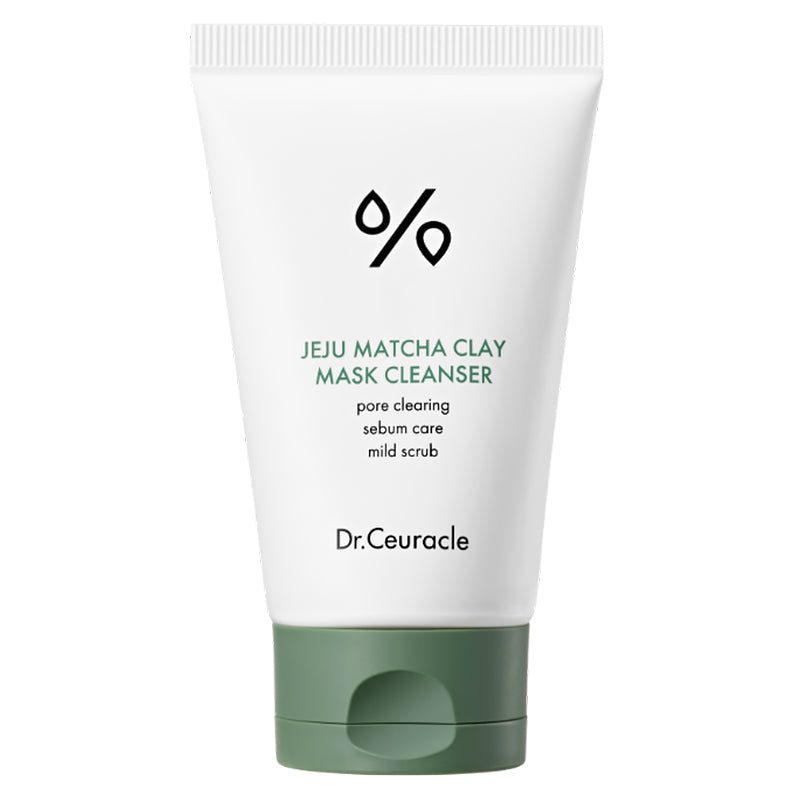
Dr. Ceuracle Jeju Matcha Clay Mask Cleanser

Dr. Ceuracle

Jeju Matcha Clay Mask Cleanser

face cleanser

Added Last edited

Fit by skin type

General, ingredient-based — not your personalized match.

Dry
59%
Combination (dry)
59%
Balanced
89%
Combination (oily)
81%
Oily
81%

See how this fits your skin

Take the skin test and I'll show you how suitable this product is for you.

Take the skin test
43
Ingredients
8
Benefits
2
Actives
Find Dupes

Dr. Ceuracle Jeju Matcha Clay Mask Cleanser is the perfect pick for skin that’s feeling a little clogged, oily, or out of balance. This clever 2-in-1 formula works as both a clay mask and a cleanser, helping to draw out excess oil, impurities, and pore build-up while leaving skin feeling clean, fresh, and comfortable. Matcha, Bentonite, and Kaolin team up to give pores a deep clean without that tight, squeaky feeling afterwards. Alongside its purifying benefits, the formula is packed with skin-loving ingredients like Green Tea, Centella Asiatica, Ceramide NP, and Beta-Glucan to help keep skin calm, hydrated, and supported. A gentle blend of LHA, Willow Bark Extract, and Gluconolactone helps smooth rough texture and keep pores looking clearer over time, making it a great addition to any routine focused on balanced, healthy-looking skin.

Key Insights

Benefits

8
Anti-Acne
Anti-Aging
Blackhead Reducing
Evens Skin Tone
Hydration
Oil Control
Pore Minimizer
Soothing

Active Ingredients

2
PHA Ceramides

About Jeju Matcha Clay Mask Cleanser

Overview

Jeju Matcha Clay Mask Cleanser is a lightweight cleanser from Dr. Ceuracle, a brand based in Korea. Its job is UV protection, with the rest of the formula working on hydration. The ingredient list runs to 43 ingredients, each broken down in full below.

Texture and finish

By its ingredient list the formula reads as light: water and humectants lead, with emollients kept lower in the order. Hydration is handled by Glycerin, Butylene Glycol and Ethylhexylglycerin, humectants that pull water into the upper layers of skin rather than sealing it there.

UV filter system

It is a mineral sunscreen, filtering with Titanium Dioxide. Between them those filters cover UVB and UVA II. They stop short of UVA I (340–400 nm), the deepest ageing wavelengths, so this is not a broad-spectrum filter system by the strictest reading. Every filter in the formula is photostable, so its protection does not fall away over the first hour in the sun — reapplication is still about sweat, water and rubbing rather than degradation.

What the formula does

Hydration: High. Ingredients that pull and hold water in the upper layers of skin, and here that comes from Glycerin, Butylene Glycol, Ethylhexylglycerin and Betaine.

Oil control: Moderate. Ingredients that moderate sebum or absorb shine, and here that comes from Bentonite, Kaolin, Magnesium Aluminum Silicate and Zinc PCA.

Soothing: Moderate. Ingredients aimed at visible redness and reactivity, and here that comes from Centella Asiatica Extract, Beta-glucan, Lauric Acid and Camellia Sinensis Leaf Extract.

Who it suits

On richness alone it suits Balanced, Combination (oily) and Oily skin best, and is the least natural fit for Dry and Combination (dry) skin. Nothing in the list is flagged as a common irritant, which is a reasonable starting point for reactive skin — though a patch test is still the only way to know.

What it does not target

The formula contributes little or nothing on firmness signalling. That is not a fault — most products are not meant to do everything — but if one of those is your priority, this is not the product that will address it.

What is not in it

Reading the full list, the formula is essential-oil-free, no drying alcohol, paraben-free, silicone-free, microplastic-free and sulfate-free. Those claims come from the ingredient list itself, not from the packaging. It does contain fragrance, worth knowing if your skin reacts to any of them.

Where it fits in a routine

It can be used morning and evening. In a routine it goes first step. Use on damp skin and rinse thoroughly. Follow with a toner or essence while skin is still slightly damp. It carries UV filters, so it belongs in your morning routine.

This summary is generated from the product's ingredient list. It is not a review, it is not the brand's own marketing claims, and it does not replace advice from a dermatologist.

Pros and cons

Drawn purely from the ingredient list

Pros

  • Every UV filter in it is photostable
  • No essential oils
  • No drying alcohol
  • Silicone-free
  • No microplastics
  • Strong humectant content for hydration
  • No common irritants flagged in the list

Things to know

  • Filter system does not reach UVA I
  • Contains fragrance or declared fragrance allergens
  • One ingredient could feed malassezia (fungal acne)

Which skin types it suits

Scored on how rich or light the formula reads from its INCI order.

Suitable for

  • Balanced skin
  • Combination (oily) skin
  • Oily skin

Less suitable for

  • Dry skin
  • Combination (dry) skin

Sensitive skin

No ingredient in this formula carries a common-irritant flag, making it a reasonable option for reactive skin. A patch test is still recommended, as individual skin reactivity varies.

Skin concerns

Based on the curated benefits documented for this product's ingredients.

Helps with

  • Hydration 17 ingredients

    Attracts and locks in moisture to keep skin plump and dewy

  • Anti-Aging 8 ingredients

    Boosts collagen and cell turnover to reduce fine lines and wrinkles

  • Soothing 6 ingredients

    Calms redness, irritation, and inflammation for sensitive skin

  • Oil Control 4 ingredients

    Regulates sebum production to reduce shine and greasiness

  • Blackhead Reducing 2 ingredients

    Helps unclog pores and reduce blackheads for clearer skin

  • Evens Skin Tone 2 ingredients

    Brightens and balances complexion for a more uniform appearance

  • Pore Minimizer 2 ingredients

    Tightens and refines the look of enlarged pores

  • Anti-Acne 1 ingredient

    Targets breakouts by reducing bacteria and unclogging pores

Does not target

Dark Spot Fading Smooths Bumpy Skin

None of the ingredients in this formula are associated with these benefits. This is not unusual, as most products are designed to target a limited number of concerns.

UV filters

Mineral filter system · does not reach UVA I

Titanium Dioxide

titanium dioxide
Protects from
UVB (290–320 nm), UVA II (320–340 nm)
Photostable
Yes — photostable
Generation
Mineral (inorganic) filter
Approved in
Approved worldwide
Maximum permitted level
Up to 25% (EU, US, KR)

Strong UVB and short-UVA protection, but it stops before UVA I — a mineral formula leaning on titanium dioxide alone needs zinc oxide beside it for deep UVA.

Key ingredients

The actives, UV filters and benefit-carrying ingredients in this formula, in the order they are listed.

1st on the list, which puts it at an estimated 30–80% of the formula.

Aqua (EU),Deionized Water,Distilled Water,Micromatrix Fractile AN,Onsen-Sui (JPN),Purified Water

Hydration

3rd on the list, which puts it at an estimated 5–20% of the formula.

Glycerine ;Glycerol (INN); Glycerol (RIFM); Glycerolum (EP); Glycyl Alcohol; 1,2,3-Propanetriol; 1,2,3-Trihydroxypropane

Hydration Anti-Aging

4th on the list, which puts it at an estimated 2–10% of the formula.

Bentonite. A colloidal clay. Consists primarily of montmorillonite (CI 77004)

Oil Control Blackhead Reducing

5th on the list, which puts it at an estimated 2–10% of the formula.

Naturally occurring substances, kaolin (CI 77004)

Oil Control Pore Minimizer

7th on the list, below the 1% line — present at under 1%, which for most ingredients is the level they work at.

Dodecanoic acid

Hydration Soothing

8th on the list, below the 1% line — present at under 1%, which for most ingredients is the level they work at.

Titanium dioxide (CI 77891)

Anti-Aging

10th on the list, below the 1% line — present at under 1%, which for most ingredients is the level they work at.

Hectorite (clay mineral)

Oil Control Pore Minimizer

12th on the list, below the 1% line — present at under 1%, which for most ingredients is the level they work at.

Stearic acid

Hydration

13th on the list, below the 1% line — present at under 1%, which for most ingredients is the level they work at.

Butane-1,3-diol (CAS No. 107-88-0/ EC No. 203-529-7) (R)-(-)-butane-1,3-diol” (CAS No. 6290-03-5/ EC No. 228-532-0)

Hydration

16th on the list, below the 1% line — present at under 1%, which for most ingredients is the level they work at.

Glucomannan is the polymer of Mannose containing side chains of glucose

Hydration

18th on the list, below the 1% line — present at under 1%, which for most ingredients is the level they work at.

Silicic acid, aluminum magnesium salt

Oil Control

20th on the list, below the 1% line — present at under 1%, which for most ingredients is the level they work at.

Stearic acid, monoester with glycerol

Hydration

Formula analysis

Each axis is scored from the ingredients present and how high up the list they sit.

Hydration High

Ingredients that pull and hold water in the upper layers of skin

Barrier support Low

Lipids and repair signals that support skin barrier integrity

Antioxidant support Low

Ingredients that mop up free radicals from UV and pollution

Oil control Moderate

Ingredients that moderate sebum or absorb shine

Brightening Low

Ingredients that act on uneven tone and post-inflammatory marks

Soothing Moderate

Ingredients aimed at visible redness and reactivity

Cell renewal Low

Retinoids, acids and enzymes that speed surface turnover

Firmness signalling None

Peptides and growth factors that signal for collagen support

Photostability Very high

Every filter in this formula is photostable

Active and supporting ingredients

"Active" here means an ingredient carrying a recorded active type or a recognised UV filter.

Active ingredients (3)

Supporting ingredients (40)

Solvents, emollients, texture agents and preservatives — the formula that carries the actives.

Water Myristic Acid Glycerin Bentonite Kaolin Potassium Hydroxide Lauric Acid ZEA Mays Starch Hectorite Palmitic Acid Stearic Acid Butylene Glycol Coco-glucoside 1,2-hexanediol Glucomannan Camellia Sinensis Leaf Water Magnesium Aluminum Silicate Sodium Sweetalmondamphoacetate Glyceryl Stearate Hydroxyacetophenone Dipropylene Glycol Chromium Ethylhexylglycerin Parfum Betaine Sodium Cocoyl Glycinate Sodium Phytate Decylene Glycol Phytosteryl/octyldodecyl Lauroyl Glutamate Camellia Sinensis Leaf Extract Hydrogenated Lecithin Centella Asiatica Extract Ficus Carica Fruit Extract Beta-glucan Salix Alba Bark Extract Ethyl Hexanediol Camellia Sinensis Leaf Powder Zinc PCA Tocopherol Capryloyl Salicylic Acid

What is and is not in it

Read from the full ingredient list. A brand's own claim may differ.

Free from

  • Essential-oil-free
  • No drying alcohol
  • Paraben-free
  • Silicone-free
  • Microplastic-free
  • Sulfate-free
  • Dye-free
  • Oil-free
  • No animal-derived ingredients

Contains

  • Fragrance

    Parfum

What to layer it with

Judged by the same curated rules our routine checker uses. It reads the ingredients, not the label.

Compatible with

  • Vitamin C (L-ascorbic acid)
  • Benzoyl peroxide
  • Azelaic acid
  • Copper peptides
  • Bakuchiol
  • Niacinamide
  • Hyaluronic acid
  • Ceramides
  • Signal peptides
  • Panthenol
  • Sunscreen

Use with caution

  • Retinoids (retinol, retinal)

    Best kept to separate routines — one in the morning, one at night, or on alternate days.

  • AHAs (glycolic, lactic)

    Can be layered, but the combination raises the irritation risk. Go slowly.

  • BHA (salicylic acid)

    Can be layered, but the combination raises the irritation risk. Go slowly.

  • PHAs (gluconolactone)

    Can be layered, but the combination raises the irritation risk. Go slowly.

Where it fits in a routine

Morning Evening
  1. Cleanse
  2. Toning
  3. Treat
  4. Moisturise
  5. Protect

This product is the "Cleanse" step.

  • Use on damp skin and rinse thoroughly.
  • Follow with a toner or essence while skin is still slightly damp.
  • It carries UV filters, so it belongs in your morning routine.

Safety and suitability

Flags to check, not verdicts. None of this is medical advice — if you are pregnant, breastfeeding or treating a skin condition, ask a doctor.

Pregnancy and breastfeeding
Nothing in this formula is on the standard pregnancy-caution list. That is not clearance — ask your doctor about anything you use daily.
Fungal acne (malassezia)
1 ingredient could feed malassezia: Glyceryl Stearate. That is about the yeast's food supply, not a prediction that you will break out.
Sensitive and reactive skin
No ingredient in this formula carries a common-irritant flag, making it a reasonable option for reactive skin. A patch test is still recommended, as individual skin reactivity varies.

Ingredients by function

Most ingredients do more than one job, so these counts add up to more than the 43 ingredients on the label.

11
Texture agent

Sets the thickness, spread and stability of the formula

10
Surfactant

Lifts oil and dirt, or holds oil and water together

6
Humectant

Draws water into the upper layers of skin

6
Solvent

Dissolves and carries everything else

5
Plant extract

Botanical material, usually for antioxidants or scent

4
Emollient

Softens and smooths by filling gaps between skin cells

4
Occlusive

Forms a film that slows water loss

3
Antioxidant

Neutralises free radicals from UV and pollution

3
Exfoliant

Loosens or dissolves dead surface cells

2
Active

Changes how skin behaves rather than how it feels

2
Soothing

Calms visible redness and irritation

2
Chelator

Binds trace metals that would otherwise spoil the formula

2
UV filter

Absorbs or scatters ultraviolet light

1
Fragrance / colour

Changes how the product smells or looks

1
pH adjuster

Sets the acidity the formula needs to work

1
Preservative

Keeps the product free of microbial growth

Ingredient breakdown

Every ingredient on the label, in order, with what it does and roughly how much of it is likely to be there.

1 Water Solvent
Estimated level
30–80%
Confidence
Moderate — INCI order above the 1% line
Roles
Solvent

1st on the list, which puts it at an estimated 30–80% of the formula.

Aqua (EU),Deionized Water,Distilled Water,Micromatrix Fractile AN,Onsen-Sui (JPN),Purified Water

Hydration
3 scientific references
  • Skin Research and Technology, May 2015, pages 131-136
  • Skin Pharmacology and Applied Skin Physiology, November-December 1999, pages 344-351
  • Journal of Cosmetic Science, September-October 1993, pages 249-262
2 Myristic Acid Surfactant
Estimated level
5–20%
Confidence
Moderate — INCI order above the 1% line
Roles
Surfactant

2nd on the list, which puts it at an estimated 5–20% of the formula.

Tetradecanoic acid

3 Glycerin Humectant
Estimated level
5–20%
Confidence
Moderate — INCI order above the 1% line
Roles
Humectant, Occlusive, Texture agent, Solvent

3rd on the list, which puts it at an estimated 5–20% of the formula.

Glycerine ;Glycerol (INN); Glycerol (RIFM); Glycerolum (EP); Glycyl Alcohol; 1,2,3-Propanetriol; 1,2,3-Trihydroxypropane

Hydration Anti-Aging
6 scientific references
  • Journal of Pharmaceutical Investigation, March 2021, pages 223-231
  • International Journal of Toxicology, November/December 2019, Volume 38, Supplement 3, pages 6S-22S
  • International Journal of Cosmetic Science, August 2016, ePublication
  • British Journal of Dermatology, July 2008, pages 23-34
  • Journal of Cosmetic Dermatology, June 2007, pages 75-82
  • Proceedings of the National Academy of Sciences, June 2003, pages 7, 360-7, 365
4 Bentonite Texture agent
Estimated level
2–10%
Confidence
Moderate — INCI order above the 1% line
Roles
Texture agent

4th on the list, which puts it at an estimated 2–10% of the formula.

Bentonite. A colloidal clay. Consists primarily of montmorillonite (CI 77004)

Oil Control Blackhead Reducing
4 scientific references
  • BMC Chemistry, September 2021, pages 1-11
  • SN Applied Sciences, May 2019, pages 1-13
  • Journal of pharmaceutical investigation, May 2016, pages 363–375
  • International Journal of Toxicology, March 2003, pages 37-102
5 Kaolin Exfoliant
Estimated level
2–10%
Confidence
Moderate — INCI order above the 1% line
Roles
Exfoliant, Texture agent

5th on the list, which puts it at an estimated 2–10% of the formula.

Naturally occurring substances, kaolin (CI 77004)

Oil Control Pore Minimizer
5 scientific references
  • Molecules, August 2016, pages 1–20
  • The Journal of Clinical and Aesthetic Dermatology, December 2013, pages 19–27
  • Complementary Medicine Research, April 2012, pages 75–79
  • International Geology Review, July 2010, pages 745–770
  • International Journal of Toxicology, 2003, pages 37–102
6 Potassium Hydroxide pH adjuster
Estimated level
under 1%
Confidence
Moderate — listed below the 1% line
Roles
pH adjuster

6th on the list, below the 1% line — present at under 1%, which for most ingredients is the level they work at.

Potassium hydroxide

7 Lauric Acid Surfactant
Estimated level
under 1%
Confidence
Moderate — listed below the 1% line
Roles
Surfactant

7th on the list, below the 1% line — present at under 1%, which for most ingredients is the level they work at.

Dodecanoic acid

Hydration Soothing
5 scientific references
  • Dermatologic Therapy, July 2020, pages 1-4
  • IOP Conference Series: Earth and Environmental Science, June 2020, pages 1-6
  • Biomaterials, October 2009, pages 6, 035-6, 040
  • Journal of the American college of Toxicology, 1987, pages 1-81
  • Tenside Surfactants Detergents, December 1976, pages 313-316
8 Titanium Dioxide UV filter
Estimated level
under 1%
Confidence
Moderate — listed below the 1% line
Roles
UV filter, Texture agent

8th on the list, below the 1% line — present at under 1%, which for most ingredients is the level they work at.

Titanium dioxide (CI 77891)

Anti-Aging
10 scientific references
  • Journal of Cosmetic Dermatology, February 2021, pages 532-537
  • Frontiers in Bioengineering and Biotechnology, June 2020
  • Journal of Nanoparticle Research, March 2020
  • Journal of the European Academy of Dermatology and Venereology, November 2019, pages 34-46
  • Photodermatology, Photoimmunology and Photomedicine, November 2019, pages 442-446
  • Journal of Cosmetic Science, September 2019, pages 223-234
  • Materials, July 2019, pages 1-24
  • Photodermatology, Photoimmunology, and Photomedicine, April 2011, pages 58-67
  • Skin Therapy Letter, July-August 2008, pages 5-7
  • Environmental and Health Perspectives, July 2008, pages 893
9 ZEA Mays Starch Occlusive
Estimated level
under 1%
Confidence
Moderate — listed below the 1% line
Roles
Occlusive, Exfoliant, Texture agent

9th on the list, below the 1% line — present at under 1%, which for most ingredients is the level they work at.

Zea Mays Starch is a high-polymeric carbohydrate material usually derived from the peeled seeds of the Corn, Zea mays L., Gramineae

10 Hectorite Texture agent
Estimated level
under 1%
Confidence
Moderate — listed below the 1% line
Roles
Texture agent

10th on the list, below the 1% line — present at under 1%, which for most ingredients is the level they work at.

Hectorite (clay mineral)

Oil Control Pore Minimizer
11 Palmitic Acid Emollient
Estimated level
under 1%
Confidence
Moderate — listed below the 1% line
Roles
Emollient, Surfactant

11th on the list, below the 1% line — present at under 1%, which for most ingredients is the level they work at.

Hexadecanoic acid

12 Stearic Acid Emollient
Estimated level
under 1%
Confidence
Moderate — listed below the 1% line
Roles
Emollient, Surfactant, Texture agent

12th on the list, below the 1% line — present at under 1%, which for most ingredients is the level they work at.

Stearic acid

Hydration
4 scientific references
  • Cosmetic Ingredient Review, May 2019, pages 1-61
  • International Journal of Cosmetic Science, August 2008, page 310
  • Therapeutics for the Clinician, May 2005, pages 317-324
  • Journal of Cosmetic Science, December 2003, pages 559-568
13 Butylene Glycol Humectant
Estimated level
under 1%
Confidence
Moderate — listed below the 1% line
Roles
Humectant, Texture agent, Solvent

13th on the list, below the 1% line — present at under 1%, which for most ingredients is the level they work at.

Butane-1,3-diol (CAS No. 107-88-0/ EC No. 203-529-7) (R)-(-)-butane-1,3-diol” (CAS No. 6290-03-5/ EC No. 228-532-0)

Hydration
5 scientific references
  • CosmeticsInfoorg, Accessed March 2021, ePublication
  • US Food and Drug Administration Code of Federal Regulations</em>, Accessed March 2021, ePublication
  • International Journal of Toxicology, May 2011, pages 5S-16S
  • Skin Research and Technology, November 2007, pages 417-24
  • Journal of the American College of Toxicology, September 1985, pages 223-248
14 Coco-glucoside Surfactant
Estimated level
under 1%
Confidence
Moderate — listed below the 1% line
Roles
Surfactant

14th on the list, below the 1% line — present at under 1%, which for most ingredients is the level they work at.

Coco-Glucoside is the product obtained by the condensation of coconut alcohol with glucose.

15 1,2-hexanediol Solvent
Estimated level
under 1%
Confidence
Moderate — listed below the 1% line
Roles
Solvent

15th on the list, below the 1% line — present at under 1%, which for most ingredients is the level they work at.

16 Glucomannan Occlusive
Estimated level
under 1%
Confidence
Moderate — listed below the 1% line
Roles
Occlusive

16th on the list, below the 1% line — present at under 1%, which for most ingredients is the level they work at.

Glucomannan is the polymer of Mannose containing side chains of glucose

Hydration
Estimated level
under 1%
Confidence
Moderate — listed below the 1% line
Roles
Plant extract

17th on the list, below the 1% line — present at under 1%, which for most ingredients is the level they work at.

Camellia Sinensis Leaf Water is an aqueous solution of the odoriferous principles of the leaves of the Tea, Camellia sinensis, Theaceae

Estimated level
under 1%
Confidence
Moderate — listed below the 1% line
Roles
Texture agent

18th on the list, below the 1% line — present at under 1%, which for most ingredients is the level they work at.

Silicic acid, aluminum magnesium salt

Oil Control
3 scientific references
  • The Cosmetic Ingredient Review, March 2021, pages 1-27
  • International Journal of Toxicology, January 2003, pages 37-102
  • International Federation Societies of Cosmetic Chemists, 1997, pages 1-43
Estimated level
under 1%
Confidence
Moderate — listed below the 1% line
Roles
Surfactant

19th on the list, below the 1% line — present at under 1%, which for most ingredients is the level they work at.

Amides, sweet-almond-oil, N-[2-[N-(2-hydroxyethyl)-N-(carboxymethyl)amino]ethyl]-, sodium salt

20 Glyceryl Stearate Emollient
Estimated level
under 1%
Confidence
Moderate — listed below the 1% line
Roles
Emollient, Surfactant

20th on the list, below the 1% line — present at under 1%, which for most ingredients is the level they work at.

Stearic acid, monoester with glycerol

Hydration
3 scientific references
  • Cosmeticsinfoorg, Accessed November 2021, ePublication
  • Drugs in Context, April 2018, pages 1-14
  • International Journal of Toxicology, May 2007, pages 1–30
21 Hydroxyacetophenone Antioxidant
Estimated level
under 1%
Confidence
Moderate — listed below the 1% line
Roles
Antioxidant

21st on the list, below the 1% line — present at under 1%, which for most ingredients is the level they work at.

Ethanone, 1-(4-hydroxyphenyl)-,p-Hydroxyacetophenone

Anti-Aging Hydration
4 scientific references
  • Journal of Oleo Science, February 2019, pages 183-191
  • Applied Environmental Microbiology, June 2018, ePublication
  • Journal of Biosciences, May-June 2004, pages 345-353
  • Scientific Reports, April 2021, pages 1–7
22 Dipropylene Glycol Texture agent
Estimated level
under 1%
Confidence
Moderate — listed below the 1% line
Roles
Texture agent, Solvent

22nd on the list, below the 1% line — present at under 1%, which for most ingredients is the level they work at.

1,1'-Oxydipropan-2-ol; Oxydipropan-2-ol; Hydroxypropyloxypropanol

Estimated level
under 1%
Confidence
Moderate — listed below the 1% line

23rd on the list, below the 1% line — present at under 1%, which for most ingredients is the level they work at.

Estimated level
under 1%
Confidence
Moderate — listed below the 1% line

24th on the list, below the 1% line — present at under 1%, which for most ingredients is the level they work at.

1,2-Propanediol, 3-(2-ethylhexyloxy)

Hydration
5 scientific references
  • PLoS One, October 2016, ePublication
  • Contact Dermatitis, May 2016, pages 281-288
  • International Journal of Toxicology, September 2013, pages 5S-21S
  • Personal Care, 2008, pages 1-4
  • Cosmetic Science Technology, 2006, pages 1-11
25 Parfum Fragrance / colour
Estimated level
under 1%
Confidence
Moderate — listed below the 1% line
Roles
Fragrance / colour

25th on the list, below the 1% line — present at under 1%, which for most ingredients is the level they work at.

Parfum is a term for ingredient labelling used to identify that a product contains a material or a combination of materials normally added to a cosmetic to produce or to mask a particular odour. According to Article 19 of the Cosmetics Regulation, 'Perfume and aromatic compositions and their raw materials shall be referred to by the terms ‘parfum’ or ‘aroma’. '

26 Betaine Humectant
Estimated level
under 1%
Confidence
Moderate — listed below the 1% line
Roles
Humectant, Texture agent

26th on the list, below the 1% line — present at under 1%, which for most ingredients is the level they work at.

Methanaminium, 1-carboxy-N,N,N-trimethyl-, hydroxide, inner salt

Hydration
5 scientific references
  • International Journal of Toxicology, 2018, pages 28S-46S
  • Food Science and Biotechnology, October 2017, pages 1391-1397
  • The Journal of Chemical Physics, June 2015, ePublication
  • The American Journal of Clinical Nutrition, September 2004, pages 539-549
  • Skin Research and Technology, February 2003, pages 50-58
Estimated level
under 1%
Confidence
Moderate — listed below the 1% line
Roles
Surfactant

27th on the list, below the 1% line — present at under 1%, which for most ingredients is the level they work at.

Glycine, N-coco acyl derivs., sodium salts

28 Sodium Phytate Chelator
Estimated level
under 1%
Confidence
Moderate — listed below the 1% line
Roles
Chelator

28th on the list, below the 1% line — present at under 1%, which for most ingredients is the level they work at.

Myo-Inositol, hexakis(dihydrogen phosphate), sodium salt

Estimated level
under 1%
Confidence
Moderate — listed below the 1% line

29th on the list, below the 1% line — present at under 1%, which for most ingredients is the level they work at.

1,2-Decanediol

Hydration
Estimated level
under 1%
Confidence
Moderate — listed below the 1% line

30th on the list, below the 1% line — present at under 1%, which for most ingredients is the level they work at.

N-(1-Oxododecyl)-L-glutamic acid, phytosterols and 2-octyl-1-dodecanol ester

Hydration
Estimated level
under 1%
Confidence
Moderate — listed below the 1% line
Roles
UV filter, Humectant, Emollient, Occlusive, Antioxidant, Plant extract, Preservative

31st on the list, below the 1% line — present at under 1%, which for most ingredients is the level they work at.

Camellia Sinensis Leaf Extract is an extract of the leaves of the Tea, Camellia sinensis, Theaceae

Anti-Aging Soothing
Estimated level
under 1%
Confidence
Moderate — listed below the 1% line
Roles
Surfactant

32nd on the list, below the 1% line — present at under 1%, which for most ingredients is the level they work at.

Lecithins, hydrogenated

Hydration
4 scientific references
  • International Journal of Toxicology, September 2020, pages 5S-25S
  • Nanocosmetics, June 2019, pages 95–140
  • Current Drug Delivery, 2016, pages 111–120
  • Pharmaceutical Research, February 2013, pages 538–55
Estimated level
under 1%
Confidence
Moderate — listed below the 1% line
Roles
Soothing, Surfactant, Plant extract

33rd on the list, below the 1% line — present at under 1%, which for most ingredients is the level they work at.

Centella Asiatica Extract is the extract of the whole plant Hydrocotyl, Centella asiatica L., Apiaceae

Soothing Anti-Aging
6 scientific references
  • Phytomedicine, April 2018, pages 110–119
  • Clinical, Cosmetic, and Investigational Dermatology, August 2017, pages 311–315
  • Indian Journal of Pharmaceutical Sciences, Jan-Feb 2016, pages 27–33
  • Postepy Dermatologii I, February 2013, pages 46–49
  • Indian Journal of Pharmaceutical Sciences, 2010, pages 546–556
  • Scientific Reports, June 2021, ePublication
Estimated level
under 1%
Confidence
Moderate — listed below the 1% line
Roles
Humectant, Plant extract

34th on the list, below the 1% line — present at under 1%, which for most ingredients is the level they work at.

Ficus Carica Fruit Extract is an extract of the fruit of the Fig, Ficus carica L., Moraceae

Estimated level
under 1%
Confidence
Moderate — listed below the 1% line

35th on the list, below the 1% line — present at under 1%, which for most ingredients is the level they work at.

beta-Glucan is a polysaccharide consisting of b(1-3) linked glucose chains carrying b(1-6) linked glucose sidechains

Soothing Hydration
6 scientific references
  • Journal of Cosmetic Dermatology, December 2018, pages 1, 101-1, 107
  • International Journal of Molecular Sciences, September 2017, pages 1-48
  • Phytotherapy Research, February 2014, pages 159-166
  • Cosmetic Ingredient Review, October 2012, pages 1-52
  • Journal of Drugs in Dermatology, February 2007, pages 167-170
  • International Journal of Cosmetic Science, October 2005, page 292
36 Ceramide NP Active
Estimated level
under 1%
Confidence
Moderate — listed below the 1% line
Roles
Active

36th on the list, below the 1% line — present at under 1%, which for most ingredients is the level they work at.

Ceramide NP,1,3,4-Octadecanetriol, 2-Octadecanamide,Stearoyl-C18-Phytosphingosine,Stearoyl-4-Hydroxysphinganine

Hydration Anti-Aging
11 scientific references
  • International Journal of Toxicology, 2020, pages 5S-25S
  • International Journal of Molecular Sciences, August 2019, pages 1-15
  • Skin Pharmacology and Physiology, 2016, pages 135-147
  • Biochimica et Biophysica Acta, October 2014, pages 2473-2483
  • Journal of the American Academy of Dermatology, July 2014, pages 177-184
  • Journal of Lipid Research, July 2008, pages 1, 466-1, 476
  • Journal of Lipid Research, September 2007, pages 1936-1943
  • American Journal of Clinical Dermatology, 2003, pages 107-129
  • Contact Dermatitis, June 2002, pages 331-338
  • Journal of Investigative Dermatology, November 2001, pages 1, 126-1, 136
  • Skin Pharmacology and Applied Skin Physiology, September-October 2001, pages 261-271
Estimated level
under 1%
Confidence
Moderate — listed below the 1% line
Roles
Soothing, Plant extract

37th on the list, below the 1% line — present at under 1%, which for most ingredients is the level they work at.

Salix Alba Bark Extract is an extract of the bark of the White Willow, Salix alba L., salicaceae

Estimated level
under 1%
Confidence
Moderate — listed below the 1% line
Roles
Solvent

38th on the list, below the 1% line — present at under 1%, which for most ingredients is the level they work at.

2-ethylhexane-1,3-diol

Estimated level
under 1%
Confidence
Moderate — listed below the 1% line
Roles
Exfoliant

39th on the list, below the 1% line — present at under 1%, which for most ingredients is the level they work at.

Camellia Sinensis Leaf Powder is a powder derived from the dried, ground leaves of Camellia sinensis.

40 Zinc PCA Humectant
Estimated level
under 1%
Confidence
Moderate — listed below the 1% line
Roles
Humectant

40th on the list, below the 1% line — present at under 1%, which for most ingredients is the level they work at.

Proline, 5-oxo-, zinc salt

Hydration
41 Tocopherol Antioxidant
Estimated level
under 1%
Confidence
Moderate — listed below the 1% line
Roles
Antioxidant

41st on the list, below the 1% line — present at under 1%, which for most ingredients is the level they work at.

3,4-Dihydro-2,5,7,8-tetramethyl-2-(4,8,12-trimethyltridecyl)-2H-benzopyran-6-ol; .alpha.-tocopherol; Vitamin E

Anti-Aging Evens Skin Tone Soothing
4 scientific references
  • Journal or Agricultural and Food Chemistry, June 2010, pages 7013-7020
  • Journal of Investigative Dermatology, November 2001, pages 1212-1217
  • Canadian Family Physician, July 2006, pages 855-856
  • Dermatologic Surgery, April 1999, pages 311-315
Estimated level
under 1%
Confidence
Moderate — listed below the 1% line
Roles
Active, Chelator

42nd on the list, below the 1% line — present at under 1%, which for most ingredients is the level they work at.

D-Glucono-1,5-lactone

Evens Skin Tone Anti-Aging Hydration
Estimated level
under 1%
Confidence
Moderate — listed below the 1% line

43rd on the list, below the 1% line — present at under 1%, which for most ingredients is the level they work at.

Benzoic acid, 2-octanoyloxy-

Anti-Acne Blackhead Reducing Soothing
People also compare

Products in the same category that share this formula's distinguishing ingredients.

1025 DOKDO Cleanser

Round Lab

Shares 4 key ingredients with Jeju Matcha Clay Mask Cleanser: Water, Glycerin, Butylene Glycol, Ceramide NP

Cicaluronic Low Ph Cleanser

Mizon

Shares 4 key ingredients with Jeju Matcha Clay Mask Cleanser: Water, Glycerin, Glyceryl Stearate, Gluconolactone

Frequently asked questions

What ingredients are in Jeju Matcha Clay Mask Cleanser?

WATER, MYRISTIC ACID, GLYCERIN, BENTONITE, KAOLIN, POTASSIUM HYDROXIDE, LAURIC ACID, TITANIUM DIOXIDE, ZEA MAYS STARCH, HECTORITE, PALMITIC ACID, STEARIC ACID, BUTYLENE GLYCOL, COCO-GLUCOSIDE, 1,2-HEXANEDIOL, GLUCOMANNAN, CAMELLIA SINENSIS LEAF WATER, MAGNESIUM ALUMINUM SILICATE, SODIUM SWEETALMONDAMPHOACETATE, GLYCERYL STEARATE, HYDROXYACETOPHENONE, DIPROPYLENE GLYCOL, CHROMIUM, ETHYLHEXYLGLYCERIN, PARFUM, BETAINE, SODIUM COCOYL GLYCINATE, SODIUM PHYTATE, DECYLENE GLYCOL, PHYTOSTERYL/OCTYLDODECYL LAUROYL GLUTAMATE, CAMELLIA SINENSIS LEAF EXTRACT, HYDROGENATED LECITHIN, CENTELLA ASIATICA EXTRACT, FICUS CARICA FRUIT EXTRACT, BETA-GLUCAN, CERAMIDE NP, SALIX ALBA BARK EXTRACT, ETHYL HEXANEDIOL, CAMELLIA SINENSIS LEAF POWDER, ZINC PCA, TOCOPHEROL, GLUCONOLACTONE, CAPRYLOYL SALICYLIC ACID.

What are the active ingredients in Jeju Matcha Clay Mask Cleanser?

CERAMIDE NP, GLUCONOLACTONE.

How do I use Jeju Matcha Clay Mask Cleanser?

Using the included silicone brush, apply an even layer to dry skin. Leave on for 3–5 minutes, then add water and gently massage to create a lather. Rinse thoroughly with lukewarm water. Use 2–3 times a week or as needed.

What skin types is Jeju Matcha Clay Mask Cleanser good for?

Judged on how rich the formula reads from its ingredient list, it suits Balanced, Combination (oily), Oily skin best. It is the least natural fit for Dry, Combination (dry) skin.

Is Jeju Matcha Clay Mask Cleanser good for sensitive skin?

No ingredient in this formula carries a common-irritant flag, making it a reasonable option for reactive skin. A patch test is still recommended, as individual skin reactivity varies.

Is Jeju Matcha Clay Mask Cleanser fungal acne safe?

One ingredient could feed malassezia: Glyceryl Stearate. That describes the yeast's food supply, not a prediction that it will cause a breakout.

Can I use Jeju Matcha Clay Mask Cleanser while pregnant?

Nothing in this formula is on the standard pregnancy-caution list. That is not medical clearance — check anything you use daily with your doctor or midwife.

Is Jeju Matcha Clay Mask Cleanser fragrance free?

No — it contains Parfum.

Does Jeju Matcha Clay Mask Cleanser contain alcohol?

No. Reading the full ingredient list, this formula is no drying alcohol.

Is Jeju Matcha Clay Mask Cleanser silicone free?

Yes. Reading the full ingredient list, this formula is silicone-free.

Does Jeju Matcha Clay Mask Cleanser contain essential oils?

No. Reading the full ingredient list, this formula is essential-oil-free.

Is Jeju Matcha Clay Mask Cleanser paraben free?

Yes. Reading the full ingredient list, this formula is paraben-free.

What can I layer with Jeju Matcha Clay Mask Cleanser?

It layers well with Vitamin C (L-ascorbic acid), Benzoyl peroxide, Azelaic acid, Copper peptides, Bakuchiol, Niacinamide. Take more care combining it with Retinoids (retinol, retinal), AHAs (glycolic, lactic), BHA (salicylic acid), PHAs (gluconolactone) — use them in separate routines or on alternate days.

When should I apply Jeju Matcha Clay Mask Cleanser?

Use it morning and evening, first step.

How many ingredients does Jeju Matcha Clay Mask Cleanser have?

It lists 43 ingredients, of which 3 are recorded as actives.

Who makes Jeju Matcha Clay Mask Cleanser?

Dr. Ceuracle, a brand based in Korea.

What UV filters are in Jeju Matcha Clay Mask Cleanser?

It filters UV with Titanium Dioxide (titanium dioxide).

Is Jeju Matcha Clay Mask Cleanser broad spectrum?

Not in the strictest sense. Its filters stop short of UVA I (340–400 nm), the deepest ageing wavelengths.

Does Jeju Matcha Clay Mask Cleanser leave a white cast?

Possibly. It filters with mineral UV filters, which sit on the surface and can leave a visible cast on deeper skin tones, especially at high SPF.

Is Jeju Matcha Clay Mask Cleanser reef safe?

It contains none of the filters named in the Hawaii and Key West reef legislation (oxybenzone and octinoxate). "Reef safe" is not a regulated term, so treat that as a fact about the filter list rather than a certification.

Can I wear Jeju Matcha Clay Mask Cleanser under makeup?

Yes. Let it set for a couple of minutes before foundation so it does not pill, and reapply over makeup with a stick or powder rather than rubbing more in.

How often should I reapply Jeju Matcha Clay Mask Cleanser?

Every two hours of sun exposure, and immediately after swimming, sweating heavily or towelling off.

Brand
Dr. Ceuracle
Country
Korea

Reviews

0 total

Log in to leave a review.

No reviews yet. Be the first to share your thoughts.
