1st on the list, which puts it at an estimated 30–80% of the formula.
Aqua (EU),Deionized Water,Distilled Water,Micromatrix Fractile AN,Onsen-Sui (JPN),Purified Water
Hydration
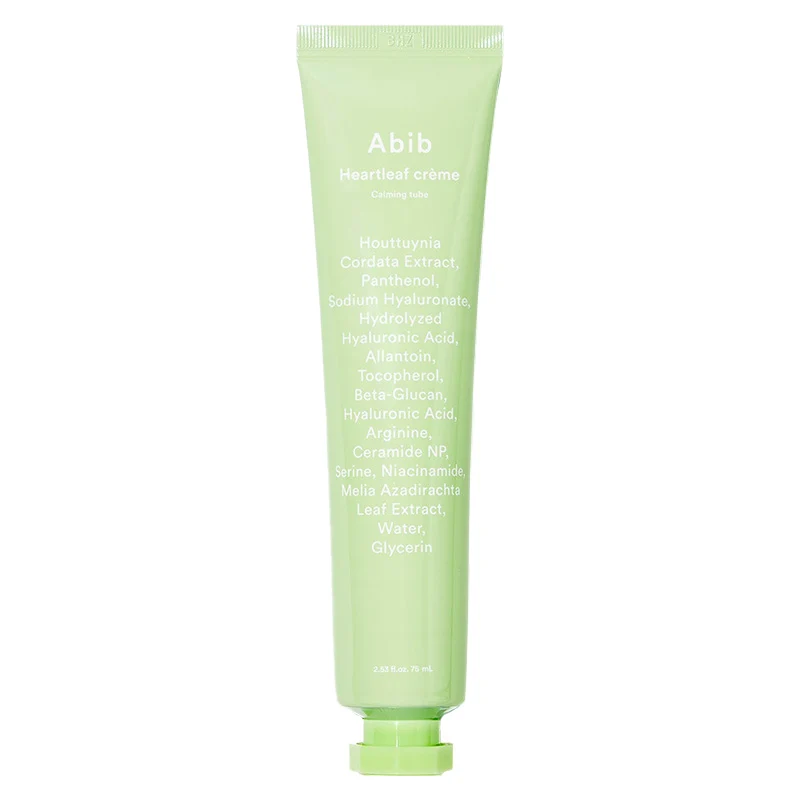
Abib
Heartleaf Creme Calming Tube
face moisturizer
Abib
face moisturizer
Added Last edited
Fit by skin type
General, ingredient-based — not your personalized match.

See how this fits your skin
Take the skin test and I'll show you how suitable this product is for you.
Take the skin testGive your skin the gentle, soothing care it deserves with the Abib Heartleaf Crème Calming Tube. This moisturizer is like a calming hug for sensitive and irritated skin, featuring a powerful 10,000 ppm of heartleaf extract—a beloved ingredient known for its ability to soothe and clarify. We've also blended in panthenol and allantoin to help strengthen your skin's natural barrier, protecting it from daily stressors. The result is a healthy, comfortable complexion that feels balanced and cared for. Experience the lightweight, sherbet-like texture that melts into your skin instantly, providing a burst of cooling hydration without any sticky or greasy feeling. With a unique blend of 8 types of hyaluronic acid and ceramide, this cream works hard to lock in moisture and keep your skin plump and supple. It's the perfect daily moisturizer for anyone looking to calm redness, control oil, and restore a clear, healthy glow.
Heartleaf Creme Calming Tube is a lightweight moisturizer from Abib, a brand based in Korea. The formula is built mainly around hydration. The ingredient list runs to 46 ingredients, each broken down in full below.
By its ingredient list the formula reads as light: water and humectants lead, with emollients kept lower in the order. Silicones in the formula tend to give a smooth, blurred finish and help it grip under makeup. Hydration is handled by Glycerin, Lauryl Dimethicone/polyglycerin-3 Crosspolymer and Panthenol, humectants that pull water into the upper layers of skin rather than sealing it there.
Hydration: Very high. Ingredients that pull and hold water in the upper layers of skin, and here that comes from Glycerin, Lauryl Dimethicone/polyglycerin-3 Crosspolymer, Panthenol and Propanediol.
Soothing: Moderate. Ingredients aimed at visible redness and reactivity, and here that comes from Panthenol, Allantoin, Beta-glucan and Niacinamide.
Barrier support: Moderate. Lipids and repair signals that support skin barrier integrity, and here that comes from Niacinamide, Panthenol, Hydrogenated Lecithin and Ceramide NP.
Oil control: Moderate. Ingredients that moderate sebum or absorb shine, and here that comes from Niacinamide, Silica and Sodium Polyacrylate Starch.
On richness alone it suits Balanced, Combination (oily) and Oily skin best, and is the least natural fit for Dry and Combination (dry) skin. Nothing in the list is flagged as a common irritant, which is a reasonable starting point for reactive skin — though a patch test is still the only way to know.
The formula contributes little or nothing on antioxidant protection, cell renewal and firmness signalling. That is not a fault — most products are not meant to do everything — but if one of those is your priority, this is not the product that will address it.
Reading the full list, the formula is fragrance-free, essential-oil-free, no drying alcohol, paraben-free, sulfate-free and dye-free. Those claims come from the ingredient list itself, not from the packaging.
It can be used morning and evening. In a routine it goes after serums. Seal in your serums with it; in the morning, sunscreen still goes on top.
This summary is generated from the product's ingredient list. It is not a review, it is not the brand's own marketing claims, and it does not replace advice from a dermatologist.
Drawn purely from the ingredient list
Scored on how rich or light the formula reads from its INCI order.
No ingredient in this formula carries a common-irritant flag, making it a reasonable option for reactive skin. A patch test is still recommended, as individual skin reactivity varies.
Based on the curated benefits documented for this product's ingredients.
Attracts and locks in moisture to keep skin plump and dewy
Boosts collagen and cell turnover to reduce fine lines and wrinkles
Calms redness, irritation, and inflammation for sensitive skin
Regulates sebum production to reduce shine and greasiness
Fades hyperpigmentation and evens out dark spots over time
Brightens and balances complexion for a more uniform appearance
Tightens and refines the look of enlarged pores
None of the ingredients in this formula are associated with these benefits. This is not unusual, as most products are designed to target a limited number of concerns.
The actives, UV filters and benefit-carrying ingredients in this formula, in the order they are listed.
1st on the list, which puts it at an estimated 30–80% of the formula.
Aqua (EU),Deionized Water,Distilled Water,Micromatrix Fractile AN,Onsen-Sui (JPN),Purified Water
2nd on the list, which puts it at an estimated 5–20% of the formula.
Dodecamethylcyclohexasiloxane
3rd on the list, which puts it at an estimated 5–20% of the formula.
Glycerine ;Glycerol (INN); Glycerol (RIFM); Glycerolum (EP); Glycyl Alcohol; 1,2,3-Propanetriol; 1,2,3-Trihydroxypropane
4th on the list, which puts it at an estimated 2–10% of the formula.
Propane-1,2,3-triyl 2-ethylhexanoate
5th on the list, which puts it at an estimated 2–10% of the formula.
Niacinamide (vitamin B3) is a gentle skincare active that repairs the skin barrier, calms redness, controls oil and evens tone at 2–5%. Official IUPAC name: **3-Pyridinecarboxamide**
6th on the list, which puts it at an estimated 2–10% of the formula.
1,2-Dihydroxypentane
12th on the list, below the 1% line — present at under 1%, which for most ingredients is the level they work at.
2-Propenoic acid, sodium salt, homopolymer, polymer with starch (graft)
13th on the list, below the 1% line — present at under 1%, which for most ingredients is the level they work at.
1,1,5,5,5-Hexamethyl-3-phenyl-3-[(trimethylsilyl)oxy]trisiloxane
17th on the list, below the 1% line — present at under 1%, which for most ingredients is the level they work at.
Houttuynia Cordata Extract is an extract of the herb, Houttuynia cordata, Saururaceae
18th on the list, below the 1% line — present at under 1%, which for most ingredients is the level they work at.
Butanamide, 2,4-dihydroxy-N-(3-hydroxypropyl)-3,3-dimethyl-, (2R)-; dl-Panthenol
19th on the list, below the 1% line — present at under 1%, which for most ingredients is the level they work at.
1,3-dihydroxypropane
20th on the list, below the 1% line — present at under 1%, which for most ingredients is the level they work at.
Silicon dioxide
Each axis is scored from the ingredients present and how high up the list they sit.
Ingredients that pull and hold water in the upper layers of skin
Lipids and repair signals that support skin barrier integrity
Ingredients that mop up free radicals from UV and pollution
Ingredients that moderate sebum or absorb shine
Ingredients that act on uneven tone and post-inflammatory marks
Ingredients aimed at visible redness and reactivity
Retinoids, acids and enzymes that speed surface turnover
Peptides and growth factors that signal for collagen support
"Active" here means an ingredient carrying a recorded active type or a recognised UV filter.
Solvents, emollients, texture agents and preservatives — the formula that carries the actives.
Read from the full ingredient list. A brand's own claim may differ.
Cyclohexasiloxane, Polyglyceryl-3 Polydimethylsiloxyethyl Dimethicone, Lauryl Dimethicone/polyglycerin-3 Crosspolymer, Phenyl Trimethicone, Dimethicone/vinyl Dimethicone Crosspolymer
Vinyl Dimethicone/methicone Silsesquioxane Crosspolymer
Judged by the same curated rules our routine checker uses. It reads the ingredients, not the label.
Nothing in this formula belongs to a group our rules can put in conflict, so it layers freely. Order still matters — thinnest texture first.
This product is the "Moisturise" step.
Flags to check, not verdicts. None of this is medical advice — if you are pregnant, breastfeeding or treating a skin condition, ask a doctor.
Most ingredients do more than one job, so these counts add up to more than the 46 ingredients on the label.
Dissolves and carries everything else
Sets the thickness, spread and stability of the formula
Draws water into the upper layers of skin
Changes how skin behaves rather than how it feels
Botanical material, usually for antioxidants or scent
Forms a film that slows water loss
Softens and smooths by filling gaps between skin cells
Binds trace metals that would otherwise spoil the formula
Lifts oil and dirt, or holds oil and water together
Neutralises free radicals from UV and pollution
Calms visible redness and irritation
Loosens or dissolves dead surface cells
Sets the acidity the formula needs to work
Every ingredient on the label, in order, with what it does and roughly how much of it is likely to be there.
1st on the list, which puts it at an estimated 30–80% of the formula.
Aqua (EU),Deionized Water,Distilled Water,Micromatrix Fractile AN,Onsen-Sui (JPN),Purified Water
2nd on the list, which puts it at an estimated 5–20% of the formula.
Dodecamethylcyclohexasiloxane
3rd on the list, which puts it at an estimated 5–20% of the formula.
Glycerine ;Glycerol (INN); Glycerol (RIFM); Glycerolum (EP); Glycyl Alcohol; 1,2,3-Propanetriol; 1,2,3-Trihydroxypropane
4th on the list, which puts it at an estimated 2–10% of the formula.
Propane-1,2,3-triyl 2-ethylhexanoate
5th on the list, which puts it at an estimated 2–10% of the formula.
Niacinamide (vitamin B3) is a gentle skincare active that repairs the skin barrier, calms redness, controls oil and evens tone at 2–5%. Official IUPAC name: **3-Pyridinecarboxamide**
6th on the list, which puts it at an estimated 2–10% of the formula.
1,2-Dihydroxypentane
7th on the list, below the 1% line — present at under 1%, which for most ingredients is the level they work at.
8th on the list, below the 1% line — present at under 1%, which for most ingredients is the level they work at.
Siloxanes and Silicones, 3-(tri(oxy-2-hydroxypropylene))oxypropyl methyl, 2-trimethylsilylpoly(oxydimethylsilyl)ethyl methyl, dimethyl
9th on the list, below the 1% line — present at under 1%, which for most ingredients is the level they work at.
Lauryl Dimethicone/Polyglycerin-3 Crosspolymer is a polymer of Lauryl Dimethicone crosslinked with diallyl Polyglycerin-3
10th on the list, below the 1% line — present at under 1%, which for most ingredients is the level they work at.
Sodium chloride
11th on the list, below the 1% line — present at under 1%, which for most ingredients is the level they work at.
2,2,4,6,6-Pentamethylheptane; Hydrocarbons, C4, 1,3-butadiene-free, polymd., triisobutylene fraction, hydrogenated
12th on the list, below the 1% line — present at under 1%, which for most ingredients is the level they work at.
2-Propenoic acid, sodium salt, homopolymer, polymer with starch (graft)
13th on the list, below the 1% line — present at under 1%, which for most ingredients is the level they work at.
1,1,5,5,5-Hexamethyl-3-phenyl-3-[(trimethylsilyl)oxy]trisiloxane
14th on the list, below the 1% line — present at under 1%, which for most ingredients is the level they work at.
Dimethicone/Vinyl Dimethicone Crosspolymer is a crosslinked dimethyl siloxane polymer (silicone elastomer) that is formed by the reaction between Hydrogen Dimethicone or Bis-Hydrogen Dimethicone, and Vinyl Dimethicone or Bis-Vinyldimethicone.
15th on the list, below the 1% line — present at under 1%, which for most ingredients is the level they work at.
Vinyl Dimethicone/Methicone Silsesquioxane Crosspolymer
16th on the list, below the 1% line — present at under 1%, which for most ingredients is the level they work at.
Trisodium citrate
17th on the list, below the 1% line — present at under 1%, which for most ingredients is the level they work at.
Houttuynia Cordata Extract is an extract of the herb, Houttuynia cordata, Saururaceae
18th on the list, below the 1% line — present at under 1%, which for most ingredients is the level they work at.
Butanamide, 2,4-dihydroxy-N-(3-hydroxypropyl)-3,3-dimethyl-, (2R)-; dl-Panthenol
19th on the list, below the 1% line — present at under 1%, which for most ingredients is the level they work at.
1,3-dihydroxypropane
20th on the list, below the 1% line — present at under 1%, which for most ingredients is the level they work at.
Silicon dioxide
21st on the list, below the 1% line — present at under 1%, which for most ingredients is the level they work at.
Melia Azadirachta Leaf Extract is an extract of the leaves of the Neem Tree, Melia azadirachta L., Meliaceae
22nd on the list, below the 1% line — present at under 1%, which for most ingredients is the level they work at.
.alpha.-d-Glucopyranosiduronic acid, (3.beta.,20.beta.)-20-carboxy-11-oxo-30-norolean-12-en-3-yl 2-O-.beta.-d-glucopyranuronosyl-, dipotassium salt
23rd on the list, below the 1% line — present at under 1%, which for most ingredients is the level they work at.
1,1'-Oxydipropan-2-ol; Oxydipropan-2-ol; Hydroxypropyloxypropanol
24th on the list, below the 1% line — present at under 1%, which for most ingredients is the level they work at.
Melia Azadirachta Flower Extract is an extract of the flowers of the Neem Tree, Melia Azadirachta L., Meliaceae
25th on the list, below the 1% line — present at under 1%, which for most ingredients is the level they work at.
Myo-Inositol, hexakis(dihydrogen phosphate), sodium salt
26th on the list, below the 1% line — present at under 1%, which for most ingredients is the level they work at.
Ethanol, 2-(phenylmethoxy)-
27th on the list, below the 1% line — present at under 1%, which for most ingredients is the level they work at.
Glycosaminoglycans, hydrolyzed
28th on the list, below the 1% line — present at under 1%, which for most ingredients is the level they work at.
Ocimum Sanctum Leaf Extract is an extract of the leaves of Ocimum sanctum, Labiatae
29th on the list, below the 1% line — present at under 1%, which for most ingredients is the level they work at.
Hyaluronic acid, sodium, salt
30th on the list, below the 1% line — present at under 1%, which for most ingredients is the level they work at.
Curcuma Longa Root Extract is an extract of the rhizomes of the Turmeric, Curcuma longa L., Zingiberaceae
31st on the list, below the 1% line — present at under 1%, which for most ingredients is the level they work at.
Corallina Officinalis Extract is an extract of the Alga, Corallina officinalis L., Corallinaceae
32nd on the list, below the 1% line — present at under 1%, which for most ingredients is the level they work at.
Hyaluronic acid, sodium salt, polymer with 1,1'-sulfonylbis[ethene]
33rd on the list, below the 1% line — present at under 1%, which for most ingredients is the level they work at.
3,4-Dihydro-2,5,7,8-tetramethyl-2-(4,8,12-trimethyltridecyl)-2H-benzopyran-6-ol; .alpha.-tocopherol; Vitamin E
34th on the list, below the 1% line — present at under 1%, which for most ingredients is the level they work at.
Hydrolyzed Hyaluronic Acid is the hydrolysate of Hyaluronic Acid derived by acid, enzyme or other method of hydrolysis
35th on the list, below the 1% line — present at under 1%, which for most ingredients is the level they work at.
1,2-Propanediol, 3-(2-ethylhexyloxy)
36th on the list, below the 1% line — present at under 1%, which for most ingredients is the level they work at.
Hyaluronic acid, 2-hydroxy-3-(N,N,N-trimethylammonio)propyl chloride derivatives
37th on the list, below the 1% line — present at under 1%, which for most ingredients is the level they work at.
Urea, (2,5-dioxo-4-imidazolidinyl)-
38th on the list, below the 1% line — present at under 1%, which for most ingredients is the level they work at.
Butane-1,3-diol (CAS No. 107-88-0/ EC No. 203-529-7) (R)-(-)-butane-1,3-diol” (CAS No. 6290-03-5/ EC No. 228-532-0)
39th on the list, below the 1% line — present at under 1%, which for most ingredients is the level they work at.
Decanoic acid, ester with 1,2,3-propanetriol octanoate; Glycerides, mixed decanoyl and octanoyl
40th on the list, below the 1% line — present at under 1%, which for most ingredients is the level they work at.
beta-Glucan is a polysaccharide consisting of b(1-3) linked glucose chains carrying b(1-6) linked glucose sidechains
41st on the list, below the 1% line — present at under 1%, which for most ingredients is the level they work at.
Hyaluronic acid
42nd on the list, below the 1% line — present at under 1%, which for most ingredients is the level they work at.
Lecithins, hydrogenated
43rd on the list, below the 1% line — present at under 1%, which for most ingredients is the level they work at.
Sodium Acetylhyaluronate
44th on the list, below the 1% line — present at under 1%, which for most ingredients is the level they work at.
L-Arginine
45th on the list, below the 1% line — present at under 1%, which for most ingredients is the level they work at.
Ceramide NP,1,3,4-Octadecanetriol, 2-Octadecanamide,Stearoyl-C18-Phytosphingosine,Stearoyl-4-Hydroxysphinganine
46th on the list, below the 1% line — present at under 1%, which for most ingredients is the level they work at.
2-Amino-3-hydroxypropanoic acid
Products in the same category that share this formula's distinguishing ingredients.
Biodance
Shares 11 key ingredients with Heartleaf Creme Calming Tube: Glycerin, Triethylhexanoin, Niacinamide, Water, Propanediol
By Wishtrend
Shares 11 key ingredients with Heartleaf Creme Calming Tube: Water, Glycerin, Panthenol, Ceramide NP, Niacinamide
House of Hur
Shares 10 key ingredients with Heartleaf Creme Calming Tube: Water, Propanediol, Glycerin, Panthenol, Sodium Hyaluronate
Dr.Althea
Shares 10 key ingredients with Heartleaf Creme Calming Tube: Water, Glycerin, Niacinamide, Pentylene Glycol, Panthenol
Dr.Melaxin
Shares 10 key ingredients with Heartleaf Creme Calming Tube: Water, Glycerin, Propanediol, Niacinamide, Panthenol
innisfree
Shares 10 key ingredients with Heartleaf Creme Calming Tube: Water, Propanediol, Glycerin, Panthenol, Hyaluronic Acid
WATER, CYCLOHEXASILOXANE, GLYCERIN, TRIETHYLHEXANOIN, NIACINAMIDE, PENTYLENE GLYCOL, 1,2-HEXANEDIOL, POLYGLYCERYL-3 POLYDIMETHYLSILOXYETHYL DIMETHICONE, LAURYL DIMETHICONE/POLYGLYCERIN-3 CROSSPOLYMER, SODIUM CHLORIDE, ISODODECANE, SODIUM POLYACRYLATE STARCH, PHENYL TRIMETHICONE, DIMETHICONE/VINYL DIMETHICONE CROSSPOLYMER, VINYL DIMETHICONE/METHICONE SILSESQUIOXANE CROSSPOLYMER, SODIUM CITRATE, HOUTTUYNIA CORDATA EXTRACT, PANTHENOL, PROPANEDIOL, SILICA, MELIA AZADIRACHTA LEAF EXTRACT, DIPOTASSIUM GLYCYRRHIZATE, DIPROPYLENE GLYCOL, MELIA AZADIRACHTA FLOWER EXTRACT, SODIUM PHYTATE, BENZYL GLYCOL, HYDROLYZED GLYCOSAMINOGLYCANS, OCIMUM SANCTUM LEAF EXTRACT, SODIUM HYALURONATE, CURCUMA LONGA ROOT EXTRACT, CORALLINA OFFICINALIS EXTRACT, SODIUM HYALURONATE CROSSPOLYMER, TOCOPHEROL, HYDROLYZED HYALURONIC ACID, ETHYLHEXYLGLYCERIN, HYDROXYPROPYLTRIMONIUM HYALURONATE, ALLANTOIN, BUTYLENE GLYCOL, CAPRYLIC/CAPRIC TRIGLYCERIDE, BETA-GLUCAN, HYALURONIC ACID, HYDROGENATED LECITHIN, SODIUM ACETYLATED HYALURONATE, ARGININE, CERAMIDE NP, SERINE.
NIACINAMIDE, PANTHENOL, SODIUM HYALURONATE, SODIUM HYALURONATE CROSSPOLYMER, HYDROLYZED HYALURONIC ACID, HYALURONIC ACID, SODIUM ACETYLATED HYALURONATE, CERAMIDE NP.
After cleansing and toning, gently apply a small amount to your entire face. Pat lightly into the skin for better absorption. Use both morning and night as the final step of your skincare routine. Tip: On days when your skin feels extra sensitive or has been exposed to the sun, apply a thicker layer of the cream to troubled areas as a soothing, overnight mask to wake up with calmer, clearer skin.
Judged on how rich the formula reads from its ingredient list, it suits Balanced, Combination (oily), Oily skin best. It is the least natural fit for Dry, Combination (dry) skin.
No ingredient in this formula carries a common-irritant flag, making it a reasonable option for reactive skin. A patch test is still recommended, as individual skin reactivity varies.
No ingredient in this formula is a recognised food source for malassezia, the yeast behind fungal acne.
Nothing in this formula is on the standard pregnancy-caution list. That is not medical clearance — check anything you use daily with your doctor or midwife.
Yes. Reading the full ingredient list, this formula is fragrance-free.
No. Reading the full ingredient list, this formula is no drying alcohol.
No — it contains Cyclohexasiloxane, Polyglyceryl-3 Polydimethylsiloxyethyl Dimethicone, Lauryl Dimethicone/polyglycerin-3 Crosspolymer, Phenyl Trimethicone, Dimethicone/vinyl Dimethicone Crosspolymer.
No. Reading the full ingredient list, this formula is essential-oil-free.
Yes. Reading the full ingredient list, this formula is paraben-free.
It layers well with Vitamin C (L-ascorbic acid), Retinoids (retinol, retinal), AHAs (glycolic, lactic), BHA (salicylic acid), PHAs (gluconolactone), Benzoyl peroxide.
Use it morning and evening, after serums.
It lists 46 ingredients, of which 8 are recorded as actives.
Abib, a brand based in Korea.
We can't find the internet
Attempting to reconnect
Something went wrong!
Attempting to reconnect