1st on the list, which puts it at an estimated 30–80% of the formula.
Aqua (EU),Deionized Water,Distilled Water,Micromatrix Fractile AN,Onsen-Sui (JPN),Purified Water
Hydration
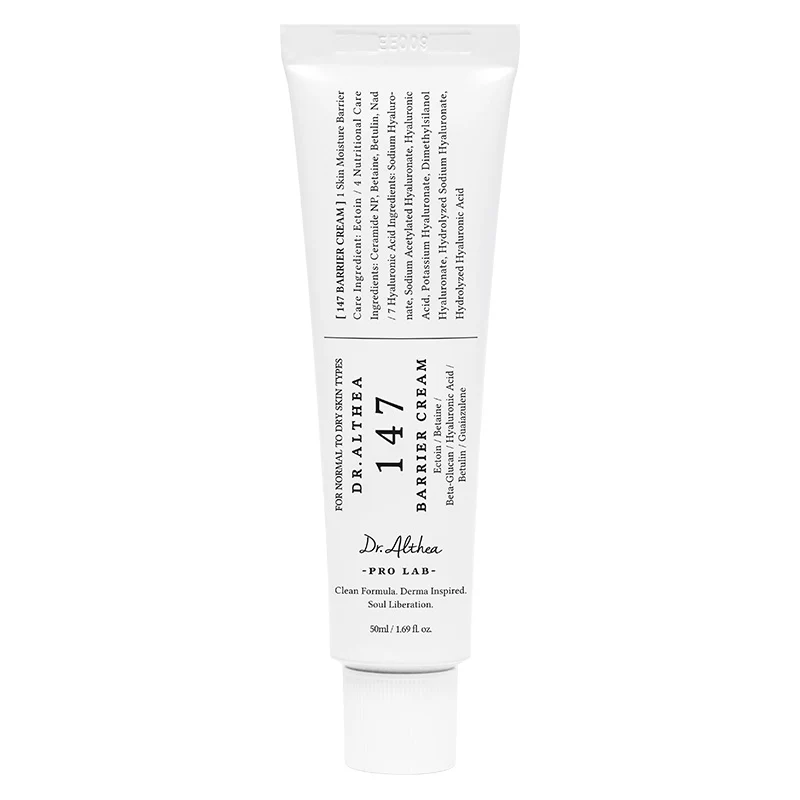
Dr.Althea
147 Barrier Cream
face cream
Dr.Althea
face cream
Added Last edited
Fit by skin type
General, ingredient-based — not your personalized match.

See how this fits your skin
Take the skin test and I'll show you how suitable this product is for you.
Take the skin testThe Dr. Althea 147 Barrier Cream is a sophisticated skincare solution formulated to enhance the skin's barrier, deeply nourish, and provide lasting hydration. At its core is the patented Paeonia Albiflora Flower Extract, which, along with other nourishing extracts like avocado fruit and ceramides, ensures comprehensive skin care. This cream is enriched with a seven-layered hyaluronic acid complex, delivering hydration across various skin depths, promoting plumpness, and offering potential anti-aging benefits. Despite its rich composition, the cream imparts a silky, non-greasy finish, making it ideal for those seeking an all-in-one skincare solution that addresses hydration, nourishment, and skin barrier protection.
147 Barrier Cream is a lightweight cream from Dr.Althea. The formula is built mainly around hydration. The ingredient list runs to 58 ingredients, each broken down in full below.
By its ingredient list the formula reads as light: water and humectants lead, with emollients kept lower in the order. Silicones in the formula tend to give a smooth, blurred finish and help it grip under makeup. Hydration is handled by Glycerin, Sodium Hyaluronate and Butylene Glycol, humectants that pull water into the upper layers of skin rather than sealing it there.
Hydration: Very high. Ingredients that pull and hold water in the upper layers of skin, and here that comes from Glycerin, Sodium Hyaluronate, Butylene Glycol and Ethylhexylglycerin.
Barrier support: Moderate. Lipids and repair signals that support skin barrier integrity, and here that comes from Hydrogenated Lecithin, Cholesterol, Ceramide NP and Glucosyl Ceramide NP.
On richness alone it suits Balanced skin best, and is the least natural fit for Dry and Combination (dry) skin. Nothing in the list is flagged as a common irritant, which is a reasonable starting point for reactive skin — though a patch test is still the only way to know.
The formula contributes little or nothing on antioxidant protection, oil control, brightening and tone and cell renewal. That is not a fault — most products are not meant to do everything — but if one of those is your priority, this is not the product that will address it.
Reading the full list, the formula is fragrance-free, essential-oil-free, no drying alcohol, paraben-free, microplastic-free and sulfate-free. Those claims come from the ingredient list itself, not from the packaging.
It can be used morning and evening. In a routine it goes after serums. Seal in your serums with it; in the morning, sunscreen still goes on top.
This summary is generated from the product's ingredient list. It is not a review, it is not the brand's own marketing claims, and it does not replace advice from a dermatologist.
Drawn purely from the ingredient list
Scored on how rich or light the formula reads from its INCI order.
No ingredient in this formula carries a common-irritant flag, making it a reasonable option for reactive skin. A patch test is still recommended, as individual skin reactivity varies.
Based on the curated benefits documented for this product's ingredients.
Attracts and locks in moisture to keep skin plump and dewy
Boosts collagen and cell turnover to reduce fine lines and wrinkles
Calms redness, irritation, and inflammation for sensitive skin
Brightens and balances complexion for a more uniform appearance
Regulates sebum production to reduce shine and greasiness
None of the ingredients in this formula are associated with these benefits. This is not unusual, as most products are designed to target a limited number of concerns.
The actives, UV filters and benefit-carrying ingredients in this formula, in the order they are listed.
1st on the list, which puts it at an estimated 30–80% of the formula.
Aqua (EU),Deionized Water,Distilled Water,Micromatrix Fractile AN,Onsen-Sui (JPN),Purified Water
2nd on the list, which puts it at an estimated 5–20% of the formula.
Glycerine ;Glycerol (INN); Glycerol (RIFM); Glycerolum (EP); Glycyl Alcohol; 1,2,3-Propanetriol; 1,2,3-Trihydroxypropane
4th on the list, which puts it at an estimated 2–10% of the formula.
Alcohols, C16-18
5th on the list, which puts it at an estimated 2–10% of the formula.
Decanoic acid, ester with 1,2,3-propanetriol octanoate; Glycerides, mixed decanoyl and octanoyl
6th on the list, which puts it at an estimated 2–10% of the formula.
1,1,1,3,5,5,5-Heptamethyl-3-(trimethylsilyloxy)trisiloxane
7th on the list, which puts it at an estimated 1–5% of the formula.
1-Decene, homopolymer, hydrogenated
9th on the list, below the 1% line — present at under 1%, which for most ingredients is the level they work at.
1,1,5,5,5-Hexamethyl-3-phenyl-3-[(trimethylsilyl)oxy]trisiloxane
12th on the list, below the 1% line — present at under 1%, which for most ingredients is the level they work at.
Octadecanoic acid, reaction products with 1,2,3-propanetriol (1:1), neutralized
16th on the list, below the 1% line — present at under 1%, which for most ingredients is the level they work at.
Brassica Oleracea Acephala Leaf Extract is the extract of the leaves of Brassica oleracea L., var. acephala, Brassicaceae
19th on the list, below the 1% line — present at under 1%, which for most ingredients is the level they work at.
Lecithins, hydrogenated
20th on the list, below the 1% line — present at under 1%, which for most ingredients is the level they work at.
Hyaluronic acid, sodium, salt
21st on the list, below the 1% line — present at under 1%, which for most ingredients is the level they work at.
Cetearyl Olivate is the ester of Cetearyl Alcohol and the fatty acids derived from olive oil
Each axis is scored from the ingredients present and how high up the list they sit.
Ingredients that pull and hold water in the upper layers of skin
Lipids and repair signals that support skin barrier integrity
Ingredients that mop up free radicals from UV and pollution
Ingredients that moderate sebum or absorb shine
Ingredients that act on uneven tone and post-inflammatory marks
Ingredients aimed at visible redness and reactivity
Retinoids, acids and enzymes that speed surface turnover
Peptides and growth factors that signal for collagen support
"Active" here means an ingredient carrying a recorded active type or a recognised UV filter.
Solvents, emollients, texture agents and preservatives — the formula that carries the actives.
Read from the full ingredient list. A brand's own claim may differ.
Methyl Trimethicone, Phenyl Trimethicone, Dimethicone/vinyl Dimethicone Crosspolymer
Judged by the same curated rules our routine checker uses. It reads the ingredients, not the label.
Nothing in this formula belongs to a group our rules can put in conflict, so it layers freely. Order still matters — thinnest texture first.
This product is the "Moisturise" step.
Flags to check, not verdicts. None of this is medical advice — if you are pregnant, breastfeeding or treating a skin condition, ask a doctor.
Most ingredients do more than one job, so these counts add up to more than the 58 ingredients on the label.
Sets the thickness, spread and stability of the formula
Draws water into the upper layers of skin
Changes how skin behaves rather than how it feels
Softens and smooths by filling gaps between skin cells
Lifts oil and dirt, or holds oil and water together
Dissolves and carries everything else
Botanical material, usually for antioxidants or scent
Forms a film that slows water loss
Neutralises free radicals from UV and pollution
Calms visible redness and irritation
Binds trace metals that would otherwise spoil the formula
Loosens or dissolves dead surface cells
Keeps the product free of microbial growth
Every ingredient on the label, in order, with what it does and roughly how much of it is likely to be there.
1st on the list, which puts it at an estimated 30–80% of the formula.
Aqua (EU),Deionized Water,Distilled Water,Micromatrix Fractile AN,Onsen-Sui (JPN),Purified Water
2nd on the list, which puts it at an estimated 5–20% of the formula.
Glycerine ;Glycerol (INN); Glycerol (RIFM); Glycerolum (EP); Glycyl Alcohol; 1,2,3-Propanetriol; 1,2,3-Trihydroxypropane
3rd on the list, which puts it at an estimated 5–20% of the formula.
1,1'-Oxydipropan-2-ol; Oxydipropan-2-ol; Hydroxypropyloxypropanol
4th on the list, which puts it at an estimated 2–10% of the formula.
Alcohols, C16-18
5th on the list, which puts it at an estimated 2–10% of the formula.
Decanoic acid, ester with 1,2,3-propanetriol octanoate; Glycerides, mixed decanoyl and octanoyl
6th on the list, which puts it at an estimated 2–10% of the formula.
1,1,1,3,5,5,5-Heptamethyl-3-(trimethylsilyloxy)trisiloxane
7th on the list, which puts it at an estimated 1–5% of the formula.
1-Decene, homopolymer, hydrogenated
8th on the list, below the 1% line — present at under 1%, which for most ingredients is the level they work at.
9th on the list, below the 1% line — present at under 1%, which for most ingredients is the level they work at.
1,1,5,5,5-Hexamethyl-3-phenyl-3-[(trimethylsilyl)oxy]trisiloxane
10th on the list, below the 1% line — present at under 1%, which for most ingredients is the level they work at.
Olus Oil (EU)
11th on the list, below the 1% line — present at under 1%, which for most ingredients is the level they work at.
Dimethicone/Vinyl Dimethicone Crosspolymer is a crosslinked dimethyl siloxane polymer (silicone elastomer) that is formed by the reaction between Hydrogen Dimethicone or Bis-Hydrogen Dimethicone, and Vinyl Dimethicone or Bis-Vinyldimethicone.
12th on the list, below the 1% line — present at under 1%, which for most ingredients is the level they work at.
Octadecanoic acid, reaction products with 1,2,3-propanetriol (1:1), neutralized
13th on the list, below the 1% line — present at under 1%, which for most ingredients is the level they work at.
Coptis Japonica Root Extract is an extract of the roots of Coptis japonica, Ranunculaceae
14th on the list, below the 1% line — present at under 1%, which for most ingredients is the level they work at.
Artemisia Princeps Leaf Extract is an extract of the leaves of Artemisia princeps, Compositae
15th on the list, below the 1% line — present at under 1%, which for most ingredients is the level they work at.
Persea Gratissima Fruit Extract is an extract of the fruit of the Avocado, Persea gratissima, Lauraceae
16th on the list, below the 1% line — present at under 1%, which for most ingredients is the level they work at.
Brassica Oleracea Acephala Leaf Extract is the extract of the leaves of Brassica oleracea L., var. acephala, Brassicaceae
17th on the list, below the 1% line — present at under 1%, which for most ingredients is the level they work at.
Hydrolyzed Gardenia Florida Extract is the hydrolysate of Gardenia Florida L., Rubiaceae, Extract derived by acid, enzyme or other method of hydrolysis
18th on the list, below the 1% line — present at under 1%, which for most ingredients is the level they work at.
Paeonia Albiflora Flower Extract is an extract of the flowers of the Peony, Paeonia albiflora, Ranunculaceae
19th on the list, below the 1% line — present at under 1%, which for most ingredients is the level they work at.
Lecithins, hydrogenated
20th on the list, below the 1% line — present at under 1%, which for most ingredients is the level they work at.
Hyaluronic acid, sodium, salt
21st on the list, below the 1% line — present at under 1%, which for most ingredients is the level they work at.
Cetearyl Olivate is the ester of Cetearyl Alcohol and the fatty acids derived from olive oil
22nd on the list, below the 1% line — present at under 1%, which for most ingredients is the level they work at.
Hexadecanoic acid
23rd on the list, below the 1% line — present at under 1%, which for most ingredients is the level they work at.
D-Glucitol, 1,4-Anhydro-, 6-monoester with olive oil fatty acids
24th on the list, below the 1% line — present at under 1%, which for most ingredients is the level they work at.
Alcohols, C12-16
25th on the list, below the 1% line — present at under 1%, which for most ingredients is the level they work at.
Docosan-1-ol
26th on the list, below the 1% line — present at under 1%, which for most ingredients is the level they work at.
Stearic acid
27th on the list, below the 1% line — present at under 1%, which for most ingredients is the level they work at.
Microcrystalline Cellulose is the isolated, colloidal crystalline portion of cellulose fibers.
28th on the list, below the 1% line — present at under 1%, which for most ingredients is the level they work at.
D-Glucopyranose, C16-18 alkyl glycosides
29th on the list, below the 1% line — present at under 1%, which for most ingredients is the level they work at.
Butane-1,3-diol (CAS No. 107-88-0/ EC No. 203-529-7) (R)-(-)-butane-1,3-diol” (CAS No. 6290-03-5/ EC No. 228-532-0)
30th on the list, below the 1% line — present at under 1%, which for most ingredients is the level they work at.
1,2-Propanediol, 3-(2-ethylhexyloxy)
31st on the list, below the 1% line — present at under 1%, which for most ingredients is the level they work at.
Ammonium Acryloyldimethyltaurate/VP Copolymer is a copolymer of ammonium acryloyldimethyltaurate and vinylpyrrolidone monomers
32nd on the list, below the 1% line — present at under 1%, which for most ingredients is the level they work at.
1,2,3-Propanetriol, homopolymer, tetradecanoates (1:1) (10 mol glycerol average molar ratio)
33rd on the list, below the 1% line — present at under 1%, which for most ingredients is the level they work at.
2-Propenoic acid, 2-methyl-, homopolymer, ester with 1,2,3-propanetriol
34th on the list, below the 1% line — present at under 1%, which for most ingredients is the level they work at.
Cellulose, carboxymethyl ether, sodium salt
35th on the list, below the 1% line — present at under 1%, which for most ingredients is the level they work at.
Cholest-5-en-3-ol (beta)-
36th on the list, below the 1% line — present at under 1%, which for most ingredients is the level they work at.
Ceramide NP,1,3,4-Octadecanetriol, 2-Octadecanamide,Stearoyl-C18-Phytosphingosine,Stearoyl-4-Hydroxysphinganine
37th on the list, below the 1% line — present at under 1%, which for most ingredients is the level they work at.
Disodium dihydrogen ethylenediaminetetraacetate
38th on the list, below the 1% line — present at under 1%, which for most ingredients is the level they work at.
Stearic acid, monoester with glycerol
39th on the list, below the 1% line — present at under 1%, which for most ingredients is the level they work at.
2-Methyl-1,3-propanediol
40th on the list, below the 1% line — present at under 1%, which for most ingredients is the level they work at.
Maltodextrin
41st on the list, below the 1% line — present at under 1%, which for most ingredients is the level they work at.
7-Isopropyl-1,4-dimethylazulene
42nd on the list, below the 1% line — present at under 1%, which for most ingredients is the level they work at.
Glucosyl Ceramide NP is the product obtained by the reaction of Glucose and Ceramide NP.
43rd on the list, below the 1% line — present at under 1%, which for most ingredients is the level they work at.
1,3,4-Octadecanetriol, 2-(2-Hydroxy) Stearamide
44th on the list, below the 1% line — present at under 1%, which for most ingredients is the level they work at.
L-Arginine
45th on the list, below the 1% line — present at under 1%, which for most ingredients is the level they work at.
2-Propenoic acid, polymer with 2,2-bis(hydroxymethyl)propane-1,3-diol 2-propenyl ether
46th on the list, below the 1% line — present at under 1%, which for most ingredients is the level they work at.
Ceramide NG,Ceramide NS,1,3-Hexadecanediol, 2-Hexadecanamide,Palmitoyl-C16-Dihydrosphingosine,1-Stearoyl-C18-Sphingosine
47th on the list, below the 1% line — present at under 1%, which for most ingredients is the level they work at.
Ceramide 2
48th on the list, below the 1% line — present at under 1%, which for most ingredients is the level they work at.
3,4-Dihydro-2,5,7,8-tetramethyl-2-(4,8,12-trimethyltridecyl)-2H-benzopyran-6-ol; .alpha.-tocopherol; Vitamin E
49th on the list, below the 1% line — present at under 1%, which for most ingredients is the level they work at.
Dimethylsilanol Hyaluronate is the ester of dimethylsilanol and hyaluronic acid.
50th on the list, below the 1% line — present at under 1%, which for most ingredients is the level they work at.
Hydrolyzed Sodium Hyaluronate is the hydrolysate of Sodium Hyaluronate derived by acid, enzyme or other method of hydrolysis
51st on the list, below the 1% line — present at under 1%, which for most ingredients is the level they work at.
Hydrolyzed Hyaluronic Acid is the hydrolysate of Hyaluronic Acid derived by acid, enzyme or other method of hydrolysis
52nd on the list, below the 1% line — present at under 1%, which for most ingredients is the level they work at.
Hyaluronic acid, potassium salt
53rd on the list, below the 1% line — present at under 1%, which for most ingredients is the level they work at.
Hyaluronic acid
54th on the list, below the 1% line — present at under 1%, which for most ingredients is the level they work at.
Hyaluronic acid, sodium salt, polymer with 1,1'-sulfonylbis[ethene]
55th on the list, below the 1% line — present at under 1%, which for most ingredients is the level they work at.
Hyaluronic acid, 2-hydroxy-3-(N,N,N-trimethylammonio)propyl chloride derivatives
56th on the list, below the 1% line — present at under 1%, which for most ingredients is the level they work at.
Hyaluronic acid, sodium salt, compd. with dimethylsilanediol
57th on the list, below the 1% line — present at under 1%, which for most ingredients is the level they work at.
58th on the list, below the 1% line — present at under 1%, which for most ingredients is the level they work at.
Ceramide EOP,1,3,4-Octadecanetriol, 2-Stearoyloxyheptacosamide,Stearoyloxyheptacosanoyl-C18-Phytosphingosine,Stearoyloxyheptacosanoyl-4-Hydroxysphinganine
Products in the same category that share this formula's distinguishing ingredients.
Dr. Althea
Shares 21 key ingredients with 147 Barrier Cream: Water, Glycerin, Cetearyl Alcohol, Caprylic/capric Triglyceride, Methyl Trimethicone
Medicube
Shares 16 key ingredients with 147 Barrier Cream: Water, Caprylic/capric Triglyceride, Hydrogenated Polydecene, Cetearyl Olivate, Glycerin
Mary&May
Shares 15 key ingredients with 147 Barrier Cream: Glycerin, Water, Caprylic/capric Triglyceride, Cetearyl Alcohol, Cetearyl Olivate
Dr.Jart+
Shares 14 key ingredients with 147 Barrier Cream: Water, Glycerin, Caprylic/capric Triglyceride, Cetearyl Alcohol, Hydrogenated Polydecene
VT Cosmetics
Shares 14 key ingredients with 147 Barrier Cream: Water, Glycerin, Caprylic/capric Triglyceride, Cetearyl Alcohol, Hydrogenated Lecithin
VT Cosmetics
Shares 14 key ingredients with 147 Barrier Cream: Water, Glycerin, Hyaluronic Acid, Caprylic/capric Triglyceride, Cetearyl Alcohol
WATER, GLYCERIN, DIPROPYLENE GLYCOL, CETEARYL ALCOHOL, CAPRYLIC/CAPRIC TRIGLYCERIDE, METHYL TRIMETHICONE, HYDROGENATED POLYDECENE, 1,2-HEXANEDIOL, PHENYL TRIMETHICONE, VEGETABLE OIL, DIMETHICONE/VINYL DIMETHICONE CROSSPOLYMER, GLYCERYL STEARATE SE, COPTIS JAPONICA ROOT EXTRACT, ARTEMISIA PRINCEPS LEAF EXTRACT, PERSEA GRATISSIMA FRUIT EXTRACT, BRASSICA OLERACEA ACEPHALA LEAF EXTRACT, HYDROLYZED GARDENIA FLORIDA EXTRACT, PAEONIA ALBIFLORA FLOWER EXTRACT, HYDROGENATED LECITHIN, SODIUM HYALURONATE, CETEARYL OLIVATE, PALMITIC ACID, SORBITAN OLIVATE, C12-16 ALCOHOLS, BEHENYL ALCOHOL, STEARIC ACID, MICROCRYSTALLINE CELLULOSE, CETEARYL GLUCOSIDE, BUTYLENE GLYCOL, ETHYLHEXYLGLYCERIN, AMMONIUM ACRYLOYLDIMETHYLTAURATE/VP COPOLYMER, POLYGLYCERYL-10 MYRISTATE, GLYCERYL POLYMETHACRYLATE, CELLULOSE GUM, CHOLESTEROL, CERAMIDE NP, DISODIUM EDTA, GLYCERYL STEARATE, METHYLPROPANEDIOL, MALTODEXTRIN, GUAIAZULENE, GLUCOSYL CERAMIDE NP, CERAMIDE AP, ARGININE, CARBOMER, CERAMIDE NS, CERAMIDE NG, TOCOPHEROL, DIMETHYLSILANOL HYALURONATE, HYDROLYZED SODIUM HYALURONATE, HYDROLYZED HYALURONIC ACID, POTASSIUM HYALURONATE, HYALURONIC ACID, SODIUM HYALURONATE CROSSPOLYMER, HYDROXYPROPYLTRIMONIUM HYALURONATE, SODIUM HYALURONATE DIMETHYLSILANOL, SODIUM ACETYL ETHYLCARBOXYL METHYLTHIAZOLIDINE CARBOXYLATE, CERAMIDE EOP.
SODIUM HYALURONATE, CERAMIDE NP, CERAMIDE AP, CERAMIDE NS, CERAMIDE NG, HYDROLYZED HYALURONIC ACID, POTASSIUM HYALURONATE, HYALURONIC ACID, SODIUM HYALURONATE CROSSPOLYMER, CERAMIDE EOP.
Wash your face with a gentle cleanser suited for your skin type. Apply less viscous skincare products like toner first. Apply an adequate amount of the 147 Barrier Cream as your final or semi-final step in your skincare routine.
Judged on how rich the formula reads from its ingredient list, it suits Balanced skin best. It is the least natural fit for Dry, Combination (dry) skin.
No ingredient in this formula carries a common-irritant flag, making it a reasonable option for reactive skin. A patch test is still recommended, as individual skin reactivity varies.
5 ingredients could feed malassezia: Glyceryl Stearate SE, Cetearyl Olivate, Sorbitan Olivate, Polyglyceryl-10 Myristate, Glyceryl Stearate. That describes the yeast's food supply, not a prediction that they will cause a breakout.
Nothing in this formula is on the standard pregnancy-caution list. That is not medical clearance — check anything you use daily with your doctor or midwife.
Yes. Reading the full ingredient list, this formula is fragrance-free.
No. Reading the full ingredient list, this formula is no drying alcohol.
No — it contains Methyl Trimethicone, Phenyl Trimethicone, Dimethicone/vinyl Dimethicone Crosspolymer.
No. Reading the full ingredient list, this formula is essential-oil-free.
Yes. Reading the full ingredient list, this formula is paraben-free.
It layers well with Vitamin C (L-ascorbic acid), Retinoids (retinol, retinal), AHAs (glycolic, lactic), BHA (salicylic acid), PHAs (gluconolactone), Benzoyl peroxide.
Use it morning and evening, after serums.
It lists 58 ingredients, of which 10 are recorded as actives.
Dr.Althea.
We can't find the internet
Attempting to reconnect
Something went wrong!
Attempting to reconnect