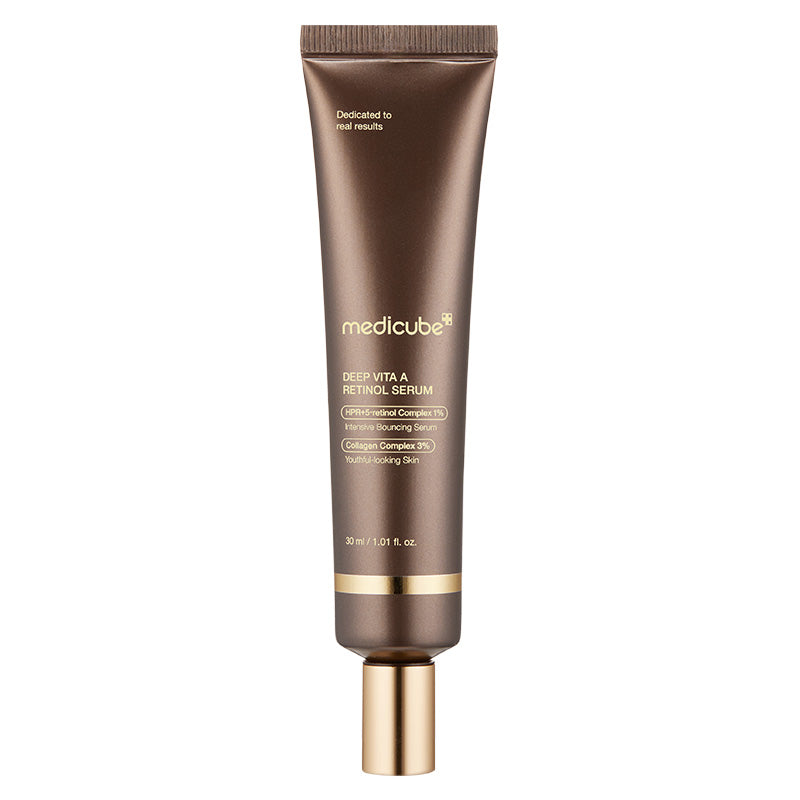
Medicube Deep Vita A Retinol Serum

Medicube

Deep Vita A Retinol Serum

face serum

Added Last edited

Fit by skin type

General, ingredient-based — not your personalized match.

Dry
67%
Combination (dry)
67%
Balanced
97%
Combination (oily)
73%
Oily
73%

See how this fits your skin

Take the skin test and I'll show you how suitable this product is for you.

Take the skin test
65
Ingredients
8
Benefits
6
Actives
Find Dupes

Deep Vita A Retinol Serum is a powerful anti-aging solution designed to improve skin texture, reduce fine lines, and promote a radiant, youthful complexion. Enriched with stabilized retinol and nourishing vitamins, it supports skin renewal while minimizing irritation, making it suitable even for sensitive skin. Lightweight and fast-absorbing, it leaves your skin smooth and revitalized.

Key Insights

Benefits

8
Anti-Acne
Anti-Aging
Dark Spot Fading
Evens Skin Tone
Hydration
Oil Control
Pore Minimizer
Soothing

Active Ingredients

6
Bakuchiol Ceramides Hyaluronic acid Retinoids Vitamin B3 (niacinamide) Vitamin B5 (panthenol)

Risks

2
Pregnancy Unsafe
Synthetic polymer

Full Ingredients

65 total
WATER DIPROPYLENE GLYCOL BUTYLENE GLYCOL GLYCERIN PROPANEDIOL 1,2-HEXANEDIOL NIACINAMIDE Vitamin B3 (niacinamide) COCO-CAPRYLATE/CAPRATE SQUALANE POLYGLYCERYL-3 DISTEARATE DIMETHYL ISOSORBIDE PENTYLENE GLYCOL PANTHENOL Vitamin B5 (panthenol) 4-T-BUTYLCYCLOHEXANOL PARFUM HYDROGENATED LECITHIN HYDROXYETHYL ACRYLATE/SODIUM ACRYLOYLDIMETHYL TAURATE COPOLYMER ACRYLATES/C10-30 ALKYL ACRYLATE CROSSPOLYMER SUCROSE PALMITATE CAPRYLIC/CAPRIC TRIGLYCERIDE HYDROXYPINACOLONE RETINOATE Retinoids DIETHYLHEXYL SYRINGYLIDENEMALONATE TROMETHAMINE ETHYLHEXYLGLYCERIN GLYCERYL STEARATE CITRATE ALLANTOIN BIOSACCHARIDE GUM-1 DIPOTASSIUM GLYCYRRHIZATE XANTHAN GUM MACADAMIA INTEGRIFOLIA SEED OIL OLEA EUROPAEA FRUIT OIL SIMMONDSIA CHINENSIS SEED OIL VITIS VINIFERA SEED OIL ADENOSINE MACADAMIA TERNIFOLIA SEED OIL RETINAL Retinoids SODIUM HYALURONATE Hyaluronic acid DISODIUM EDTA RETINOL Retinoids BAKUCHIOL Bakuchiol RETINYL PALMITATE Retinoids BRASSICA CAMPESTRIS STEROLS LINOLEIC ACID CHOLESTEROL POLYGLYCERYL-10 LAURATE CERAMIDE NP Ceramides PPG-13-DECYLTETRADECETH-24 RETINYL LINOLEATE Retinoids PHYTOSTERYL/BEHENYL/OCTYLDODECYL LAUROYL GLUTAMATE BETA-GLUCAN ALUMINUM/MAGNESIUM HYDROXIDE STEARATE PENTAERYTHRITYL TETRA-DI-T-BUTYL HYDROXYHYDROCINNAMATE POTASSIUM CETYL PHOSPHATE POLYGLYCERYL-3 METHYLGLUCOSE DISTEARATE SILICA ISOPROPYL LAUROYL SARCOSINATE TOCOPHEROL HYDROLYZED COLLAGEN RETINYL RETINOATE Retinoids CHITOSAN CENTELLA ASIATICA EXTRACT CENTELLA ASIATICA LEAF EXTRACT CENTELLA ASIATICA ROOT EXTRACT TRIS(TETRAMETHYLHYDROXYPIPERIDINOL) CITRATE BENZOTRIAZOLYL DODECYL P-CRESOL

About Deep Vita A Retinol Serum

Overview

Deep Vita A Retinol Serum is a cushioning serum from Medicube, a brand based in Korea. The formula is built mainly around hydration and soothing. The ingredient list runs to 65 ingredients, each broken down in full below.

Texture and finish

By its ingredient list the formula reads as moderately cushioned — emollient enough to feel like a cream, without the heaviest occlusives near the top. The oils in it point to a dewy, emollient finish rather than a matte one. Hydration is handled by Butylene Glycol, Glycerin and Propanediol, humectants that pull water into the upper layers of skin rather than sealing it there.

What the formula does

Hydration: High. Ingredients that pull and hold water in the upper layers of skin, and here that comes from Butylene Glycol, Glycerin, Propanediol and Panthenol.

Soothing: High. Ingredients aimed at visible redness and reactivity, and here that comes from Panthenol, Hydroxypinacolone Retinoate, Allantoin and Beta-glucan.

Barrier support: Moderate. Lipids and repair signals that support skin barrier integrity, and here that comes from Niacinamide, Squalane, Panthenol and Hydrogenated Lecithin.

Brightening: Moderate. Ingredients that act on uneven tone and post-inflammatory marks, and here that comes from Niacinamide, Dipotassium Glycyrrhizate, Hydroxypinacolone Retinoate and Retinal.

Who it suits

On richness alone it suits Balanced skin best, and is the least natural fit for Dry, Combination (dry), Combination (oily) and Oily skin. Nothing in the list is flagged as a common irritant, which is a reasonable starting point for reactive skin — though a patch test is still the only way to know.

What it does not target

The formula contributes little or nothing on antioxidant protection and firmness signalling. That is not a fault — most products are not meant to do everything — but if one of those is your priority, this is not the product that will address it.

What is not in it

Reading the full list, the formula is essential-oil-free, no drying alcohol, paraben-free, silicone-free, microplastic-free and sulfate-free. Those claims come from the ingredient list itself, not from the packaging. It does contain fragrance, worth knowing if your skin reacts to any of them.

Where it fits in a routine

It can be used morning and evening. In a routine it goes after toner, before moisturiser. Apply to clean, dry skin and give it a minute to absorb before the next layer. Introduce one new treatment at a time so you can identify what is working.

This summary is generated from the product's ingredient list. It is not a review, it is not the brand's own marketing claims, and it does not replace advice from a dermatologist.

Pros and cons

Drawn purely from the ingredient list

Pros

  • No essential oils
  • No drying alcohol
  • Silicone-free
  • No microplastics
  • Strong humectant content for hydration
  • Several soothing ingredients
  • No common irritants flagged in the list

Things to know

  • Contains fragrance or declared fragrance allergens
  • 13 ingredients could feed malassezia (fungal acne)
  • Contains ingredients usually flagged for review during pregnancy

Which skin types it suits

Scored on how rich or light the formula reads from its INCI order.

Suitable for

  • Balanced skin

Less suitable for

  • Dry skin
  • Combination (dry) skin
  • Combination (oily) skin
  • Oily skin

Sensitive skin

No ingredient in this formula carries a common-irritant flag, making it a reasonable option for reactive skin. A patch test is still recommended, as individual skin reactivity varies.

Skin concerns

Based on the curated benefits documented for this product's ingredients.

Helps with

  • Hydration 19 ingredients

    Attracts and locks in moisture to keep skin plump and dewy

  • Anti-Aging 17 ingredients

    Boosts collagen and cell turnover to reduce fine lines and wrinkles

  • Soothing 12 ingredients

    Calms redness, irritation, and inflammation for sensitive skin

  • Evens Skin Tone 4 ingredients

    Brightens and balances complexion for a more uniform appearance

  • Anti-Acne 3 ingredients

    Targets breakouts by reducing bacteria and unclogging pores

  • Pore Minimizer 3 ingredients

    Tightens and refines the look of enlarged pores

  • Oil Control 2 ingredients

    Regulates sebum production to reduce shine and greasiness

  • Dark Spot Fading 1 ingredient

    Fades hyperpigmentation and evens out dark spots over time

Does not target

Blackhead Reducing Smooths Bumpy Skin

None of the ingredients in this formula are associated with these benefits. This is not unusual, as most products are designed to target a limited number of concerns.

Key ingredients

The actives, UV filters and benefit-carrying ingredients in this formula, in the order they are listed.

1st on the list, which puts it at an estimated 30–80% of the formula.

Aqua (EU),Deionized Water,Distilled Water,Micromatrix Fractile AN,Onsen-Sui (JPN),Purified Water

Hydration
3rd on the list, which puts it at an estimated 5–20% of the formula.

Butane-1,3-diol (CAS No. 107-88-0/ EC No. 203-529-7) (R)-(-)-butane-1,3-diol” (CAS No. 6290-03-5/ EC No. 228-532-0)

Hydration

4th on the list, which puts it at an estimated 2–10% of the formula.

Glycerine ;Glycerol (INN); Glycerol (RIFM); Glycerolum (EP); Glycyl Alcohol; 1,2,3-Propanetriol; 1,2,3-Trihydroxypropane

Hydration Anti-Aging

5th on the list, which puts it at an estimated 2–10% of the formula.

1,3-dihydroxypropane

Hydration
Niacinamide Vitamin B3 (niacinamide)

7th on the list, below the 1% line — present at under 1%, which for most ingredients is the level they work at.

Niacinamide (vitamin B3) is a gentle skincare active that repairs the skin barrier, calms redness, controls oil and evens tone at 2–5%. Official IUPAC name: **3-Pyridinecarboxamide**

Soothing Anti-Aging Pore Minimizer

9th on the list, below the 1% line — present at under 1%, which for most ingredients is the level they work at.

2,6,10,15,19,23-Hexamethyltetracosane

Hydration Anti-Aging

12th on the list, below the 1% line — present at under 1%, which for most ingredients is the level they work at.

1,2-Dihydroxypentane

Hydration
Panthenol Vitamin B5 (panthenol)

13th on the list, below the 1% line — present at under 1%, which for most ingredients is the level they work at.

Butanamide, 2,4-dihydroxy-N-(3-hydroxypropyl)-3,3-dimethyl-, (2R)-; dl-Panthenol

Hydration Soothing

16th on the list, below the 1% line — present at under 1%, which for most ingredients is the level they work at.

Lecithins, hydrogenated

Hydration

20th on the list, below the 1% line — present at under 1%, which for most ingredients is the level they work at.

Decanoic acid, ester with 1,2,3-propanetriol octanoate; Glycerides, mixed decanoyl and octanoyl

Hydration

21st on the list, below the 1% line — present at under 1%, which for most ingredients is the level they work at.

Anti-Acne Anti-Aging Evens Skin Tone

22nd on the list, below the 1% line — present at under 1%, which for most ingredients is the level they work at.

Propanedioic Acid, [(4-Hydroxy-3,5-Dimethoxyphenyl)Methylene]-, Bis(2-Ethylhexyl) Ester

Anti-Aging

Formula analysis

Each axis is scored from the ingredients present and how high up the list they sit.

Hydration High

Ingredients that pull and hold water in the upper layers of skin

Barrier support Moderate

Lipids and repair signals that support skin barrier integrity

Antioxidant support None

Ingredients that mop up free radicals from UV and pollution

Oil control Moderate

Ingredients that moderate sebum or absorb shine

Brightening Moderate

Ingredients that act on uneven tone and post-inflammatory marks

Soothing High

Ingredients aimed at visible redness and reactivity

Cell renewal Moderate

Retinoids, acids and enzymes that speed surface turnover

Firmness signalling None

Peptides and growth factors that signal for collagen support

Active and supporting ingredients

"Active" here means an ingredient carrying a recorded active type or a recognised UV filter.

Active ingredients (11)

Supporting ingredients (54)

Solvents, emollients, texture agents and preservatives — the formula that carries the actives.

Water Dipropylene Glycol Butylene Glycol Glycerin Propanediol 1,2-hexanediol Coco-caprylate/caprate Squalane Polyglyceryl-3 Distearate Dimethyl Isosorbide Pentylene Glycol 4-t-butylcyclohexanol Parfum Hydrogenated Lecithin Hydroxyethyl Acrylate/sodium Acryloyldimethyl Taurate Copolymer Acrylates/c10-30 Alkyl Acrylate Crosspolymer Sucrose Palmitate Caprylic/capric Triglyceride Diethylhexyl Syringylidenemalonate Tromethamine Ethylhexylglycerin Glyceryl Stearate Citrate Allantoin Biosaccharide Gum-1 Dipotassium Glycyrrhizate Xanthan Gum Macadamia Integrifolia Seed Oil Olea Europaea Fruit Oil Simmondsia Chinensis Seed Oil Vitis Vinifera Seed Oil Adenosine Macadamia Ternifolia Seed Oil Disodium Edta Brassica Campestris Sterols Linoleic Acid Cholesterol Polyglyceryl-10 Laurate Ppg-13-decyltetradeceth-24 Phytosteryl/behenyl/octyldodecyl Lauroyl Glutamate Beta-glucan Aluminum/magnesium Hydroxide Stearate Pentaerythrityl Tetra-di-t-butyl Hydroxyhydrocinnamate Potassium Cetyl Phosphate Polyglyceryl-3 Methylglucose Distearate Silica Isopropyl Lauroyl Sarcosinate Tocopherol Hydrolyzed Collagen Chitosan Centella Asiatica Extract Centella Asiatica Leaf Extract Centella Asiatica Root Extract Tris(tetramethylhydroxypiperidinol) Citrate Benzotriazolyl Dodecyl P-cresol

What is and is not in it

Read from the full ingredient list. A brand's own claim may differ.

Free from

  • Essential-oil-free
  • No drying alcohol
  • Paraben-free
  • Silicone-free
  • Microplastic-free
  • Sulfate-free
  • Dye-free
  • No animal-derived ingredients

Contains

  • Fragrance

    Parfum

  • Facial oils

    Macadamia Integrifolia Seed Oil, Olea Europaea Fruit Oil, Simmondsia Chinensis Seed Oil, Vitis Vinifera Seed Oil, Macadamia Ternifolia Seed Oil

What to layer it with

Judged by the same curated rules our routine checker uses. It reads the ingredients, not the label.

Compatible with

  • Retinoids (retinol, retinal)
  • Copper peptides
  • Bakuchiol
  • Niacinamide
  • Hyaluronic acid
  • Ceramides
  • Signal peptides
  • Panthenol
  • Sunscreen

Use with caution

  • AHAs (glycolic, lactic)

    Best kept to separate routines — one in the morning, one at night, or on alternate days.

  • BHA (salicylic acid)

    Best kept to separate routines — one in the morning, one at night, or on alternate days.

  • PHAs (gluconolactone)

    Best kept to separate routines — one in the morning, one at night, or on alternate days.

  • Benzoyl peroxide

    Best kept to separate routines — one in the morning, one at night, or on alternate days.

  • Vitamin C (L-ascorbic acid)

    Can be layered, but the combination raises the irritation risk. Go slowly.

  • Azelaic acid

    Can be layered, but the combination raises the irritation risk. Go slowly.

Where it fits in a routine

Morning Evening
  1. Cleanse
  2. Toning
  3. Treat
  4. Moisturise
  5. Protect

This product is the "Treat" step.

  • Apply to clean, dry skin and give it a minute to absorb before the next layer.
  • Introduce one new treatment at a time so you can identify what is working.

Safety and suitability

Flags to check, not verdicts. None of this is medical advice — if you are pregnant, breastfeeding or treating a skin condition, ask a doctor.

Pregnancy and breastfeeding
Contains Retinal, Retinol, Retinyl Palmitate, Retinyl Linoleate, Retinyl Retinoate, Hydroxypinacolone Retinoate, usually reviewed with a doctor during pregnancy.
Fungal acne (malassezia)
13 ingredients could feed malassezia: Polyglyceryl-3 Distearate, Sucrose Palmitate, Glyceryl Stearate Citrate, Macadamia Integrifolia Seed Oil, Olea Europaea Fruit Oil, Simmondsia Chinensis Seed Oil, Vitis Vinifera Seed Oil, Macadamia Ternifolia Seed Oil. That is about the yeast's food supply, not a prediction that you will break out.
Sensitive and reactive skin
No ingredient in this formula carries a common-irritant flag, making it a reasonable option for reactive skin. A patch test is still recommended, as individual skin reactivity varies.
Recorded ingredient risks
Pregnancy Unsafe, Synthetic polymer

Ingredients by function

Most ingredients do more than one job, so these counts add up to more than the 65 ingredients on the label.

12
Emollient

Softens and smooths by filling gaps between skin cells

12
Texture agent

Sets the thickness, spread and stability of the formula

11
Active

Changes how skin behaves rather than how it feels

11
Surfactant

Lifts oil and dirt, or holds oil and water together

8
Solvent

Dissolves and carries everything else

6
Occlusive

Forms a film that slows water loss

5
Humectant

Draws water into the upper layers of skin

3
Antioxidant

Neutralises free radicals from UV and pollution

3
Plant extract

Botanical material, usually for antioxidants or scent

2
Soothing

Calms visible redness and irritation

2
UV filter

Absorbs or scatters ultraviolet light

1
Fragrance / colour

Changes how the product smells or looks

1
Chelator

Binds trace metals that would otherwise spoil the formula

1
Exfoliant

Loosens or dissolves dead surface cells

1
pH adjuster

Sets the acidity the formula needs to work

1
Preservative

Keeps the product free of microbial growth

Ingredient breakdown

Every ingredient on the label, in order, with what it does and roughly how much of it is likely to be there.

1 Water Solvent
Estimated level
30–80%
Confidence
Moderate — INCI order above the 1% line
Roles
Solvent

1st on the list, which puts it at an estimated 30–80% of the formula.

Aqua (EU),Deionized Water,Distilled Water,Micromatrix Fractile AN,Onsen-Sui (JPN),Purified Water

Hydration
3 scientific references
  • Skin Research and Technology, May 2015, pages 131-136
  • Skin Pharmacology and Applied Skin Physiology, November-December 1999, pages 344-351
  • Journal of Cosmetic Science, September-October 1993, pages 249-262
2 Dipropylene Glycol Texture agent
Estimated level
5–20%
Confidence
Moderate — INCI order above the 1% line
Roles
Texture agent, Solvent

2nd on the list, which puts it at an estimated 5–20% of the formula.

1,1'-Oxydipropan-2-ol; Oxydipropan-2-ol; Hydroxypropyloxypropanol

3 Butylene Glycol Humectant
Estimated level
5–20%
Confidence
Moderate — INCI order above the 1% line
Roles
Humectant, Texture agent, Solvent

3rd on the list, which puts it at an estimated 5–20% of the formula.

Butane-1,3-diol (CAS No. 107-88-0/ EC No. 203-529-7) (R)-(-)-butane-1,3-diol” (CAS No. 6290-03-5/ EC No. 228-532-0)

Hydration
5 scientific references
  • CosmeticsInfoorg, Accessed March 2021, ePublication
  • US Food and Drug Administration Code of Federal Regulations</em>, Accessed March 2021, ePublication
  • International Journal of Toxicology, May 2011, pages 5S-16S
  • Skin Research and Technology, November 2007, pages 417-24
  • Journal of the American College of Toxicology, September 1985, pages 223-248
4 Glycerin Humectant
Estimated level
2–10%
Confidence
Moderate — INCI order above the 1% line
Roles
Humectant, Occlusive, Texture agent, Solvent

4th on the list, which puts it at an estimated 2–10% of the formula.

Glycerine ;Glycerol (INN); Glycerol (RIFM); Glycerolum (EP); Glycyl Alcohol; 1,2,3-Propanetriol; 1,2,3-Trihydroxypropane

Hydration Anti-Aging
6 scientific references
  • Journal of Pharmaceutical Investigation, March 2021, pages 223-231
  • International Journal of Toxicology, November/December 2019, Volume 38, Supplement 3, pages 6S-22S
  • International Journal of Cosmetic Science, August 2016, ePublication
  • British Journal of Dermatology, July 2008, pages 23-34
  • Journal of Cosmetic Dermatology, June 2007, pages 75-82
  • Proceedings of the National Academy of Sciences, June 2003, pages 7, 360-7, 365
5 Propanediol Texture agent
Estimated level
2–10%
Confidence
Moderate — INCI order above the 1% line
Roles
Texture agent, Solvent

5th on the list, which puts it at an estimated 2–10% of the formula.

1,3-dihydroxypropane

Hydration
4 scientific references
  • PubChem Compound Summary, April 2021, ePublication
  • SpecialChem, Accessed April 2021, ePublication
  • Cosmetic Ingredient Review, June 2018, pages 1-73
  • Cosmetics & Toiletries, May 2013, pages 81-86
Estimated level
under 1%
Confidence
Moderate — listed below the 1% line
Roles
Solvent

6th on the list, below the 1% line — present at under 1%, which for most ingredients is the level they work at.

7 Niacinamide Active
Estimated level
under 1%
Confidence
Moderate — listed below the 1% line
Roles
Active

7th on the list, below the 1% line — present at under 1%, which for most ingredients is the level they work at.

Niacinamide (vitamin B3) is a gentle skincare active that repairs the skin barrier, calms redness, controls oil and evens tone at 2–5%. Official IUPAC name: **3-Pyridinecarboxamide**

Soothing Anti-Aging Pore Minimizer
15 scientific references
  • International Journal of Dermatology, February 2021, pages 166-173
  • Biomolecules & Therapeutics, July 2019, pages 562-569
  • Experimental Dermatology, February 2019, pages 15-22
  • Dermatologic Therapy, September 2017, ePublication
  • Journal of Investigative Dermatology, May 2017, page S116
  • International Journal of Pharmaceutics, March 2017, pages 158-162
  • Facial Plastic Surgery Clinics of North America, May 2016, pages 145-152
  • Clinical, Cosmetic, and Investigational Dermatology, July 2015, pages 405-412
  • Skin Pharmacology and Physiology, June 2014, pages 311-315
  • International Journal of Pharmacy, January 2013, pages 192-201
  • Dermatoendrocrinology, July 2012, pages 308-319
  • International Journal of Toxicology, September 2005, pages 1-31
  • Dermatologic Surgery, July 2005, pages 860-865
  • International Journal of Cosmetic Science, October 2004, pages 231-238
  • Journal of Cosmetic Dermatology, April 2004, pages 88-93
Estimated level
under 1%
Confidence
Moderate — listed below the 1% line
Roles
Emollient

8th on the list, below the 1% line — present at under 1%, which for most ingredients is the level they work at.

Alcohols, coco, mixed esters with octanoic and decanoic acids

9 Squalane Emollient
Estimated level
under 1%
Confidence
Moderate — listed below the 1% line
Roles
Emollient

9th on the list, below the 1% line — present at under 1%, which for most ingredients is the level they work at.

2,6,10,15,19,23-Hexamethyltetracosane

Hydration Anti-Aging
9 scientific references
  • Cosmetics Ingredient Review, 2019, ePublication
  • ACS Open, July 2017, pages 3, 989–3, 996
  • Indian Journal of Dermatology, May-June 2016, pages 279-297
  • The Journal of Clinical and Aesthetic Dermatology, June 2014, pages 25-32
  • Journal of Cosmetic Science, January-February 2013, pages 59-66
  • Advances in Food and Nutrition Research, 2012, pages 223-233
  • Molecules, January 2009, pages 540-554
  • Journal of Investigative Dermatology, November 2006, pages 2, 430-2, 437
  • Free Radical Research, April 2002, pages 471-477
Estimated level
under 1%
Confidence
Moderate — listed below the 1% line
Roles
Surfactant

10th on the list, below the 1% line — present at under 1%, which for most ingredients is the level they work at.

1,2,3-Propanetriol, homopolymer, octadecanoates (1:2) (2 mol glycerol average molar ratio)

11 Dimethyl Isosorbide Texture agent
Estimated level
under 1%
Confidence
Moderate — listed below the 1% line
Roles
Texture agent, Solvent

11th on the list, below the 1% line — present at under 1%, which for most ingredients is the level they work at.

1,4:3,6-Dianhydro-2,5-di-O-methyl-D-glucitol

Estimated level
under 1%
Confidence
Moderate — listed below the 1% line
Roles
Solvent

12th on the list, below the 1% line — present at under 1%, which for most ingredients is the level they work at.

1,2-Dihydroxypentane

Hydration
4 scientific references
  • https://thedermreviewcom/pentylene-glycol/
  • Regulatory Toxicology and Pharmacology, July 2017, pages 106-111
  • Prospector, June 2015, ePublication
  • International Journal of Toxicology, October 2012, pages 147S-168S
13 Panthenol Active
Estimated level
under 1%
Confidence
Moderate — listed below the 1% line
Roles
Active

13th on the list, below the 1% line — present at under 1%, which for most ingredients is the level they work at.

Butanamide, 2,4-dihydroxy-N-(3-hydroxypropyl)-3,3-dimethyl-, (2R)-; dl-Panthenol

Hydration Soothing
7 scientific references
  • The Linus Pauling Institute, Oregon State University, Accessed April 2021, ePublication
  • International Journal of Cosmetic Science, December 2019, pages 534-547
  • Journal of Cosmetic Dermatology, January 2019, pages 346-354
  • Cosmetic Ingredient Review, March 2018, pages 1-51
  • The Journal of Dermatological Treatment, August 2017, pages 173-180
  • Journal of Cosmetic Science, August 2011, pages 361-370
  • American Journal of Clinical Dermatology, Volume 3, 2002, pages 427-433
Estimated level
under 1%
Confidence
Moderate — listed below the 1% line

14th on the list, below the 1% line — present at under 1%, which for most ingredients is the level they work at.

Cyclohexanol, 4-(1,1-dimethylethyl)-

5 scientific references
  • Journal of Cosmetic Dermatology, June 2020, pages 1,409-1,414
  • International Journal of Cosmetic Science, December 2019, pages 534–547
  • Clinical, Cosmetic and Investigational Dermatology, September 2018, pages 421-429
  • Journal of the European Academy of Dermatology and Venereology, February 2016, pages 9-16; and Volume 30 Supplement, pages 21-27
  • Experimental Dermatology, November 2010, pages 980-986
15 Parfum Fragrance / colour
Estimated level
under 1%
Confidence
Moderate — listed below the 1% line
Roles
Fragrance / colour

15th on the list, below the 1% line — present at under 1%, which for most ingredients is the level they work at.

Parfum is a term for ingredient labelling used to identify that a product contains a material or a combination of materials normally added to a cosmetic to produce or to mask a particular odour. According to Article 19 of the Cosmetics Regulation, 'Perfume and aromatic compositions and their raw materials shall be referred to by the terms ‘parfum’ or ‘aroma’. '

Estimated level
under 1%
Confidence
Moderate — listed below the 1% line
Roles
Surfactant

16th on the list, below the 1% line — present at under 1%, which for most ingredients is the level they work at.

Lecithins, hydrogenated

Hydration
4 scientific references
  • International Journal of Toxicology, September 2020, pages 5S-25S
  • Nanocosmetics, June 2019, pages 95–140
  • Current Drug Delivery, 2016, pages 111–120
  • Pharmaceutical Research, February 2013, pages 538–55
Estimated level
under 1%
Confidence
Moderate — listed below the 1% line
Roles
Texture agent

17th on the list, below the 1% line — present at under 1%, which for most ingredients is the level they work at.

Hydroxyethyl Acrylate/Sodium Acryloyldimethyl Taurate Copolymer is a copolymer of sodium hydroxyethyl acrylate and acryloyldimethyl taurate monomers

Synthetic polymer
Estimated level
under 1%
Confidence
Moderate — listed below the 1% line
Roles
Occlusive, Texture agent

18th on the list, below the 1% line — present at under 1%, which for most ingredients is the level they work at.

C10-30 alkyl propenoate, polymer with propenoic acid, butenoic acidand/or alkyl propenoates, product with propenyl sucrose ether or propenyl 2,2-dihydroxymethyl-1,3-propanediol

Synthetic polymer
19 Sucrose Palmitate Emollient
Estimated level
under 1%
Confidence
Moderate — listed below the 1% line
Roles
Emollient, Surfactant

19th on the list, below the 1% line — present at under 1%, which for most ingredients is the level they work at.

Sucrose palmitate

Estimated level
under 1%
Confidence
Moderate — listed below the 1% line

20th on the list, below the 1% line — present at under 1%, which for most ingredients is the level they work at.

Decanoic acid, ester with 1,2,3-propanetriol octanoate; Glycerides, mixed decanoyl and octanoyl

Hydration
5 scientific references
  • International Journal of Toxicology, September 2020, pages 34-35
  • Periodica Polytechnica Chemical Engineering, 2014, pages 43-48
  • International Journal of Toxicology, January 2003, pages 4-5
  • Food and Chemical Toxicology, January 2000, pages 79-98
  • Journal of the Society of Cosmetic Chemists, August 1985, pages 303-311
Estimated level
under 1%
Confidence
Moderate — listed below the 1% line
Roles
Active

21st on the list, below the 1% line — present at under 1%, which for most ingredients is the level they work at.

Anti-Acne Anti-Aging Evens Skin Tone
Estimated level
under 1%
Confidence
Moderate — listed below the 1% line
Roles
Occlusive

22nd on the list, below the 1% line — present at under 1%, which for most ingredients is the level they work at.

Propanedioic Acid, [(4-Hydroxy-3,5-Dimethoxyphenyl)Methylene]-, Bis(2-Ethylhexyl) Ester

Anti-Aging
4 scientific references
  • Cosmetics, May 2017, ePublication
  • International Journal of Cosmetic Science, February 2017, pages 25-35
  • Journal of Cosmetic Science, September-October 2013, pages 317-328
  • Photochemistry and Photobiology, May-June 2006, Volume 82, Issue 3, pages 823-828
23 Tromethamine pH adjuster
Estimated level
under 1%
Confidence
Moderate — listed below the 1% line
Roles
pH adjuster

23rd on the list, below the 1% line — present at under 1%, which for most ingredients is the level they work at.

1,3-Propanediol, 2-amino-2-(hydroxymethyl)-

Estimated level
under 1%
Confidence
Moderate — listed below the 1% line

24th on the list, below the 1% line — present at under 1%, which for most ingredients is the level they work at.

1,2-Propanediol, 3-(2-ethylhexyloxy)

Hydration
5 scientific references
  • PLoS One, October 2016, ePublication
  • Contact Dermatitis, May 2016, pages 281-288
  • International Journal of Toxicology, September 2013, pages 5S-21S
  • Personal Care, 2008, pages 1-4
  • Cosmetic Science Technology, 2006, pages 1-11
Estimated level
under 1%
Confidence
Moderate — listed below the 1% line
Roles
Emollient, Surfactant

25th on the list, below the 1% line — present at under 1%, which for most ingredients is the level they work at.

1,2,3-Propanetricarboxylic acid, 2-hydroxy-, ester with 1,2,3-propanetriol monooctadecanoate

Hydration
26 Allantoin Occlusive
Estimated level
under 1%
Confidence
Moderate — listed below the 1% line
Roles
Occlusive, Soothing

26th on the list, below the 1% line — present at under 1%, which for most ingredients is the level they work at.

Urea, (2,5-dioxo-4-imidazolidinyl)-

Soothing
8 scientific references
  • Chemistry Series, March 2020, pages 7-21
  • Molecules, June 2019, pages 1-33
  • European Journal of Pharmacology, February 2018, pages 68-78
  • Journal of the American Academy of Dermatology, June 2017, Volume 76, Issue 2, Supplement 1
  • Pharmacognosy Review, Volume 5, July-December 2011
  • International Journal of Toxicology, May 2010, Supplement, pages 84S-97S
  • Journal of Occupational Medicine and Toxicology, October 2008, ePublication
  • https://wwwaccessdatafdagov/scripts/cdrh/cfdocs/cfcfr/CFRSearchcfm?CFRPart=347&showFR=1
Estimated level
under 1%
Confidence
Moderate — listed below the 1% line

27th on the list, below the 1% line — present at under 1%, which for most ingredients is the level they work at.

Biosaccharide Gum-1 is a fermentation gum derived from sorbitol. It is described as a polymer of α-L-fucose-1|->|3-α- D-galactose-1|->|3-α-D-galacturonic acid trisaccharides

Hydration Soothing
Estimated level
under 1%
Confidence
Moderate — listed below the 1% line
Roles
Humectant

28th on the list, below the 1% line — present at under 1%, which for most ingredients is the level they work at.

.alpha.-d-Glucopyranosiduronic acid, (3.beta.,20.beta.)-20-carboxy-11-oxo-30-norolean-12-en-3-yl 2-O-.beta.-d-glucopyranuronosyl-, dipotassium salt

Soothing Dark Spot Fading
8 scientific references
  • How to Care for Red, Sensitive Skin
  • 7 Best Products for Sensitive Skin
  • Skincare Tips for Calming Redness
  • Skin-Soothing Ingredients
  • How the Paula’s Choice CALM Collection Works
  • The Best Moisturizers for Sensitive Skin
  • The Best Ways to Treat Acne and Sensitive Skin
  • Skin Care for Extremely Dry, Sensitive Skin
29 Xanthan Gum Surfactant
Estimated level
under 1%
Confidence
Moderate — listed below the 1% line
Roles
Surfactant, Texture agent

29th on the list, below the 1% line — present at under 1%, which for most ingredients is the level they work at.

Xanthan gum

Estimated level
under 1%
Confidence
Moderate — listed below the 1% line

30th on the list, below the 1% line — present at under 1%, which for most ingredients is the level they work at.

Macadamia Integrifolia Seed Oil is the fixed oil obtained from the nuts of the Macadamia integrifolia, Proteaceae

Estimated level
under 1%
Confidence
Moderate — listed below the 1% line

31st on the list, below the 1% line — present at under 1%, which for most ingredients is the level they work at.

Olea Europaea Fruit Oil is the fixed oil obtained from the ripe fruit of the Olive, Olea europaea L., Oleaceae. It consists primarily of the glycerides of the fatty acids linoleic, oleic and palmitic

Hydration Anti-Aging
Estimated level
under 1%
Confidence
Moderate — listed below the 1% line
Roles
Emollient

32nd on the list, below the 1% line — present at under 1%, which for most ingredients is the level they work at.

Simmondsia Chinensis Seed Oil is the fixed oil expressed or extracted from seeds of the desert shrub, Jojoba, Simmondsia chinensis, Buxaceae

Estimated level
under 1%
Confidence
Moderate — listed below the 1% line
Roles
Emollient

33rd on the list, below the 1% line — present at under 1%, which for most ingredients is the level they work at.

Vitis Vinifera Seed Oil is the fixed oil, consisting primarily of the glycerides of the fatty acids, obtained by pressing the seeds of the Grape, Vitis Vinifera L., Vitaceae

Estimated level
under 1%
Confidence
Moderate — listed below the 1% line

34th on the list, below the 1% line — present at under 1%, which for most ingredients is the level they work at.

6-Amino-9-beta-D-ribofuranosyl-9H-purine

Soothing
8 scientific references
  • PubChem, Accessed May 2021, ePublication
  • Cosmetic Ingredient Review, September 2020, pages 1-38
  • Experimental Dermatology, August 2014, pages 553-554
  • Journal of Investigative Dermatology, August 2011, pages 526-546
  • International Journal of Cosmetic Science, December 2006, pages 447-451
  • British Journal of Pharmacology, October 2008, issue 4, pages 475-486
  • PloS One, May 2008 (ePublication)
  • >International Journal of Cosmetic Science, August 2006, pages 447-451
Estimated level
under 1%
Confidence
Moderate — listed below the 1% line
Roles
Emollient

35th on the list, below the 1% line — present at under 1%, which for most ingredients is the level they work at.

Macadamia Ternifolia Seed Oil is the fixed oil obtained from the nuts of the Bushnut, Macadamia ternifolia, Proteaceae. It consists primarily of the glycerides of the fatty acids

36 Retinal Active
Estimated level
under 1%
Confidence
Moderate — listed below the 1% line
Roles
Active

36th on the list, below the 1% line — present at under 1%, which for most ingredients is the level they work at.

2,4,6,8-Nonatetraenal, 3,7-dimethyl-9-(2,6,6-trimethyl-1-cyclohexen-1-yl)-, (all-E)-

Anti-Aging Evens Skin Tone Oil Control Pregnancy Unsafe
10 scientific references
  • Dermatology, August 2002, pages 153–158
  • Journal of Cosmetic Dermatology, November 2021, pages 3,586-3,592
  • Journal of Cosmetic Dermatology, September 2021, pages 2,874-2,879
  • Cells, December 2020, pages 1-14
  • Journal of Cosmetic Dermatology, January 2018, pages 471-475
  • Global Dermatology, January 2016, pages 232-236
  • Dermatology, September 2013, pages 231–237
  • Journal Der Deutschen Dermatologischen Gesellschaft, December 2008, pages 1,023-1,031
  • Dermatology, 1999, pages 57-60
  • Dermatology, 1999, pages 29-31
Estimated level
under 1%
Confidence
Moderate — listed below the 1% line
Roles
Humectant, Active

37th on the list, below the 1% line — present at under 1%, which for most ingredients is the level they work at.

Hyaluronic acid, sodium, salt

Hydration Anti-Aging Soothing
5 scientific references
  • Der Hautarzt; Zeitschrift fur Dermatologie, Venerologie, und Verwandte Gebiete, December 2017, pages 987-993
  • Journal of Cosmetic Dermatology, July 2014, pages 277-287
  • Journal of Clinical and Aesthetic Dermatology, October 2012, pages 20-23
  • DermatoEndocrinology, July-December 2012, pages 253-258
  • Journal of Drugs in Dermatology, September 2011, pages 990-1000
38 Disodium Edta Texture agent
Estimated level
under 1%
Confidence
Moderate — listed below the 1% line
Roles
Texture agent, Chelator

38th on the list, below the 1% line — present at under 1%, which for most ingredients is the level they work at.

Disodium dihydrogen ethylenediaminetetraacetate

39 Retinol Active
Estimated level
under 1%
Confidence
Moderate — listed below the 1% line
Roles
Active

39th on the list, below the 1% line — present at under 1%, which for most ingredients is the level they work at.

Retinol; vitamin A

Anti-Aging Anti-Acne Pore Minimizer Pregnancy Unsafe
10 scientific references
  • Journal of Drugs in Dermatology, September 2019, pages 918-923; and March 2015, pages 271-280
  • Experimental Dermatology, August 2019, pages 906-913
  • Archives of Dermatological Research, May 2017, pages 275-283
  • International Journal of Cosmetic Science, February 2017, pages 56-65
  • Dermatology, May 2014, pages 314-325
  • Dermatoendocrinology, July 2012, issue 3, pages 308-319
  • Toxicological Research, March 2010, pages 61-66
  • Archives of Dermatology, May 2007, pages 606-612
  • The Journal of Pathology, January 2007, issue 2, pages 241-251
  • Clinical Interventions in Aging, December 2006, pages 327-348
40 Bakuchiol Emollient
Estimated level
under 1%
Confidence
Moderate — listed below the 1% line
Roles
Emollient, Active, Antioxidant, Preservative

40th on the list, below the 1% line — present at under 1%, which for most ingredients is the level they work at.

Bakuchiol (babchi seed extract) is a plant-based retinol alternative that softens wrinkles and fades dark spots with less irritation. IUPAC name: 4-[(1E,3S)-3,7-dimethyl-3-vinylocta-1,6-dien-1-yl]phenol

Soothing Anti-Aging Evens Skin Tone
14 scientific references
  • International Journal of Molecular Sciences, July 2020, pages 1-12
  • Pharmacological Research, March 2019, pages 208-213
  • British Journal of Dermatology, February 2019, pages 253-254
  • Oncotarget, March 2016, pages 14, 616-14, 627
  • International Journal of Cosmetic Science, June 2014, pages 221-230
  • Bioscience, Biotechnology, and Biochemistry, 2010, pages 1504-1506
  • The American Journal of Chinese Medicine, 2010, pages 105-114
  • Pharmacognosy Review, January-June 2010, pages 68-76
  • British Journal of Dermatology, 2019 (randomized trial vs retinol: bjd.16918)
  • Phytochemistry Reviews, 2024 (review: s11101-024-09926-y)
  • International Journal of Cosmetic Science, 2026 (review: ics.70116)
  • PubMed 41151326, 2025 (bakuchiol against MRSA)
  • PubMed 38199573, 2024 (antiviral targets PHB2, VDAC1, VDAC2)
  • PubMed 37857572, 2023 (C. elegans lifespan and amyloid-beta)
Estimated level
under 1%
Confidence
Moderate — listed below the 1% line
Roles
Active

41st on the list, below the 1% line — present at under 1%, which for most ingredients is the level they work at.

Retinol, hexadecanoate

Anti-Aging Pregnancy Unsafe
7 scientific references
  • Antioxidants, November 2020
  • International Journal of Toxicology, October 2017
  • Journal of Biomedical Nanotechnology, February 2016, pages 394-403
  • Acta Biochimica Polonica, 2015, pages 201-206
  • Journal of Lipid Research, July 2013, pages 1, 731–1, 743
  • Clinical Interventions in Aging, December 2006, pages 327-348
  • Journal of Investigative Dermatology, November 2003, pages 1163-1167
Estimated level
under 1%
Confidence
Moderate — listed below the 1% line
Roles
Emollient

42nd on the list, below the 1% line — present at under 1%, which for most ingredients is the level they work at.

Brassica Campestris Sterols is a mixture of sterols obtained from the Cabbage, Brassica campestris L., Brassicaceae

43 Linoleic Acid Emollient
Estimated level
under 1%
Confidence
Moderate — listed below the 1% line
Roles
Emollient, Surfactant

43rd on the list, below the 1% line — present at under 1%, which for most ingredients is the level they work at.

9,12-Octadecadienoic acid (9Z, 12Z)-

Anti-Aging Hydration
6 scientific references
  • https://wwwcir-safetyorg/sites/default/files/facids042019finalreppdf
  • Clinical, Cosmetic and Investigational Dermatology, January 2018, pages 21-28
  • https://thedermreviewcom/linoleic-acid/
  • Dermatology Research and Practice, 2012, pages 9231-9234
  • Archives of Dermatological Research, 1998, issue 7, pages 375-381
  • Clinical and Experimental Dermatology, 1998, issue 2, pages 56-58
44 Cholesterol Emollient
Estimated level
under 1%
Confidence
Moderate — listed below the 1% line
Roles
Emollient, Surfactant, Texture agent

44th on the list, below the 1% line — present at under 1%, which for most ingredients is the level they work at.

Cholest-5-en-3-ol (beta)-

Hydration Anti-Aging
4 scientific references
  • Frontiers in Bioengineering and Biotechnology, August 2015, pages 1-6
  • Journal of Cosmetic Dermatology, July 2007, pages 239-242
  • Journal of Structural Biology, June 2007, pages 386-400
  • International Journal of Toxicology, 2006, pages 1-89
Estimated level
under 1%
Confidence
Moderate — listed below the 1% line

45th on the list, below the 1% line — present at under 1%, which for most ingredients is the level they work at.

1,2,3-Propanetriol, homopolymer, dodecanoates (1:1) (10 mol glycerol average molar ratio)

46 Ceramide NP Active
Estimated level
under 1%
Confidence
Moderate — listed below the 1% line
Roles
Active

46th on the list, below the 1% line — present at under 1%, which for most ingredients is the level they work at.

Ceramide NP,1,3,4-Octadecanetriol, 2-Octadecanamide,Stearoyl-C18-Phytosphingosine,Stearoyl-4-Hydroxysphinganine

Hydration Anti-Aging
11 scientific references
  • International Journal of Toxicology, 2020, pages 5S-25S
  • International Journal of Molecular Sciences, August 2019, pages 1-15
  • Skin Pharmacology and Physiology, 2016, pages 135-147
  • Biochimica et Biophysica Acta, October 2014, pages 2473-2483
  • Journal of the American Academy of Dermatology, July 2014, pages 177-184
  • Journal of Lipid Research, July 2008, pages 1, 466-1, 476
  • Journal of Lipid Research, September 2007, pages 1936-1943
  • American Journal of Clinical Dermatology, 2003, pages 107-129
  • Contact Dermatitis, June 2002, pages 331-338
  • Journal of Investigative Dermatology, November 2001, pages 1, 126-1, 136
  • Skin Pharmacology and Applied Skin Physiology, September-October 2001, pages 261-271
Estimated level
under 1%
Confidence
Moderate — listed below the 1% line
Roles
Surfactant

47th on the list, below the 1% line — present at under 1%, which for most ingredients is the level they work at.

Polyoxyethylene (24) Polyoxypropylene (13) Decyltetradecyl Ether

Estimated level
under 1%
Confidence
Moderate — listed below the 1% line
Roles
Active

48th on the list, below the 1% line — present at under 1%, which for most ingredients is the level they work at.

Retinol, 9,12-octadecadienoate, (Z,Z)-

Pregnancy Unsafe
Estimated level
under 1%
Confidence
Moderate — listed below the 1% line

49th on the list, below the 1% line — present at under 1%, which for most ingredients is the level they work at.

N-Dodecanoylglutamic acid, esters with (3-.beta.)-sigmast-5-en-3-ol, docosanol, and 2-octyldodecanol

Estimated level
under 1%
Confidence
Moderate — listed below the 1% line

50th on the list, below the 1% line — present at under 1%, which for most ingredients is the level they work at.

beta-Glucan is a polysaccharide consisting of b(1-3) linked glucose chains carrying b(1-6) linked glucose sidechains

Soothing Hydration
6 scientific references
  • Journal of Cosmetic Dermatology, December 2018, pages 1, 101-1, 107
  • International Journal of Molecular Sciences, September 2017, pages 1-48
  • Phytotherapy Research, February 2014, pages 159-166
  • Cosmetic Ingredient Review, October 2012, pages 1-52
  • Journal of Drugs in Dermatology, February 2007, pages 167-170
  • International Journal of Cosmetic Science, October 2005, page 292
Estimated level
under 1%
Confidence
Moderate — listed below the 1% line
Roles
Texture agent

51st on the list, below the 1% line — present at under 1%, which for most ingredients is the level they work at.

Aluminum magnesium hydroxide and stearic acid

Estimated level
under 1%
Confidence
Moderate — listed below the 1% line
Roles
Antioxidant

52nd on the list, below the 1% line — present at under 1%, which for most ingredients is the level they work at.

Benzenepropanoic acid, 3,5-bis(1,1-dimethylethyl)-4-hydroxy-, 2,2-bis[[3-[3,5-bis(1,1-dimethylethyl)-4-hydroxyphenyl]-1-oxopropoxy] methyl]-1,3-propanediyl ester

Estimated level
under 1%
Confidence
Moderate — listed below the 1% line
Roles
Surfactant

53rd on the list, below the 1% line — present at under 1%, which for most ingredients is the level they work at.

1-hexadecanol, phosphate, potassium salt

Estimated level
under 1%
Confidence
Moderate — listed below the 1% line
Roles
Surfactant

54th on the list, below the 1% line — present at under 1%, which for most ingredients is the level they work at.

Methyl-D-glucopyranoside, ethers with 1,2,3-propanetriol homopolymer, octadecanoates (1:1:2) (3 mol glycerol average molar ratio)

55 Silica Exfoliant
Estimated level
under 1%
Confidence
Moderate — listed below the 1% line
Roles
Exfoliant, Texture agent

55th on the list, below the 1% line — present at under 1%, which for most ingredients is the level they work at.

Silicon dioxide

Oil Control
6 scientific references
  • Advances in Colloid and Interface Science, July 2021, page 10, 2437
  • Cosmetic Ingredient Review, October 2019, pages 1-34
  • Nanomedicine, August 2019, pages 2, 243-2, 267
  • Biological and Pharmaceutical Bulletin, 2016, pages 1, 201-1, 205
  • European Journal of Pharmaceutics and Biopharmaceutics, January 2015, pages 116-125
  • Cosmetics & Toiletries, April 2015, pages 36-45
Estimated level
under 1%
Confidence
Moderate — listed below the 1% line

56th on the list, below the 1% line — present at under 1%, which for most ingredients is the level they work at.

Glycine, N-methyl-N-(1-oxododecyl)-, 1-methylethyl ester

57 Tocopherol Antioxidant
Estimated level
under 1%
Confidence
Moderate — listed below the 1% line
Roles
Antioxidant

57th on the list, below the 1% line — present at under 1%, which for most ingredients is the level they work at.

3,4-Dihydro-2,5,7,8-tetramethyl-2-(4,8,12-trimethyltridecyl)-2H-benzopyran-6-ol; .alpha.-tocopherol; Vitamin E

Anti-Aging Evens Skin Tone Soothing
4 scientific references
  • Journal or Agricultural and Food Chemistry, June 2010, pages 7013-7020
  • Journal of Investigative Dermatology, November 2001, pages 1212-1217
  • Canadian Family Physician, July 2006, pages 855-856
  • Dermatologic Surgery, April 1999, pages 311-315
Estimated level
under 1%
Confidence
Moderate — listed below the 1% line
Roles
Humectant, Emollient, Occlusive

58th on the list, below the 1% line — present at under 1%, which for most ingredients is the level they work at.

Collagens, hydrolyzates. Substance obtained by acidic, alkaline, or enzymatic hydrolysis of hoofs and horns composed primarily of amino acids, peptides, and proteins. It may contain impurities consisting chiefly of carbohydrates and lipids along with smaller quantities of miscellaneous organic substances of biological origin.

Hydration
Estimated level
under 1%
Confidence
Moderate — listed below the 1% line
Roles
Active

59th on the list, below the 1% line — present at under 1%, which for most ingredients is the level they work at.

Retinoic acid, retinyl ester

Anti-Aging Anti-Acne Pore Minimizer Pregnancy Unsafe
60 Chitosan Occlusive
Estimated level
under 1%
Confidence
Moderate — listed below the 1% line
Roles
Occlusive

60th on the list, below the 1% line — present at under 1%, which for most ingredients is the level they work at.

Chitin, deacylated

Soothing
Estimated level
under 1%
Confidence
Moderate — listed below the 1% line
Roles
Soothing, Surfactant, Plant extract

61st on the list, below the 1% line — present at under 1%, which for most ingredients is the level they work at.

Centella Asiatica Extract is the extract of the whole plant Hydrocotyl, Centella asiatica L., Apiaceae

Soothing Anti-Aging
6 scientific references
  • Phytomedicine, April 2018, pages 110–119
  • Clinical, Cosmetic, and Investigational Dermatology, August 2017, pages 311–315
  • Indian Journal of Pharmaceutical Sciences, Jan-Feb 2016, pages 27–33
  • Postepy Dermatologii I, February 2013, pages 46–49
  • Indian Journal of Pharmaceutical Sciences, 2010, pages 546–556
  • Scientific Reports, June 2021, ePublication
Estimated level
under 1%
Confidence
Moderate — listed below the 1% line
Roles
Plant extract

62nd on the list, below the 1% line — present at under 1%, which for most ingredients is the level they work at.

Centella Asiatica Leaf Extract is an extract of the leaves of the Hydrocotyl, Centella asiatica L., Apiaceae

Estimated level
under 1%
Confidence
Moderate — listed below the 1% line
Roles
Plant extract

63rd on the list, below the 1% line — present at under 1%, which for most ingredients is the level they work at.

Centella Asiatica Root Extract is an extract of the roots of the Hydrocotyl, Centella asiatica L., Apiaceae

Estimated level
under 1%
Confidence
Moderate — listed below the 1% line
Roles
UV filter

64th on the list, below the 1% line — present at under 1%, which for most ingredients is the level they work at.

4-Piperidinol, 1-Hydroxy-2,2,6,6-Tetramethyl -, 2-Hydroxy-1,2,3-Propanetricarboxylate (3:1) (salt)

Estimated level
under 1%
Confidence
Moderate — listed below the 1% line
Roles
UV filter

65th on the list, below the 1% line — present at under 1%, which for most ingredients is the level they work at.

Phenol, 2-(2H-Benzotriazol-2-yl)-6-Dodecyl-4-Methyl-, Branched and Linear

People also compare

Products in the same category that share this formula's distinguishing ingredients.

Deep Water Surge Serum 30

Arencia

Shares 12 key ingredients with Deep Vita A Retinol Serum: Water, Butylene Glycol, Glycerin, Propanediol, Niacinamide

345 Relief Serum

Dr.Althea

Shares 11 key ingredients with Deep Vita A Retinol Serum: Water, Propanediol, Butylene Glycol, Glycerin, Niacinamide

Bakuchiol Plumping Serum

Eqqualberry

Shares 11 key ingredients with Deep Vita A Retinol Serum: Water, Butylene Glycol, Glycerin, Niacinamide, Hydrogenated Lecithin

Deep Water Surge Serum

Arencia

Shares 11 key ingredients with Deep Vita A Retinol Serum: Water, Propanediol, Glycerin, Sodium Hyaluronate, Niacinamide

Frequently asked questions

What ingredients are in Deep Vita A Retinol Serum?

WATER, DIPROPYLENE GLYCOL, BUTYLENE GLYCOL, GLYCERIN, PROPANEDIOL, 1,2-HEXANEDIOL, NIACINAMIDE, COCO-CAPRYLATE/CAPRATE, SQUALANE, POLYGLYCERYL-3 DISTEARATE, DIMETHYL ISOSORBIDE, PENTYLENE GLYCOL, PANTHENOL, 4-T-BUTYLCYCLOHEXANOL, PARFUM, HYDROGENATED LECITHIN, HYDROXYETHYL ACRYLATE/SODIUM ACRYLOYLDIMETHYL TAURATE COPOLYMER, ACRYLATES/C10-30 ALKYL ACRYLATE CROSSPOLYMER, SUCROSE PALMITATE, CAPRYLIC/CAPRIC TRIGLYCERIDE, HYDROXYPINACOLONE RETINOATE, DIETHYLHEXYL SYRINGYLIDENEMALONATE, TROMETHAMINE, ETHYLHEXYLGLYCERIN, GLYCERYL STEARATE CITRATE, ALLANTOIN, BIOSACCHARIDE GUM-1, DIPOTASSIUM GLYCYRRHIZATE, XANTHAN GUM, MACADAMIA INTEGRIFOLIA SEED OIL, OLEA EUROPAEA FRUIT OIL, SIMMONDSIA CHINENSIS SEED OIL, VITIS VINIFERA SEED OIL, ADENOSINE, MACADAMIA TERNIFOLIA SEED OIL, RETINAL, SODIUM HYALURONATE, DISODIUM EDTA, RETINOL, BAKUCHIOL, RETINYL PALMITATE, BRASSICA CAMPESTRIS STEROLS, LINOLEIC ACID, CHOLESTEROL, POLYGLYCERYL-10 LAURATE, CERAMIDE NP, PPG-13-DECYLTETRADECETH-24, RETINYL LINOLEATE, PHYTOSTERYL/BEHENYL/OCTYLDODECYL LAUROYL GLUTAMATE, BETA-GLUCAN, ALUMINUM/MAGNESIUM HYDROXIDE STEARATE, PENTAERYTHRITYL TETRA-DI-T-BUTYL HYDROXYHYDROCINNAMATE, POTASSIUM CETYL PHOSPHATE, POLYGLYCERYL-3 METHYLGLUCOSE DISTEARATE, SILICA, ISOPROPYL LAUROYL SARCOSINATE, TOCOPHEROL, HYDROLYZED COLLAGEN, RETINYL RETINOATE, CHITOSAN, CENTELLA ASIATICA EXTRACT, CENTELLA ASIATICA LEAF EXTRACT, CENTELLA ASIATICA ROOT EXTRACT, TRIS(TETRAMETHYLHYDROXYPIPERIDINOL) CITRATE, BENZOTRIAZOLYL DODECYL P-CRESOL.

What are the active ingredients in Deep Vita A Retinol Serum?

NIACINAMIDE, PANTHENOL, HYDROXYPINACOLONE RETINOATE, RETINAL, SODIUM HYALURONATE, RETINOL, BAKUCHIOL, RETINYL PALMITATE, CERAMIDE NP, RETINYL LINOLEATE, RETINYL RETINOATE.

How do I use Deep Vita A Retinol Serum?

Apply 2–3 drops onto clean, dry skin at night. Gently spread evenly over the face, avoiding eye and lip areas. Follow with moisturizer. Start with 2–3 nights per week, gradually increasing frequency. Always use sunscreen during the day, as retinol increases sun sensitivity.

What skin types is Deep Vita A Retinol Serum good for?

Judged on how rich the formula reads from its ingredient list, it suits Balanced skin best. It is the least natural fit for Dry, Combination (dry), Combination (oily), Oily skin.

Is Deep Vita A Retinol Serum good for sensitive skin?

No ingredient in this formula carries a common-irritant flag, making it a reasonable option for reactive skin. A patch test is still recommended, as individual skin reactivity varies.

Is Deep Vita A Retinol Serum fungal acne safe?

13 ingredients could feed malassezia: Polyglyceryl-3 Distearate, Sucrose Palmitate, Glyceryl Stearate Citrate, Macadamia Integrifolia Seed Oil, Olea Europaea Fruit Oil, Simmondsia Chinensis Seed Oil, Vitis Vinifera Seed Oil, Macadamia Ternifolia Seed Oil. That describes the yeast's food supply, not a prediction that they will cause a breakout.

Can I use Deep Vita A Retinol Serum while pregnant?

It contains Retinal, Retinol, Retinyl Palmitate, Retinyl Linoleate, Retinyl Retinoate, Hydroxypinacolone Retinoate, which are usually reviewed with a doctor during pregnancy. Ask your doctor or midwife before using it.

Is Deep Vita A Retinol Serum fragrance free?

No — it contains Parfum.

Does Deep Vita A Retinol Serum contain alcohol?

No. Reading the full ingredient list, this formula is no drying alcohol.

Is Deep Vita A Retinol Serum silicone free?

Yes. Reading the full ingredient list, this formula is silicone-free.

Does Deep Vita A Retinol Serum contain essential oils?

No. Reading the full ingredient list, this formula is essential-oil-free.

Is Deep Vita A Retinol Serum paraben free?

Yes. Reading the full ingredient list, this formula is paraben-free.

What can I layer with Deep Vita A Retinol Serum?

It layers well with Retinoids (retinol, retinal), Copper peptides, Bakuchiol, Niacinamide, Hyaluronic acid, Ceramides. Take more care combining it with AHAs (glycolic, lactic), BHA (salicylic acid), PHAs (gluconolactone), Benzoyl peroxide, Vitamin C (L-ascorbic acid), Azelaic acid — use them in separate routines or on alternate days.

When should I apply Deep Vita A Retinol Serum?

Use it morning and evening, after toner, before moisturiser.

How many ingredients does Deep Vita A Retinol Serum have?

It lists 65 ingredients, of which 11 are recorded as actives.

Who makes Deep Vita A Retinol Serum?

Medicube, a brand based in Korea.

Brand
Medicube
Country
Korea

Reviews

0 total

Log in to leave a review.

No reviews yet. Be the first to share your thoughts.
