1st on the list, which puts it at an estimated 30–80% of the formula.
Aqua (EU),Deionized Water,Distilled Water,Micromatrix Fractile AN,Onsen-Sui (JPN),Purified Water
Hydration
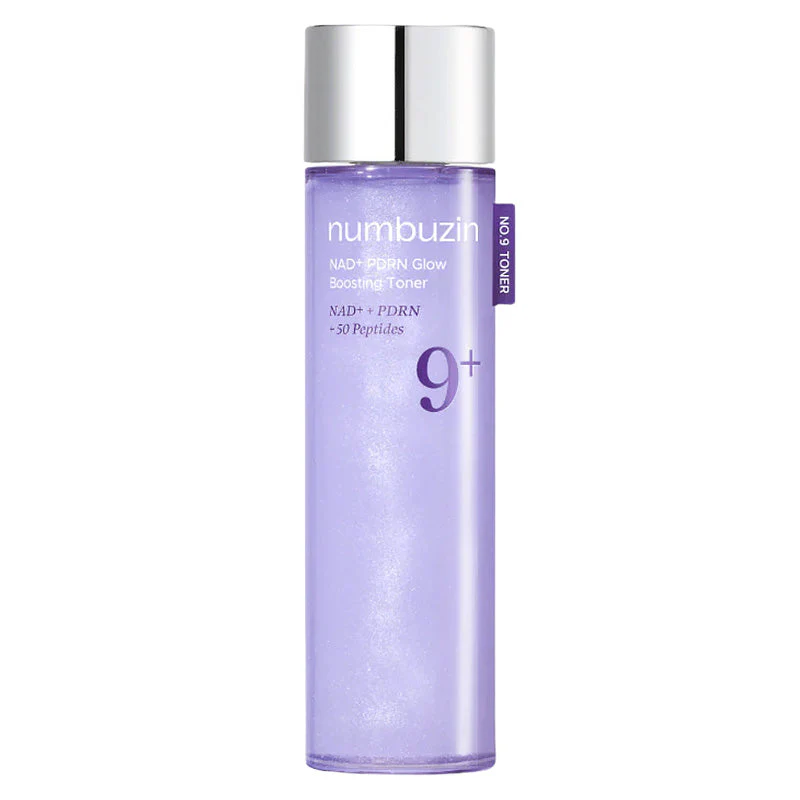
Numbuzin
No.9 NAD PDRN Glow Boosting Toner
face toner
Numbuzin
face toner
Added Last edited
Fit by skin type
General, ingredient-based — not your personalized match.

See how this fits your skin
Take the skin test and I'll show you how suitable this product is for you.
Take the skin testEssence-like firming toner with ceramide pearls for radiant glow. Deeply hydrates and plumps skin while instantly awakening luminous radiance with each use. Visibly refines the look of pores and sagging with ceramide-derived pearls that firm and rejuvenate. Clinically proven to enhance glow on key facial points and improve elasticity by supporting natural collagen production. Refines horizontal, vertical, and diagonal pores in just 7 days to help prevent wrinkles and early signs of aging for a luminous, rejuvenated complexion.
No.9 NAD PDRN Glow Boosting Toner is a cushioning toner from Numbuzin, a brand based in Korean. The formula is built mainly around firmness signalling, hydration and soothing. The ingredient list runs to 125 ingredients, each broken down in full below.
By its ingredient list the formula reads as moderately cushioned — emollient enough to feel like a cream, without the heaviest occlusives near the top. The oils in it point to a dewy, emollient finish rather than a matte one. Hydration is handled by Methylpropanediol, Propanediol and Glycerin, humectants that pull water into the upper layers of skin rather than sealing it there.
Firmness signalling: Very high. Peptides and growth factors that signal for collagen support, and here that comes from Adenosine, Adenosine Triphosphate, Pisum Sativum Peptide and Dipeptide Diaminobutyroyl Benzylamide Diacetate.
Hydration: Very high. Ingredients that pull and hold water in the upper layers of skin, and here that comes from Methylpropanediol, Propanediol, Glycerin and Ethylhexylglycerin.
Soothing: High. Ingredients aimed at visible redness and reactivity, and here that comes from Niacinamide, Glyceryl Glucoside, Xylitylglucoside and Tocopheryl Acetate.
Barrier support: Moderate. Lipids and repair signals that support skin barrier integrity, and here that comes from Niacinamide, Hydrogenated Lecithin, Ceramide NP and Tripeptide-32.
On richness alone it suits Balanced skin best, and is the least natural fit for Dry, Combination (dry), Combination (oily) and Oily skin. Nothing in the list is flagged as a common irritant, which is a reasonable starting point for reactive skin — though a patch test is still the only way to know.
The formula contributes little or nothing on cell renewal. That is not a fault — most products are not meant to do everything — but if one of those is your priority, this is not the product that will address it.
Reading the full list, the formula is fragrance-free, essential-oil-free, no drying alcohol, paraben-free, silicone-free and microplastic-free. Those claims come from the ingredient list itself, not from the packaging.
It can be used morning and evening. In a routine it goes after cleansing, before serums. Apply to slightly damp skin so the humectants have water to hold on to.
This summary is generated from the product's ingredient list. It is not a review, it is not the brand's own marketing claims, and it does not replace advice from a dermatologist.
Drawn purely from the ingredient list
Scored on how rich or light the formula reads from its INCI order.
No ingredient in this formula carries a common-irritant flag, making it a reasonable option for reactive skin. A patch test is still recommended, as individual skin reactivity varies.
Based on the curated benefits documented for this product's ingredients.
Attracts and locks in moisture to keep skin plump and dewy
Boosts collagen and cell turnover to reduce fine lines and wrinkles
Calms redness, irritation, and inflammation for sensitive skin
Fades hyperpigmentation and evens out dark spots over time
Targets breakouts by reducing bacteria and unclogging pores
Tightens and refines the look of enlarged pores
None of the ingredients in this formula are associated with these benefits. This is not unusual, as most products are designed to target a limited number of concerns.
The actives, UV filters and benefit-carrying ingredients in this formula, in the order they are listed.
1st on the list, which puts it at an estimated 30–80% of the formula.
Aqua (EU),Deionized Water,Distilled Water,Micromatrix Fractile AN,Onsen-Sui (JPN),Purified Water
2nd on the list, which puts it at an estimated 5–20% of the formula.
2-Methyl-1,3-propanediol
3rd on the list, which puts it at an estimated 5–20% of the formula.
Niacinamide (vitamin B3) is a gentle skincare active that repairs the skin barrier, calms redness, controls oil and evens tone at 2–5%. Official IUPAC name: **3-Pyridinecarboxamide**
5th on the list, which puts it at an estimated 2–10% of the formula.
1,3-dihydroxypropane
8th on the list, below the 1% line — present at under 1%, which for most ingredients is the level they work at.
alpha-D-Glucopyranoside, 2-Hydroxy-1-(Hydroxymethyl)ethyl
9th on the list, below the 1% line — present at under 1%, which for most ingredients is the level they work at.
Xylitylglucoside
10th on the list, below the 1% line — present at under 1%, which for most ingredients is the level they work at.
Castor oil (Ricinus communis), hydrogenated, ethoxylated (40 mol EO average molar ratio)
11th on the list, below the 1% line — present at under 1%, which for most ingredients is the level they work at.
D-Xylitol, 1,4-Anhydro-
12th on the list, below the 1% line — present at under 1%, which for most ingredients is the level they work at.
Glycerine ;Glycerol (INN); Glycerol (RIFM); Glycerolum (EP); Glycyl Alcohol; 1,2,3-Propanetriol; 1,2,3-Trihydroxypropane
16th on the list, below the 1% line — present at under 1%, which for most ingredients is the level they work at.
3,4-Dihydro-2,5,7,8-tetramethyl-2-(4,8,12-trimethyltridecyl)-2H-benzopyran-6-yl acetate
17th on the list, below the 1% line — present at under 1%, which for most ingredients is the level they work at.
Xylitol
18th on the list, below the 1% line — present at under 1%, which for most ingredients is the level they work at.
Alcohols, C16-18
Each axis is scored from the ingredients present and how high up the list they sit.
Ingredients that pull and hold water in the upper layers of skin
Lipids and repair signals that support skin barrier integrity
Ingredients that mop up free radicals from UV and pollution
Ingredients that moderate sebum or absorb shine
Ingredients that act on uneven tone and post-inflammatory marks
Ingredients aimed at visible redness and reactivity
Retinoids, acids and enzymes that speed surface turnover
Peptides and growth factors that signal for collagen support
"Active" here means an ingredient carrying a recorded active type or a recognised UV filter.
Solvents, emollients, texture agents and preservatives — the formula that carries the actives.
Read from the full ingredient list. A brand's own claim may differ.
Helianthus Annuus Seed Oil
Collagen
Judged by the same curated rules our routine checker uses. It reads the ingredients, not the label.
Best kept to separate routines — one in the morning, one at night, or on alternate days.
This product is the "Toning" step.
Flags to check, not verdicts. None of this is medical advice — if you are pregnant, breastfeeding or treating a skin condition, ask a doctor.
Most ingredients do more than one job, so these counts add up to more than the 125 ingredients on the label.
Amino-acid chains that signal for repair or firmness
Changes how skin behaves rather than how it feels
Forms a film that slows water loss
Draws water into the upper layers of skin
Sets the thickness, spread and stability of the formula
Lifts oil and dirt, or holds oil and water together
Neutralises free radicals from UV and pollution
Botanical material, usually for antioxidants or scent
Softens and smooths by filling gaps between skin cells
Binds trace metals that would otherwise spoil the formula
Dissolves and carries everything else
Sets the acidity the formula needs to work
Keeps the product free of microbial growth
Every ingredient on the label, in order, with what it does and roughly how much of it is likely to be there.
1st on the list, which puts it at an estimated 30–80% of the formula.
Aqua (EU),Deionized Water,Distilled Water,Micromatrix Fractile AN,Onsen-Sui (JPN),Purified Water
2nd on the list, which puts it at an estimated 5–20% of the formula.
2-Methyl-1,3-propanediol
3rd on the list, which puts it at an estimated 5–20% of the formula.
Niacinamide (vitamin B3) is a gentle skincare active that repairs the skin barrier, calms redness, controls oil and evens tone at 2–5%. Official IUPAC name: **3-Pyridinecarboxamide**
4th on the list, which puts it at an estimated 2–10% of the formula.
Oxirane, methyl-, polymer with oxirane
5th on the list, which puts it at an estimated 2–10% of the formula.
1,3-dihydroxypropane
6th on the list, below the 1% line — present at under 1%, which for most ingredients is the level they work at.
7th on the list, below the 1% line — present at under 1%, which for most ingredients is the level they work at.
Propanol, [(1-methyl-1,2-ethanediyl)bis(oxy)]bis-
8th on the list, below the 1% line — present at under 1%, which for most ingredients is the level they work at.
alpha-D-Glucopyranoside, 2-Hydroxy-1-(Hydroxymethyl)ethyl
9th on the list, below the 1% line — present at under 1%, which for most ingredients is the level they work at.
Xylitylglucoside
10th on the list, below the 1% line — present at under 1%, which for most ingredients is the level they work at.
Castor oil (Ricinus communis), hydrogenated, ethoxylated (40 mol EO average molar ratio)
11th on the list, below the 1% line — present at under 1%, which for most ingredients is the level they work at.
D-Xylitol, 1,4-Anhydro-
12th on the list, below the 1% line — present at under 1%, which for most ingredients is the level they work at.
Glycerine ;Glycerol (INN); Glycerol (RIFM); Glycerolum (EP); Glycyl Alcohol; 1,2,3-Propanetriol; 1,2,3-Trihydroxypropane
13th on the list, below the 1% line — present at under 1%, which for most ingredients is the level they work at.
1,2,3-Propanetriol, homopolymer, dodecanoates (1:1) (10 mol glycerol average molar ratio)
14th on the list, below the 1% line — present at under 1%, which for most ingredients is the level they work at.
Product obtained by the fermentation of glucose and methyl rapeseedate by the microorganism Candida bombicola
15th on the list, below the 1% line — present at under 1%, which for most ingredients is the level they work at.
Alcohols, C20-40, ethoxylated (10 mol EO average molar ratio)
16th on the list, below the 1% line — present at under 1%, which for most ingredients is the level they work at.
3,4-Dihydro-2,5,7,8-tetramethyl-2-(4,8,12-trimethyltridecyl)-2H-benzopyran-6-yl acetate
17th on the list, below the 1% line — present at under 1%, which for most ingredients is the level they work at.
Xylitol
18th on the list, below the 1% line — present at under 1%, which for most ingredients is the level they work at.
Alcohols, C16-18
19th on the list, below the 1% line — present at under 1%, which for most ingredients is the level they work at.
Deoxyribonucleic acid, sodium salts
20th on the list, below the 1% line — present at under 1%, which for most ingredients is the level they work at.
Lecithins, hydrogenated
21st on the list, below the 1% line — present at under 1%, which for most ingredients is the level they work at.
Glucose
22nd on the list, below the 1% line — present at under 1%, which for most ingredients is the level they work at.
Polyacrylate Crosspolymer-6 is a copolymer of ammonium acryloyldimethyltaurate, dimethylacrylamide, lauryl methacrylate and laureth-4 methacrylate, crosslinked with trimethylolpropane triacrylate
23rd on the list, below the 1% line — present at under 1%, which for most ingredients is the level they work at.
1,2-Propanediol, 3-(2-ethylhexyloxy)
24th on the list, below the 1% line — present at under 1%, which for most ingredients is the level they work at.
6-Amino-9-beta-D-ribofuranosyl-9H-purine
25th on the list, below the 1% line — present at under 1%, which for most ingredients is the level they work at.
Ceramide NP,1,3,4-Octadecanetriol, 2-Octadecanamide,Stearoyl-C18-Phytosphingosine,Stearoyl-4-Hydroxysphinganine
26th on the list, below the 1% line — present at under 1%, which for most ingredients is the level they work at.
Myo-Inositol, hexakis(dihydrogen phosphate), sodium salt
27th on the list, below the 1% line — present at under 1%, which for most ingredients is the level they work at.
Helianthus Annuus Seed Oil is the oil expressed from the seeds of the Sunflower, Helianthus annuus L., Compositae
28th on the list, below the 1% line — present at under 1%, which for most ingredients is the level they work at.
Melia Azadirachta Leaf Extract is an extract of the leaves of the Neem Tree, Melia azadirachta L., Meliaceae
29th on the list, below the 1% line — present at under 1%, which for most ingredients is the level they work at.
Melia Azadirachta Flower Extract is an extract of the flowers of the Neem Tree, Melia Azadirachta L., Meliaceae
30th on the list, below the 1% line — present at under 1%, which for most ingredients is the level they work at.
2-Hydroxy-1,2,3-propanetricarboxylic acid
31st on the list, below the 1% line — present at under 1%, which for most ingredients is the level they work at.
Cellulose, 2-hydroxyethyl ether
32nd on the list, below the 1% line — present at under 1%, which for most ingredients is the level they work at.
Trisodium citrate
33rd on the list, below the 1% line — present at under 1%, which for most ingredients is the level they work at.
Phytosterols is a complex mixture of sterols isolated from the higher plants
34th on the list, below the 1% line — present at under 1%, which for most ingredients is the level they work at.
Coccinia Indica Fruit Extract is an extract of the fruit of Coccinia indica, Cucurbitaceae
35th on the list, below the 1% line — present at under 1%, which for most ingredients is the level they work at.
Aloe Barbadensis Flower Extract is an extract of the flowers of the aloe, Aloe barbadensis, Liliaceae
36th on the list, below the 1% line — present at under 1%, which for most ingredients is the level they work at.
Solanum Melogena Fruit Extract is an extract of the fruit of the Eggplant, Solanum melongena L., Solanaceae
37th on the list, below the 1% line — present at under 1%, which for most ingredients is the level they work at.
2-Methylpropan-2-ol
38th on the list, below the 1% line — present at under 1%, which for most ingredients is the level they work at.
Ocimum Sanctum Leaf Extract is an extract of the leaves of Ocimum sanctum, Labiatae
39th on the list, below the 1% line — present at under 1%, which for most ingredients is the level they work at.
Curcuma Longa Root Extract is an extract of the rhizomes of the Turmeric, Curcuma longa L., Zingiberaceae
40th on the list, below the 1% line — present at under 1%, which for most ingredients is the level they work at.
Corallina Officinalis Extract is an extract of the Alga, Corallina officinalis L., Corallinaceae
41st on the list, below the 1% line — present at under 1%, which for most ingredients is the level they work at.
Cyanocobalamin; Vitamine B12
42nd on the list, below the 1% line — present at under 1%, which for most ingredients is the level they work at.
Decanoic acid, ester with 1,2,3-propanetriol octanoate; Glycerides, mixed decanoyl and octanoyl
43rd on the list, below the 1% line — present at under 1%, which for most ingredients is the level they work at.
Collagens, hydrolyzates. Substance obtained by acidic, alkaline, or enzymatic hydrolysis of hoofs and horns composed primarily of amino acids, peptides, and proteins. It may contain impurities consisting chiefly of carbohydrates and lipids along with smaller quantities of miscellaneous organic substances of biological origin.
44th on the list, below the 1% line — present at under 1%, which for most ingredients is the level they work at.
Butane-1,3-diol (CAS No. 107-88-0/ EC No. 203-529-7) (R)-(-)-butane-1,3-diol” (CAS No. 6290-03-5/ EC No. 228-532-0)
45th on the list, below the 1% line — present at under 1%, which for most ingredients is the level they work at.
Adenosine 5'-triphosphate.
46th on the list, below the 1% line — present at under 1%, which for most ingredients is the level they work at.
Adenosine 5'-(trihydrogen diphosphate), 5'->5'-ester with 3-(aminocarbonyl)-1-beta-D-ribofuranosylpyridinium hydroxide, inner salt
47th on the list, below the 1% line — present at under 1%, which for most ingredients is the level they work at.
1,3-Benzenediol, 5-[(1E)-2-(4-Hydroxyphenyl)ethenyl]-
48th on the list, below the 1% line — present at under 1%, which for most ingredients is the level they work at.
Pullulan is a polysaccharide produced from starch by cultivating the yeast, Aureobasidium pullulans
49th on the list, below the 1% line — present at under 1%, which for most ingredients is the level they work at.
Sodium N-methyl-N-(1-oxohexadecyl)aminoacetate
50th on the list, below the 1% line — present at under 1%, which for most ingredients is the level they work at.
Hexadecanoic acid
51st on the list, below the 1% line — present at under 1%, which for most ingredients is the level they work at.
Poly(oxy-1,2-ethanediyl), .alpha.-carboxymethyl-.omega.-hydroxy-, C12-14-isoalkyl ethers, sodium salts (7 mol EO average molar ratio)
52nd on the list, below the 1% line — present at under 1%, which for most ingredients is the level they work at.
Pisum SativumPeptide is the di-/tri- peptide fraction isolated from Pisum Sativum (Pea) Protein by ultra-membrane filtration the Pea, Pisum sativum L., Fabaceae
53rd on the list, below the 1% line — present at under 1%, which for most ingredients is the level they work at.
Stearic acid
54th on the list, below the 1% line — present at under 1%, which for most ingredients is the level they work at.
1,2,3-Propanetriol, homopolymer, dodecanoates (1:1) (6 mol glycerol average molar ratio)
55th on the list, below the 1% line — present at under 1%, which for most ingredients is the level they work at.
Octane-1,2-diol
56th on the list, below the 1% line — present at under 1%, which for most ingredients is the level they work at.
57th on the list, below the 1% line — present at under 1%, which for most ingredients is the level they work at.
Dextran
58th on the list, below the 1% line — present at under 1%, which for most ingredients is the level they work at.
Hydrolyzed Elastin is the hydrolysate of elastin derived by acid, enzyme or other method of hydrolysis
59th on the list, below the 1% line — present at under 1%, which for most ingredients is the level they work at.
Naturally occurring substances, soluble collagen
60th on the list, below the 1% line — present at under 1%, which for most ingredients is the level they work at.
Acetyl Tetrapeptide-3 is product obtained by the acetylation of Tetrapeptide-3
61st on the list, below the 1% line — present at under 1%, which for most ingredients is the level they work at.
Trifolium Pratense Flower Extract is an extract of the flowers of the Red Clover, Trifolium pratense L., Fabaceae
62nd on the list, below the 1% line — present at under 1%, which for most ingredients is the level they work at.
Disodium dihydrogen ethylenediaminetetraacetate
63rd on the list, below the 1% line — present at under 1%, which for most ingredients is the level they work at.
Tetradecanoic acid
64th on the list, below the 1% line — present at under 1%, which for most ingredients is the level they work at.
Acetyl hexapeptide-8 is the synthetic peptide consisting of arginine, methionine, and acetylated glutamic acid residues
65th on the list, below the 1% line — present at under 1%, which for most ingredients is the level they work at.
D-mannose
66th on the list, below the 1% line — present at under 1%, which for most ingredients is the level they work at.
SH-Octapeptide-4 is a recombinant human peptide produced synthetically to be identical to the protein, Enkephalin. It contains 8 amino acids consisting of glycine, histidine, leucine, lysine, phenylalanine, and tyrosine
67th on the list, below the 1% line — present at under 1%, which for most ingredients is the level they work at.
sh-Decapeptide-7 is a single chain recombinant human peptide, produced synthetically to be identical to the protein, Enkephalin. It contains 10 amino acids consisting of glycine, leucine, lysine, phenylalanine, serine, threonine and tyrosine
68th on the list, below the 1% line — present at under 1%, which for most ingredients is the level they work at.
Lysine, synthetic pentapeptide with serine, and threonine, hexadecanoyl derivatives
69th on the list, below the 1% line — present at under 1%, which for most ingredients is the level they work at.
L-Lysine, N-(1-oxohexadecyl)glycyl-L-histidyl-
70th on the list, below the 1% line — present at under 1%, which for most ingredients is the level they work at.
Copper Tripeptide-1 is a copper complex of Tripeptide-1
71st on the list, below the 1% line — present at under 1%, which for most ingredients is the level they work at.
Hexapeptide-9 is a synthetic peptide containing Glutamine, Glycine and Proline residues
72nd on the list, below the 1% line — present at under 1%, which for most ingredients is the level they work at.
Nonapeptide-1 is a synthetic nonapeptide derived from arginine, lysine, methionine, phenylalanine, proline, tryptophan and valine
73rd on the list, below the 1% line — present at under 1%, which for most ingredients is the level they work at.
Tripeptide-1 is a synthetic peptide containing glycine, histidine, and lysine
74th on the list, below the 1% line — present at under 1%, which for most ingredients is the level they work at.
Icosanoic acid
75th on the list, below the 1% line — present at under 1%, which for most ingredients is the level they work at.
Collagens. A fibrous protein comprising one third of the total protein in mammalian organisms. It is a polypeptide containing three peptide chains and rich in proline and hydroxyproline
76th on the list, below the 1% line — present at under 1%, which for most ingredients is the level they work at.
Elastins. An insoluble protein extracted from mammalian organisms
77th on the list, below the 1% line — present at under 1%, which for most ingredients is the level they work at.
Glycine, N-(N-L-.gamma.-glutamyl-L-cysteinyl)-
78th on the list, below the 1% line — present at under 1%, which for most ingredients is the level they work at.
Palmitoyl Tetrapeptide-7 is the reaction product of palmitic acid and Tetrapeptide-7
79th on the list, below the 1% line — present at under 1%, which for most ingredients is the level they work at.
L-Arginine, polymer with L-lysine
80th on the list, below the 1% line — present at under 1%, which for most ingredients is the level they work at.
Oligopeptide-29 is a synthetic peptide containing 12 amino acids consisting of alanine, arginine, histidine, leucine, lysine, proline and serine
81st on the list, below the 1% line — present at under 1%, which for most ingredients is the level they work at.
Oligopeptide-32 is the synthetic peptide containing 12 amino acids consisting of alanine, arginine, hisitidine, leucine, lysine, propline, serine, and tryptophan
82nd on the list, below the 1% line — present at under 1%, which for most ingredients is the level they work at.
Acetyl Tetrapeptide-5 is product obtained by the acetylation of Tetrapeptide-5
83rd on the list, below the 1% line — present at under 1%, which for most ingredients is the level they work at.
Acetyl Tetrapeptide-9 is a reaction product of acetic acid and Tetrapeptide-9
84th on the list, below the 1% line — present at under 1%, which for most ingredients is the level they work at.
Acetyl Tetrapeptide-2 is product obtained by the acetylation of Tetrapeptide-2
85th on the list, below the 1% line — present at under 1%, which for most ingredients is the level they work at.
Acetyl Octapeptide-3 is the reaction product of acetic acid and Octapeptide-3
86th on the list, below the 1% line — present at under 1%, which for most ingredients is the level they work at.
Acetyl Hexapeptide-1 is reaction product of Alanine, arginine, histidine, leucine, phenylalanine and tryptophane hexapeptide with acetic acid
87th on the list, below the 1% line — present at under 1%, which for most ingredients is the level they work at.
Polymer derived from alanine, histidine and lysine, copper derivative, hydrochloride
88th on the list, below the 1% line — present at under 1%, which for most ingredients is the level they work at.
Tyrosine acetate and arginine, hexadecyl ester, dipeptide
89th on the list, below the 1% line — present at under 1%, which for most ingredients is the level they work at.
Acetyl sh-Pentapeptide-1 is product obtained by the acetylation of sh-Pentapeptide-1
90th on the list, below the 1% line — present at under 1%, which for most ingredients is the level they work at.
Biotinoyl Tripeptide-1 is the reaction product of Biotin and Tripeptide-1
91st on the list, below the 1% line — present at under 1%, which for most ingredients is the level they work at.
Dipeptide-4 is a synthetic peptide consisting of cysteine and glycine; Cysteine, synthetic dipeptide with glycine
92nd on the list, below the 1% line — present at under 1%, which for most ingredients is the level they work at.
Hexapeptide-11 is a synthetic peptide containing Alanine, Phenylalanine, Proline and Valine residues
93rd on the list, below the 1% line — present at under 1%, which for most ingredients is the level they work at.
Hexapeptide-12 is a synthetic peptide containing Alanine, Glycine, Proline and Valine residues
94th on the list, below the 1% line — present at under 1%, which for most ingredients is the level they work at.
Dodecanoic acid
95th on the list, below the 1% line — present at under 1%, which for most ingredients is the level they work at.
Myristoyl Pentapeptide-17 is the product of the reaction of myristic acid and Pentapeptide-17.
96th on the list, below the 1% line — present at under 1%, which for most ingredients is the level they work at.
Myristoyl Hexapeptide-16 is the product of the reaction of myristic acid and Hexapeptide-16
97th on the list, below the 1% line — present at under 1%, which for most ingredients is the level they work at.
Myristoyl Pentapeptide-3 is the reaction product of Myristic Acid with a synthetic peptide containing Threonine, Serine and lysine
98th on the list, below the 1% line — present at under 1%, which for most ingredients is the level they work at.
Nicotinoyl Tripeptide-1 is the product obtained by the reaction of Niacin with Tripeptide-1
99th on the list, below the 1% line — present at under 1%, which for most ingredients is the level they work at.
Nonapeptide-7 is a synthetic peptide consisting of alanine, arginine, cysteine, leucine, phenylalanine, proline, serine and threonine
100th on the list, below the 1% line — present at under 1%, which for most ingredients is the level they work at.
Nicotinoyl Tripeptide-35 is the product obtained by the reaction of Niacin and Tripeptide-35.
101st on the list, below the 1% line — present at under 1%, which for most ingredients is the level they work at.
Nicotinoyl Dipeptide-26 is the product obtained by the reaction of Niacin and Dipeptide-26.
102nd on the list, below the 1% line — present at under 1%, which for most ingredients is the level they work at.
Nicotinoyl Dipeptide-23 is the product obtained by the reaction of Niacin and Dipeptide-23.
103rd on the list, below the 1% line — present at under 1%, which for most ingredients is the level they work at.
Octapeptide-2 is a synthetic peptide composed of glutamic acid, glutamine, leucine, lysine, and threonine
104th on the list, below the 1% line — present at under 1%, which for most ingredients is the level they work at.
Palmitoyl Tripeptide-5 is the reaction product of palmitic acid and Tripeptide-5
105th on the list, below the 1% line — present at under 1%, which for most ingredients is the level they work at.
Glycine, N-(1-oxohexadecyl)-L-valylglycyl-L-valyl-L-alanyl-L-prolyl-
106th on the list, below the 1% line — present at under 1%, which for most ingredients is the level they work at.
Pentapeptide-13 is a synthetic peptide consisting of alanine, arginine, lysine, proline and valine
107th on the list, below the 1% line — present at under 1%, which for most ingredients is the level they work at.
Palmitoyl Tetrapeptide-10 is the product obtained by the reaction of palmitic acid and Tetrapeptide-10
108th on the list, below the 1% line — present at under 1%, which for most ingredients is the level they work at.
Palmitoyl Tripeptide-38 is the reaction product of palmitic acid and Tripeptide-38
109th on the list, below the 1% line — present at under 1%, which for most ingredients is the level they work at.
Palmitoyl Tripeptide-29 is the product obtained by the reaction of palmitic acid and Tripeptide-29
110th on the list, below the 1% line — present at under 1%, which for most ingredients is the level they work at.
Palmitoyl Tripeptide-8 is the product obtained by the reaction of palmitic acid and Tripeptide-8
111th on the list, below the 1% line — present at under 1%, which for most ingredients is the level they work at.
Tetrapeptide-39 Hexapeptide-40 Nonapeptide-20 sr-Spider Polypeptide-3 Decapeptide-30 is a single chain recombinant fusion peptide, produced by fermentation in Lactobacillus The starting gene is synthesized by the fusion of the gene from sr-Spider Polypeptide-3, Tetrapeptide-39, Hexapeptide-40, Nonapeptide-20, and Decapeptide-30. The fusion peptide contains 134 amino acids which may contain disulfide bonds and/or glycosylation, and consists of the proper sequence of the 20 standard amino acids
112th on the list, below the 1% line — present at under 1%, which for most ingredients is the level they work at.
Tetrapeptide-44 is the synthetic peptide consisting of alanine, glycine, phenylalanine and proline.
113th on the list, below the 1% line — present at under 1%, which for most ingredients is the level they work at.
Tetrapeptide-30 is the synthetic peptide consisting of glutamic acid, lysine and proline
114th on the list, below the 1% line — present at under 1%, which for most ingredients is the level they work at.
Tripeptide-10 Citrulline is the reaction product of Citrulline and Tripeptide-10; Aspartic acid, synthetic tripeptide with isoleucine and lysine, reaction product with 5-ureido-2-aminopentanoic acid
115th on the list, below the 1% line — present at under 1%, which for most ingredients is the level they work at.
Tripeptide-32 is the synthetic peptide consisting of proline, serine and threonine
116th on the list, below the 1% line — present at under 1%, which for most ingredients is the level they work at.
Tripeptide-29 is the synthetic peptide consisting of glycine, proline and hydroxyproline
117th on the list, below the 1% line — present at under 1%, which for most ingredients is the level they work at.
sh-Polypeptide-22 is a single chain recombinant human peptide, produced by fermentation in E. coli. The starting gene is synthesized to be identical to the human gene which codes for Transforming Growth Factor Beta 1. It contains a maximum of 390 amino acids which may contain disulfide bonds and/or glycosylation. The protein consists of the proper sequence of the 20 standard amino acids
118th on the list, below the 1% line — present at under 1%, which for most ingredients is the level they work at.
sh-Oligopeptide-1 is a single chain recombinant human peptide, produced by fermentation in E. coli. The starting gene is synthesized to be identical to the human gene which codes for Epidermal Growth Factor. It contains a maximum of 53 amino acids which may contain disulfide bonds and/or sugar. The protein consists of the proper sequence of the standard amino acids
119th on the list, below the 1% line — present at under 1%, which for most ingredients is the level they work at.
sh-Polypeptide-1 is a single chain synthetic human peptide, produced by fermentation in E. coli. The starting gene is a synthesized copy of the human gene which codes for Basic Fibroblast Growth Factor used as such or adapted to the production host. It contains a maximum of 288 amino acids which may contain disulfide bonds and/or glycosylation. The protein consists of the proper sequence of the 20 standard amino acids.
120th on the list, below the 1% line — present at under 1%, which for most ingredients is the level they work at.
It is a single chain recombinant human peptide, produced by fermentation in E. Coli. The starting gene is a synthesized copy of the human gene which codes for Vascular Endothelial Growth Factor A used as such or adapted to the production host.
121st on the list, below the 1% line — present at under 1%, which for most ingredients is the level they work at.
It is a single chain recombinant human peptide,produced by fermentation in E. coli. The starting gene is a synthesized copy of the human gene which codes for Insulin-Like Growth Factor used as such or adapted to the production host.
122nd on the list, below the 1% line — present at under 1%, which for most ingredients is the level they work at.
sh-Polypeptide-11 is a single chain recombinant human peptide, produced by fermentation in E. Coli. The starting gene is a synthesized copy of the human gene which codes for Acidic Fibroblast Growth Factor 1 used as such or adapted to the production host. It contains a maximum of 155 amino acids which may contain disulfide bonds and/or glycosylation. The protein consists of the proper sequence of the 20 standard amino acids.
123rd on the list, below the 1% line — present at under 1%, which for most ingredients is the level they work at.
It is a single chain recombinant human peptide, produced by fermentation in E. Coli. The starting gene is a synthesized copy of the human gene which codes for Keratinocyte Growth Factor used as such or adapted to the production host.
124th on the list, below the 1% line — present at under 1%, which for most ingredients is the level they work at.
PGF,PLGF
125th on the list, below the 1% line — present at under 1%, which for most ingredients is the level they work at.
Hepatocyte Growth Factor
Products in the same category that share this formula's distinguishing ingredients.
Dr.Melaxin
Shares 13 key ingredients with No.9 NAD PDRN Glow Boosting Toner: Glycerin, Niacinamide, Propanediol, Glyceryl Glucoside, Citric Acid
beplain
Shares 11 key ingredients with No.9 NAD PDRN Glow Boosting Toner: Water, Glycerin, Propanediol, Citric Acid, Acetyl Hexapeptide-8
JAYJUN
Shares 10 key ingredients with No.9 NAD PDRN Glow Boosting Toner: Water, Glycerin, Niacinamide, Cetearyl Alcohol, Glyceryl Glucoside
Medicube
Shares 10 key ingredients with No.9 NAD PDRN Glow Boosting Toner: Water, Glycerin, Niacinamide, Xylitol, Citric Acid
Eqqualberry
Shares 9 key ingredients with No.9 NAD PDRN Glow Boosting Toner: Water, Niacinamide, Glycerin, Ceramide NP, Acetyl Hexapeptide-8
Dr.Melaxin
Shares 8 key ingredients with No.9 NAD PDRN Glow Boosting Toner: Water, Propanediol, Glycerin, Niacinamide, Xylitol
WATER, METHYLPROPANEDIOL, NIACINAMIDE, PEG/PPG-17/6 COPOLYMER, PROPANEDIOL, 1,2-HEXANEDIOL, TRIPROPYLENE GLYCOL, GLYCERYL GLUCOSIDE, XYLITYLGLUCOSIDE, PEG-40 HYDROGENATED CASTOR OIL, ANHYDROXYLITOL, GLYCERIN, POLYGLYCERYL-10 LAURATE, CANDIDA BOMBICOLA/GLUCOSE/METHYL RAPESEEDATE FERMENT, C20-40 PARETH-10, TOCOPHERYL ACETATE, XYLITOL, CETEARYL ALCOHOL, SODIUM DNA, HYDROGENATED LECITHIN, GLUCOSE, POLYACRYLATE CROSSPOLYMER-6, ETHYLHEXYLGLYCERIN, ADENOSINE, CERAMIDE NP, SODIUM PHYTATE, HELIANTHUS ANNUUS SEED OIL, MELIA AZADIRACHTA LEAF EXTRACT, MELIA AZADIRACHTA FLOWER EXTRACT, CITRIC ACID, HYDROXYETHYLCELLULOSE, SODIUM CITRATE, PHYTOSTEROLS, COCCINIA INDICA FRUIT EXTRACT, ALOE BARBADENSIS FLOWER EXTRACT, SOLANUM MELONGENA FRUIT EXTRACT, T-BUTYL ALCOHOL, OCIMUM SANCTUM LEAF EXTRACT, CURCUMA LONGA ROOT EXTRACT, CORALLINA OFFICINALIS EXTRACT, CYANOCOBALAMIN, CAPRYLIC/CAPRIC TRIGLYCERIDE, HYDROLYZED COLLAGEN, BUTYLENE GLYCOL, ADENOSINE TRIPHOSPHATE, NICOTINAMIDE ADENINE DINUCLEOTIDE, RESVERATROL, PULLULAN, SODIUM PALMITOYL SARCOSINATE, PALMITIC ACID, SODIUM C12-14 SEC-PARETH-8 CARBOXYLATE, PISUM SATIVUM PEPTIDE, STEARIC ACID, POLYGLYCERYL-6 LAURATE, CAPRYLYL GLYCOL, DIPEPTIDE DIAMINOBUTYROYL BENZYLAMIDE DIACETATE, DEXTRAN, HYDROLYZED ELASTIN, SOLUBLE COLLAGEN, ACETYL TETRAPEPTIDE-3, TRIFOLIUM PRATENSE FLOWER EXTRACT, DISODIUM EDTA, MYRISTIC ACID, ACETYL HEXAPEPTIDE-8, MANNOSE, SH-OCTAPEPTIDE-4, SH-DECAPEPTIDE-7, PALMITOYL PENTAPEPTIDE-4, PALMITOYL TRIPEPTIDE-1, COPPER TRIPEPTIDE-1, HEXAPEPTIDE-9, NONAPEPTIDE-1, TRIPEPTIDE-1, ARACHIDIC ACID, COLLAGEN, ELASTIN, GLUTATHIONE, PALMITOYL TETRAPEPTIDE-7, ARGININE/LYSINE POLYPEPTIDE, OLIGOPEPTIDE-29, OLIGOPEPTIDE-32, ACETYL TETRAPEPTIDE-5, ACETYL TETRAPEPTIDE-9, ACETYL TETRAPEPTIDE-2, ACETYL OCTAPEPTIDE-3, ACETYL HEXAPEPTIDE-1, ALANINE/HISTIDINE/LYSINE POLYPEPTIDE COPPER HCL, ACETYL DIPEPTIDE-1 CETYL ESTER, ACETYL SH-PENTAPEPTIDE-1, BIOTINOYL TRIPEPTIDE-1, DIPEPTIDE-4, HEXAPEPTIDE-11, HEXAPEPTIDE-12, LAURIC ACID, MYRISTOYL PENTAPEPTIDE-17, MYRISTOYL HEXAPEPTIDE-16, MYRISTOYL PENTAPEPTIDE-4, NICOTINOYL TRIPEPTIDE-1, NONAPEPTIDE-7, NICOTINOYL TRIPEPTIDE-35, NICOTINOYL DIPEPTIDE-26, NICOTINOYL DIPEPTIDE-23, OCTAPEPTIDE-2, PALMITOYL TRIPEPTIDE-5, PALMITOYL HEXAPEPTIDE-12, PENTAPEPTIDE-13, PALMITOYL TETRAPEPTIDE-10, PALMITOYL TRIPEPTIDE-38, PALMITOYL TRIPEPTIDE-29, PALMITOYL TRIPEPTIDE-8, TETRAPEPTIDE-39 HEXAPEPTIDE-40 NONAPEPTIDE-20 SR-SPIDER POLYPEPTIDE-3 DECAPEPTIDE-30, TETRAPEPTIDE-44, TETRAPEPTIDE-30, TRIPEPTIDE-10 CITRULLINE, TRIPEPTIDE-32, TRIPEPTIDE-29, SH-POLYPEPTIDE-22, SH-OLIGOPEPTIDE-1, SH-POLYPEPTIDE-1, SH-POLYPEPTIDE-9, SH-OLIGOPEPTIDE-2, SH-POLYPEPTIDE-11, SH-POLYPEPTIDE-3, SH-POLYPEPTIDE-16, SH-POLYPEPTIDE-62.
NIACINAMIDE, CERAMIDE NP, CITRIC ACID, PISUM SATIVUM PEPTIDE, DIPEPTIDE DIAMINOBUTYROYL BENZYLAMIDE DIACETATE, ACETYL HEXAPEPTIDE-8, PALMITOYL PENTAPEPTIDE-4, PALMITOYL TRIPEPTIDE-1, COPPER TRIPEPTIDE-1, TRIPEPTIDE-1, PALMITOYL TETRAPEPTIDE-7, ACETYL OCTAPEPTIDE-3, ACETYL SH-PENTAPEPTIDE-1, BIOTINOYL TRIPEPTIDE-1, HEXAPEPTIDE-11, MYRISTOYL PENTAPEPTIDE-17, MYRISTOYL PENTAPEPTIDE-4, NICOTINOYL TRIPEPTIDE-1, PENTAPEPTIDE-13, PALMITOYL TRIPEPTIDE-8, TETRAPEPTIDE-39 HEXAPEPTIDE-40 NONAPEPTIDE-20 SR-SPIDER POLYPEPTIDE-3 DECAPEPTIDE-30, TRIPEPTIDE-10 CITRULLINE, TRIPEPTIDE-32, TRIPEPTIDE-29, SH-POLYPEPTIDE-22, SH-OLIGOPEPTIDE-1, SH-POLYPEPTIDE-1, SH-POLYPEPTIDE-9, SH-OLIGOPEPTIDE-2, SH-POLYPEPTIDE-11, SH-POLYPEPTIDE-3, SH-POLYPEPTIDE-16, SH-POLYPEPTIDE-62.
1. Gently shake the toner to activate ceramide pearls 2. Apply a moderate amount onto skin while lightly patting to enhance absorption 3. For areas with visible fine lines or wrinkles, apply an extra layer for targeted care 4. Follow with serum and moisturizer or pair with No.9 Essence to maximize synergy
Judged on how rich the formula reads from its ingredient list, it suits Balanced skin best. It is the least natural fit for Dry, Combination (dry), Combination (oily), Oily skin.
No ingredient in this formula carries a common-irritant flag, making it a reasonable option for reactive skin. A patch test is still recommended, as individual skin reactivity varies.
3 ingredients could feed malassezia: Polyglyceryl-10 Laurate, Helianthus Annuus Seed Oil, Polyglyceryl-6 Laurate. That describes the yeast's food supply, not a prediction that they will cause a breakout.
Nothing in this formula is on the standard pregnancy-caution list. That is not medical clearance — check anything you use daily with your doctor or midwife.
Yes. Reading the full ingredient list, this formula is fragrance-free.
No. Reading the full ingredient list, this formula is no drying alcohol.
Yes. Reading the full ingredient list, this formula is silicone-free.
No. Reading the full ingredient list, this formula is essential-oil-free.
Yes. Reading the full ingredient list, this formula is paraben-free.
It layers well with Vitamin C (L-ascorbic acid), Retinoids (retinol, retinal), AHAs (glycolic, lactic), BHA (salicylic acid), PHAs (gluconolactone), Azelaic acid. Take more care combining it with Benzoyl peroxide — use them in separate routines or on alternate days.
Use it morning and evening, after cleansing, before serums.
It lists 125 ingredients, of which 33 are recorded as actives.
Numbuzin, a brand based in Korean.
We can't find the internet
Attempting to reconnect
Something went wrong!
Attempting to reconnect